Friday, June 30, 2023

Addressing technical challenges with BC-FIPS


Last week I talked about the requirements for implementing TLS and a certified encryption module (specifically Bouncy Castle FIPS or BC-FIPS).  Today I'm going to tell you a bit more about technically how one my go about this, and the specific technical challenges that you may run into.

First of all, BC-FIPS provides some installation instructions that a) no longer work with JDK-11, and b) also don't play well with Spring Boot uber-jar class loading using standard Classpath override mechanisms.  I never found root cause for this problem, all I wound up doing was simply dynamically loaded the BC-FIPS security modules at application startup.

These (non-working) instructions include modifications needed to the JDK, specifically the java.security file and lib/ext folders.

There are three aspects of this configuration:

  1. Creating a compliant SecureRandom (this is described in the BC-FIPS documentation).
  2. Installing the BC FIPS Security Provider
  3. Installing the BC JSSE Security Provider

I do this in a static method BEFORE database initialization.  The reason for this is that DB initialization code needs to be able to get a FIPS compliant socket factory to initialize the connection pool.

private static void init() {
    // This is necessary initialization to use BCFKS module
    CryptoServicesRegistrar.setSecureRandom(getSecureRandom());
    Security.insertProviderAt(new BouncyCastleFipsProvider(), 1);
    Security.insertProviderAt(new BouncyCastleJsseProvider(), 2);
}


/**
 * Generate a a NIST SP 800-90A compliant secure random number
 * generator.
 *
 * @return A compliant generator.
 */
private static SecureRandom getSecureRandom() {

    /*
     * According to NIST Special Publication 800-90A, a Nonce is
     * A time-varying value that has at most a negligible chance of
     * repeating, e.g., a random value that is generated anew for each    
     * use, a timestamp, a sequence number, or some combination of
     * these.
     *
     * The nonce is combined with the entropy input to create the initial
     * DRBG seed.
     */
    byte [] nonce = ByteBuffer.allocate(8).putLong(System.nanoTime()).array();
    EntropySourceProvider entSource = new BasicEntropySourceProvider(new SecureRandom(), true);
    FipsDRBG.Builder drgbBldr = FipsDRBG.SHA512
        .fromEntropySource(entSource).setSecurityStrength(256)
        .setEntropyBitsRequired(256);
    return drgbBldr.build(nonce, true);
}

The code above effectively does what making changes to the JDK's java.security (as recommended by BC-FIPS documentation).  I make all the recommended changes except the ones that initialize the security providers, because I cannot configure the JDK to load the BC classes from the lib/ext folder since that is no longer supported in JDK-11.  The alternative suggested is to put the location of those classes on your classpath during application startup.  However, I also discovered that doesn't work, likely due to conflicts with how uber-jar classloading works (as in fact, those classes technically are on the classpath in the uber-jar).  I also swap out the default keystore format from JKS to BCFKS to ensure compliance with BC-FIPS KeyStore requirements.  Technically JKS is fine for Certificate stores, but frankly, I didn't even want to enable JKS support in case something broke somewhere else.

If your database is in the cloud (e.g., AWS or Azure), you may need to add a certificate to cacerts to enable the database connection using JSSE (BC-FIPS or native Java JSSE code).  I just do this to the cacerts file in the deployed JDK.

    keytool -keystore cacerts -storepass SECRET -noprompt -trustcacerts -importcert -alias awscert -file certificate.der

Next, to convert cacerts to BCFIPS format, this is what you will need to do:

    keytool -importkeystore -srckeystore cacerts -srcstoretype JKS -srcstorepass changeit \

        -destkeystore jssecacerts -deststorepass changeit -deststoretype BCFKS -providername BCFIPS \

        -provider org.bouncycastle.jcajce.provider.BouncyCastleFipsProvider -providerpath lib/bc-fips-1.0.2.3.jar

This does the conversion, and will create a new file "jssecacerts" in the BCFKS format.  The JDK looks for jssecacerts before cacerts, and so now I have both formats still hanging around in case I need them.

A simpler way to do this conversion is with KeyStore Explorer, I tool I often use to inspect/modify key and trust store content.  This tool already has BCFKS support built in, even if it may not be BCFIPS compliant (straight BC also supports the BCFKS format, it's just not a certified component).

Finally, you'll have to change how you configure SSL/TLS for your server and/or client components.  Our system programatically configures using beans for KeyStore, TrustStore, et cetera, but other servers may just use property or configuration values (e.g., server.xml for Tomcat).

Anywhere the default keystore type is present, you'll need to change the type of keystore to BCFKS, and if the provider type is specified, you'd use BCFIPS (as for keytool commands above).

If you want to get a KeyManagerFactory, TrustManagerFactory, or SSLContext programatically, here's how you'd get those:

KeyManagerFactory keyMgrFact = KeyManagerFactory.getInstance("PKIX", "BCJSSE");
TrustManagerFactory trustMgrFact = TrustManagerFactory.getInstance("PKIX", "BCJSSE");
SSLContext sslContext = SSLContext.getInstance("TLS""BCJSSE");

Anywhere the default keystore type is present, you'll need to change the type of keystore to BCFKS, and if you need to specify the KeyStore provider, you'd specify BCFIPS as the provider.

This ensures that all encryption used to protect key and trust material is FIPS compliantly encrypted.  Sadly, the encryption used for JKS nor PKCS12 formats are themselves compliant.

In the continuing saga of this effort, I just recently completed another set of code changes that ensures that I can just drop in new key and trust stores on a shared file system, and all my servers will automatically reconfigure themselves with the latest and greatest.  This greatly simplifies updating certificates for annual renewals or for other reasons, with zero downtime.  More on that later.


Thursday, June 22, 2023

TLS, FIPS and the Bouncy Castle Certified Encryption Module

Image Courtesy of Wikipedia
History

Becoming educated in a topic seems to offer opportunities to become yet further educated, or in other words, once you've demonstrated expertise in a particular technology, more problems related to it will come your way.  So be careful what you work on.

Many years ago, I had to work out how to implement the IHE ATNA profile.  I spent quite a bit of time on this project and became rather expert at diagnosing TLS problems, and configuring Tomcat to support the IHE Audit Trail and Node Authentication Profile (ATNA).  So much so that I first wrote on my experiences in the IHE ATNA FAQ.

Java, has come quite a ways since then.  When the ATNA FAQ was originally written, I think I was using JDK 1.4 or 1.5, which did not have great support even for TLS 1.0.  Now Java is has cranked JDK versions past 11 all the way to 21.  Although, for reasons I will explain below, mine only goes to 11 for this post (I do use JDK 17 for other development).

TLS has also come a long way, releasing new versions, first 1.1, then 1.2, most currently 1.3, and I'm damn near certain there will be a 1.4 and maybe even a 1.5.  Many a system supports TLS.  But often, when working for large corporations or government agencies, you need to go even further, using a NIST Certified FIPS implementation of TLS.  That's one of the problems I've had to work with a team to solve.

Problem Statement

I'm presently embarked upon completely integrating FIPS certified encryption into a Java application that I'm working on (it's already integrated for inbound and outbound communications, this is for other uses).  That application runs on JDK 11 in a Spring Boot 1.5 Java application running inside an Alpine Linux based Docker container, and had already used Bouncy Castle for its crypto activities. Getting all the details right in that environment is a tricky prospect, as I will explain in later posts.  This is just the intro so that folks can understand a bit more about the requirements to be met.

Bouncy Castle

Anyone who does anything with Java and TLS probably is familiar with the Legion of the Bouncy Castle (BC) Crypto libraries.  And if you've been doing Health Information Exchange development work, you are also likely to be aware of NIST FIPS 140-2.  Some of you may even have used BC in FIPS compliant mode (or perhaps had to enable FIPS on your Windows Servers or elsewhere in Java code).  

I haven't seen a lot of attention on using FIPS certified encryption (except in AWS or Azure's Government Cloud environments), and less so in pure Java software implementation. The point of using a certified encryption module is to be sure that the encryption is secure, and the point of having a FIPS compliant mode is to ensure that other insecure encryption capabilities cannot be used.  These are essential requirements in a system where the potential impact to confidentiality, integrity or availability is of at least moderate concern. In healthcare, I believe we'd all agree that it's at least that important when exchanging healthcare data.  And also, there's a federal standard for the term "moderate", as found in the lesser known FIPS 199.

The straight BC libraries, while supporting encryption, aren't NIST Certified Modules.  That's an extra step that requires testing from NIST NVLAP certification laboratories, much like ONC Certification is also performed by accredited laboratories.  Instead, you have to use the FIPS Certified versions of the Bouncy Castle Libraries.  These libraries are largely compatible with the non-certified libraries, but are missing some capabilities those libraries have, frankly because those capabilities aren't certifiable.  They support encryption certainly, but may use ciphers that aren't considered to be secure.

The BC FIPS libraries are currently NIST certified for up to JDK-11.  If you look at BC's roadmap for FIPS certified modules you will see that the first BC FIPS release supporting JDK versions higher than 11 are 1.0.2.4, and 2.0, and those should both support JDK 17.  The 2.0 stream is being submitted through testing using FIPS 140-3, while 1.0.2.4 is tested under FIPS 140-2 requirements.  The first NC FIPS 1.x release that will be tested under 140-3 will be 1.0.3.  While FIPS 140-2 is still the minimum requirement for many government agencies (for those classified as FIPS Moderate), those agencies will require FIPS 140-3 certified modules in the near future.  After 2026, there won't be any FIPS 140-2 certified products (the certification expires), and any new products are now being certified are currently being certified under FIPS 140-3.

Bouncy Castle FIPS modules are freely available for download via Maven, but the latest and greatest code bases are only available to support contract holders.

There are other suppliers of NIST Certified encryption modules for Java, but the Legion of the Bouncy Castle is probably the most widely known, and has the broadest use by other respected software providers (e.g., RedHat, Oracle, and many others).  Some Java implementations rely on OpenSSL, another widely known crypto package.  I prefer to stick with pure Java solutions when I can, so OpenSSL is not my most favorite option.  It's also difficult to configure in Tomcat (which isn't to say that Bouncy Castle is easy, just not as hard).

Now that I've bored you to tears with the requirements that I have to work with, and the solution that was selected (BC-FIPS), later posts will talk more about the implementation details, so that maybe more Java based Healthcare IT applications will take on this prospect.  It would be nice if someday all encryption in Health IT was done by encryption modules that were rigorously tested and which refused to implement insecure protocols (such as SSL, TLS 1.0 or 1.1).  But until implementing such encryption is a LOT easier in Java (and other) applications, that's going to be a hard row to hoe.


Tuesday, June 20, 2023

My HTI1 comments to @ONC_HealthIT

This is what I just submitted for HTI-1 comments.  It's a text file, not a PDF or Word document with a lovely cover letter.  ONC doesn't need all that.  It's generally ordered in the same way as their comment template, but I chose NOT to comment on a bunch of things, and I didn't label it.  Frankly, that all goes back to my first commentThis rule is so extensive, and covers so much new detail that the current deadline for submission of comments is simply too short to process the material adequately.

There's a ton of small issues with spelling and grammar.  It's what happens when all I have is 30 minutes to summarize everything I've just spent this 4-day weekend working on when I wasn't BBQ-ing or playing video games or reading cheap Sci-fi novels or something else.

For what it's worth, I've put over 80 hours of thought into reading, commenting on, and getting feedback from others on this particular rule (at least 10 of that this weekend).

------------

Stop producing such large rules every two to three years. Instead, consider adding smaller chunks of optional certification criteria more frequently (e.g., annually) to address specific topics (e.g., Public Health reporting, Scheduling, Subscriptions, et cetera) and give adequate time for implementation.  Make a schedule for updating the rule (every three years), and stick to it, and leave out the kitchen sink.  I love and hate the RFI questions.  It's a good way to get out the vote, as it were, each big rule essentially being a presidential election.  At the same time, it's extra work in an already huge endeavor that could be better served by an annual strategic RFI inquiry.

Please do discontinue year themed editions. The years were always wrongly applied in any case.

Yes, please do use the definition of "Revised Certification criteria" as defined in the proposed rule.

Please do adopt the most current published versions of USCDI, FHIR US Core and C-CDA Companion Guide, but provide a reasonable time period for implementation, no less than two years after publication of a final rule, and preferably 3.

Please use current guidance on Sex Parameters for Clinical Use (rather than the badly named Sex for Clinical Use) and do not treat this a patient observation. You could literally kill somebody if you mess this up and get it confused with Sex/Gender.  Pay more attention to the parts of this that are truly important, which are those parts that are outside of Male - Typical and Female Typical, where these observations need MORE work.

Where the dictionary will do, please stop defining terms to mean something in conflict.

Provide already has an adequate dictionary definition, what more do you need?  If there is something extra, please say it.

Demographics is already observations about a person useful for classification, why do you need to add observations to the name?

A singular fairness measure doesn't exist.  Corbett-Savises and Goel describe 3 mechanisms to ensure fairness, and in one of these, 8 different measures; Berk et al give 7, and Corbett-Savises and Goel already describe area under the ROC Curve. 

Others have shown that if effects differ between groups, fairness is not possible to establish.  Read page 69 in the chapter on Fairness in "The Alignment Problem" by Brian Christian.  Instead, report on how fairness was approached, and leave it as text.

There simply isn't a single number here yet, and there likely won't be for some time.

The new DSI criteria raises an issue of anti-competiviness that ONC should consider carefully. Certified algorithms have a higher regulatory bar. Uncertified algorithms can be used and built on APIs. Providers will use both. Consider carefully how the impact of requiring certified clinical decision support capabilities in a Base EHR (for which providers are incented by CMS) interacts with the need to promote competition. Ensure that this regulation and further like it don't create a requirement to generate a one-off feature to meet the criteria, but can instead promote and advance clinical decision support use in EHR systems in a fair and competetive way.  In other words, ensure that certified clinical decision support has a percieved benefit other than just checking a box on a feature list for Base EHR system.

The Predictive decision support definition should include the word clinical:

​Predictive decision support intervention means technology intended to support **clinical** decision-making based on algorithms or models that derive relationships from training or example data and then are used to produce an output or outputs related to, but not limited to, prediction, classification, recommendation, evaluation, or analysis. 

Yeah, NTP is good enough as it is.

Start using industry standard ways of defining SLAs if you are going to start including SLAs such as performance times in a rule.

e.g., 95% of requests are completed in 15 minutes.

Please stop referencing draft content in section 299. Yes, I understand ONC is coordinating 10 or more different moving parts but if I can get it done in time as an unpaid volunteer, then people who are being paid by an ONC contract should be able to get it done in time as well. Otherwise, find other contractors who can. It feels sloppy.

Patient demographics and observations.  Leave the title "Patient Demographics"  They are all demographics.  All demographics can be classified as observations about the patient.  The name change does little to add clarity and instead promotes a distinction between classically concieved demographics and novel demographics that really makes that latter second class citizens in data collection.

DS4P sucks.  It's not a good implementation guide, for CDA or for FHIR.  It does little to explain how to use existing FHIR features to meet an existing need, it's been primarily driven by VA and one ambulatory vendor with an add-on product, with little adoption anywhere else.  This work needs a do-over.  The CDA work requires hundreds of lines of XML to do what the V3 RIM indended in one line. The FHIR work provides NO conformance criteria (profiles on uses of defined terminology on FHIR resources).  There's nothing at all that addresses how to express break glass (essential when security tags are introduced with an exception for emergency care).

You really should look into what is going on with the IHE Patient Consent on FHIR (PCF) profile for future rulemaking.

Josh Mandel is awesome.  I love some of what Argonaut has done. But honestly, Scheduling misses the boat for patient needs in a broad sense, and as currently specified only serves providers or payers with an existing relationship to a consumer needing an appointment. This needs more patient/consumer focused attention.

On RFI inquiries: ONC clearly needs someone to help them develop a plan for strategic adoption of standards. This is part marketing, part industry leadership, part alliance development, and then several parts execution in standards development. ONC focuses well on the latter part of this, but fails to accomplish it elsewhere. Argonaut and Da Vinci initiatives seem to have improved on the former parts, but there are still missing constituencies, especially those focused on patient empowerment. Some of those missing constituencies lack the marketing, industry leadership and standards awareness skills necessary to pull it off. ONC could help here, but the model used by Helios for Public Health is not one that seems to be developing the necessary industry leadership or momentum to drive itself forward without continued ONC and CDC support, and there's no such group as yet for patient empowering initiatives.

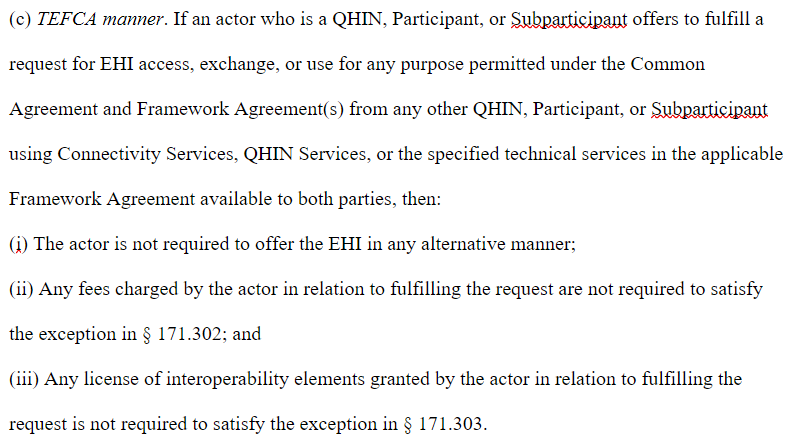
I like the focus that the TECFA manner allows QHIN and QHIN participants to focus on interoperability using nationally recognized standards.  I think it could be more clearly written.

With regard to data segmentation, I've previously developed FHIR APIS for Certified EHR systems that allow data to be restricted at the patient, visit or observation level, limiting access for different users and purposes of use. The first step is to ensure that systems are able to tag the data in certain ways for a limited set of use cases, the second is to ensure that sensitive data assocaited with a "restricted" visit can be tied back to that visit so that the restricted associated with that visit (e.g., a self-pay visit) can be identified, and then lastly to ensure that only users with specific access (e.g. emergency care, or with access to restricted visits) can access such data, and only when those accesses are requested.  There is no rocket science in this effort, but a lot of due dilligence. The key challenges are:

1. Ensuring that data access layer understand the 
   a. The associated user access priviledges and 
   b. Requested purpose of use
2. Only retrieve and return data that is allowed by 1a and 1b.

Most EHRs do NOT have or drive this capability into product. It's expensive to rework systems that weren't designed with this kind of security at the outset.

I would focus first on the "restricted" visit use case (e.g., self-pay visit).  

1. Define the security flag associated with this visit.
2. Define the access roles and priviledges associated with the use of this information.
3. Define the application functions associated with the display of this information to a user in
a. The EHR
b. The PHR
c. treatment, payment and operations use cases.
d. Other disclosers.
4. Define the mechanism by which purpose of use is communicated via APIs (e.g., Scope, HTTP Category Header)
5. Define the application functions to support "break the glass functionality"
6. Define what happens when restricted data is requested but not authorized (e.g., via search).
a. Can a user know that restricted data exists?
b. Is this a feature available only to some users but not to others?  (e.g., provider can know that restricted data exists that will be shown if they have break the glass privileges, but others will NOT be shown any indication).


Friday, June 2, 2023

HTI1 Robin's Eggs


For those who've been reading this blog for a decade or more, you probably know what a Robin's Egg is.  For those who don't, click the preceding link.

And while Robin is no longer with us, these eggs live on in her memory.  For those who want their Robin's eggs for HTI-1, you can find them here.

There are two files you can grab: 

  1. An edited version of ONC's 508 Compliant Word document containing the text of the rule.  Most of the reformatting is simply adding headings to the damn thing so that it has a navigable table of contents.
  2. A spreadsheet containing all 36 tables from HTI-1.


Wednesday, May 24, 2023

HTI1, the raw tweet stream on the next round of @ONC_HealthIT's CEHRT requirements

 My long overdue tweet-through of @ONC_HealthIT's #HTI1 rule begins. 

The stream is over 100 tweets long.  I'm making the raw data available first, I'll summarize it later.

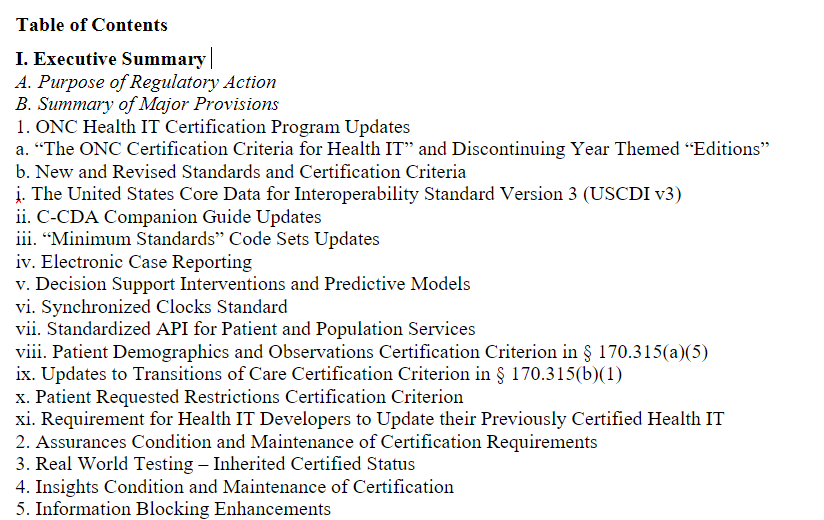
Highlights: Certification has new requirements for decision support, patient demographics, and observation and electronic case reporting (eCR), + updates to USCDI. #HTI1 
The TOC provides more highlights:B. Summary of Major Provisi...
ONC learned from experts on commenting on long documents. They make the text available in Word, and provide a comment template. @IHEIntl and @HL7 have benefited from comment templates for decades. #HTI1 
#HTI1 is a long rule, 62967 pages in length. I may have to take a break or two going through it. I'll likely segment the Decision Support Interventions (#DSI) as a separate topic for later. 
Thematically, @ONC_HealthIT references encouragement of economic growth through advancement of Health IT, health equity, and transparency in #HTI1 
In the theme of "there can be only one", yearly themed certification criteria are going away. There will only be ONE certification criteria as of #HTI1. This will avoid confusion, and prior rules already made the need for upgrading mandatory under conditions of certification. 
The first change of #HTI1 is the switch from USCDI v1 to USCDI v3. The jump of two versions may surprise some, but I honestly don't see it as being that big of a deal. The advancement of USCDI is done quite well and is very transparent. See
Another possible double promotion in #HTI1 is from the C-CDA Companion Guide Release 2.0 to Release 4.0 if HL7 finishes it in time, or Release 3.0 if not. Again, I'm all for this.

Although seeing 2 in a row makes me wonder about the rest... like promotions in brain candy SciFi 
Another slew of #HTI1 updates to terminology standards in §170.207
(a) Problems
(c) Laboratory tests
(d) Medications
(e) Immunizations
(f) Race & ethnicity
(m) Numerical references
(n) Sex
(o) SOGI data
(p) Social, psych & behavioral data
(r) Provider type
(s) Patient insurance 
These #HTI terminology changes will impact §170.315 (a,b,c and f).

There's also a name change from in §170.207(o) from “sexual orientation and gender identity” to “sexual orientation and gender information” 
So far, I'm likely to be largely supportive of these changes in #HTI1. Like many, I've long been an advocate of keeping the terminology used in #HealthIT systems up to date on a regular basis. If this is a challenge for your Health IT vendor, you need a new one. 
Electronic case reporting will get a deeper dive later in my review of #HTI1@ONC_HealthIT chose NOT to make a choice between #FHIR and @HL7 CDA for eCase reporting, in fact, it appears to NOT even choose a standard, saying "consistent with" where both CDA & FHIR options exist 
If you saw the HIMSS interop showcase demonstration of eCase Reporting with FHIR, what you mostly saw was slideware. That's because many are still working towards it, but have presently deployed CDA versions. Thus, the #HTI1 choice seems appropriate as it ... 
... allows the industry to move towards FHIR for eCase reporting, yet leaves them with a CDA standards based solution for now so that those certifying under #HTI1 can proceed forward with both. In a few years, I suspect only FHIR will be supported. 
Someone needs to understand that #HTI1 sets a #FHIR under eCR, and that folks implementing eCR solutions need to move faster in getting FHIR deployed. 
I'll talk more about #HTI1 #eCR in more detail later, just like I will with Decision Support Interventions #DSI. These are both topics requiring focus and detail. 
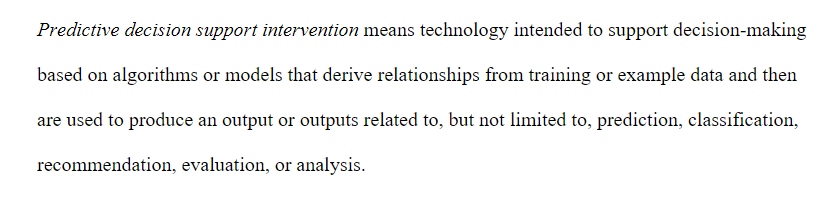
In #HTI1: **predictive decision support intervention** #DSI "means technology intended to support decision-making based on algorithms or models that derive relationships from ... data ... used to produce ..., prediction, classification, recommendation, evaluation, or analysis.Image
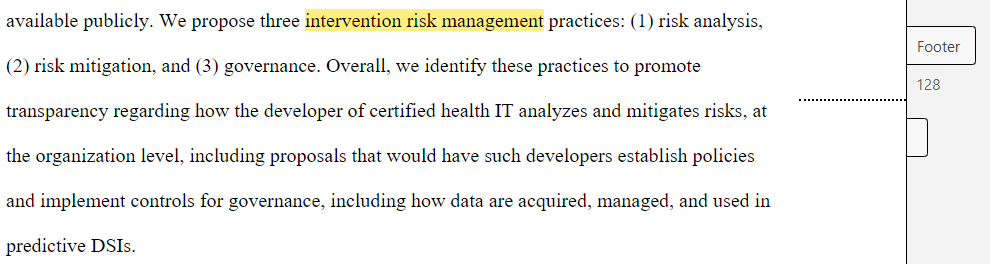
"intervention risk management" is a key phrase in the #DSI discussions in #HTI1.
"We propose three intervention risk management practices: (1) risk analysis, (2) risk mitigation, and (3) governance." 
#IRM ~= "... practices to promote transparency regarding how ... certified health IT analyzes and mitigates risks, at the organization level, ... developers establish policies & implement controls for governance, including ... data ... acquired, managed, and used ..."#HIT1Image
I had to jump ahead just to understand the implications of what appears in the introduction. I'm really only at page 22 of the intro in #HTI1 but had to move ahead 100+ pages just to understand what "intervention risk management" (#IRM) was in @ONC_HealthIT's collective minds. 
Back to simple stuff in #HTI1:
Network Time Protocol (NTP), yes, version? Pick one. Any currently implemented version is likely good enough. I agree. 
Next up: FHIR US Core v6.0 if ready in time, otherwise v5.0.1. If you were counting, that's three double promotions in #HTI1. I think this shows some of the challenges @ONC_HealthIT has in keeping the standards and related guides updated. Still not opposed though. 
Note, that's FHIR US Core, not Core FHIR that's being updated to version 6.0 in #HTI1. So far, I've found no mention of FHIR R4B either via search, so I'm assuming it's NOT to be (or 4B). 
SMART on FHIR only gets a single promotion in #HTI1, from v1 to v2. And tokens get to last only an hour. And endpoint URLs must be published.

Sounds good so far. 
So, in #HTI1 Patient Demographics changes to "Patient Demographics and Observations" in apparent deference to people who think some of the SOGI or other observations aren't demographic data. 
My dictionary says demographics are: "statistical data relating to the population and particular groups within it." It's also correct that some of these are "observations". It's not a hill I will die on, but it feels stupid. The former is correct and need not change in #HTI1 
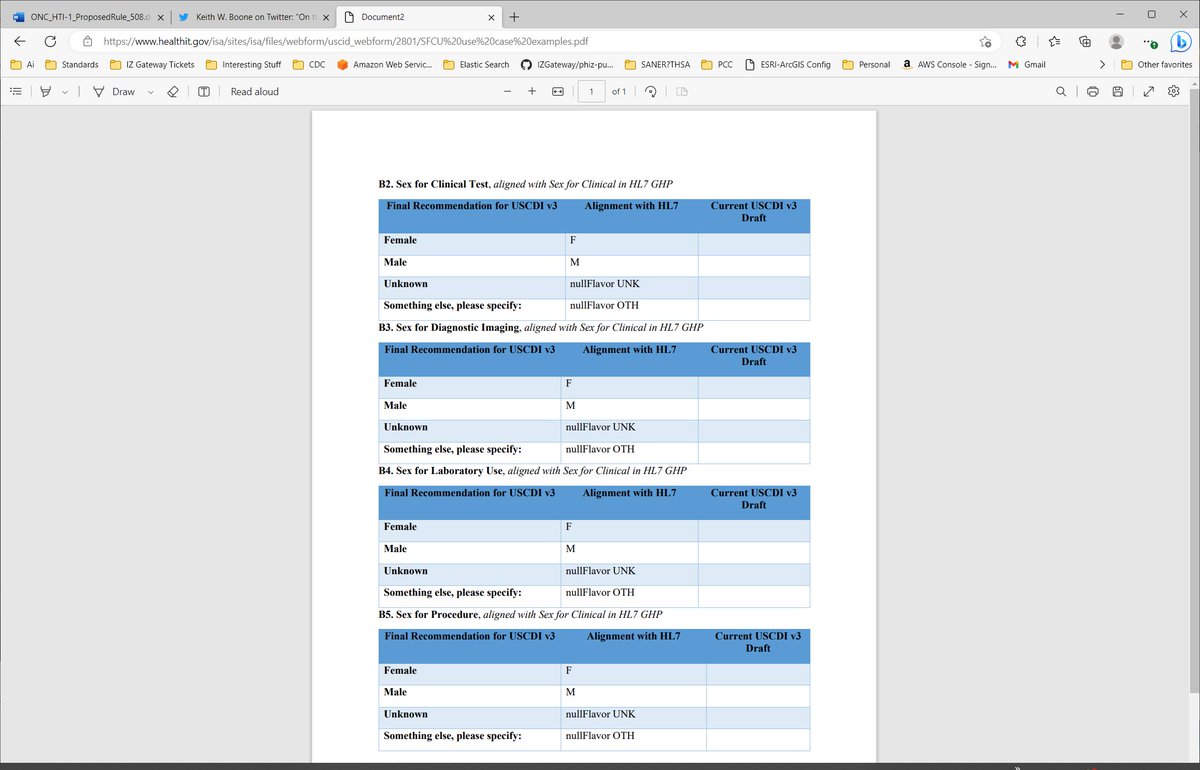
On the other hand, I'm very concerned about "Sex for Clinical Use", because right now this seems to be a reversion to "birth sex" or something, and it's VERY ill-defined.

There are numerous sexual characteristics that are relevant for clinical use & these vary based on context. 
Are we talking about genes? Endocrinology? Organs?
In the days of ANSI/HITSP, somewhere we enumerated a dozen clinically significant gender/sex related aspects which might have clinical relevance based on context. #HTI1 takes too simple an approach for an important topic. 
If you want to get clinical, then damn it all, get clinical in #HTI1. This is NOWHERE close to clinical:

* Female
* Male
* Unknown
* Something else, please specifyImage
The side effect of this data element in #HTI1, given lack of specificity addressing real concerns of Lab, Imaging, Procedures and Clinical Testing is to enable providers to assign gender as they see it. It's NOT clinical & likely to be abused in parental (I know better) form. 
The other danger is that this uses the same terminology with contextually sensitive definitions. This is completely inappropriate for how to use terminology. The definition of the term DOES NOT change with context. #HTI1 should NOT go down this path. 
On a positive note, two additional demographics (NOTE, I don't call them observations, though some might argue with me) including pronouns and name to use for the patient are included under this same section. So, this part of #HTI1 is not all bad. 
Transitions of care is being updated in #HTI1 to align with USCDI v3. This is pretty much a no-brainer that I fully support (except for Sex for Clinical Use #SFCU). 
#HTI1 proposes to add the ability to tag data as being restricted:
(14) Patient requested restrictions.
i) .. enable a user to flag whether such data needs to be restricted ... used or disclosed as set forth in 45 CFR § 164.522;
ii) Prevent any data flagged ... from ... use ... 
#HTI1 presents a reasonable first approach at enabling fine-grained sensitive data tagging. The key challenge for many #HealthIT providers is figuring out how to implement it. ... 
One approach to implementing #HTI1 fine-grained sensitive data tagging is to have a way to communicate authorizations and purpose of use to the data access tier, and let it provide only what is authorized. 
... been there ... released it even. It's perfectly reasonable, if a little invasive.

The restricted access of #HTI1 is very much aligned to support 45 CFR 164.522 (see law.cornell.edu/cfr/text/45/16…), and that gives you hints about tagging.

So does #FHIR:
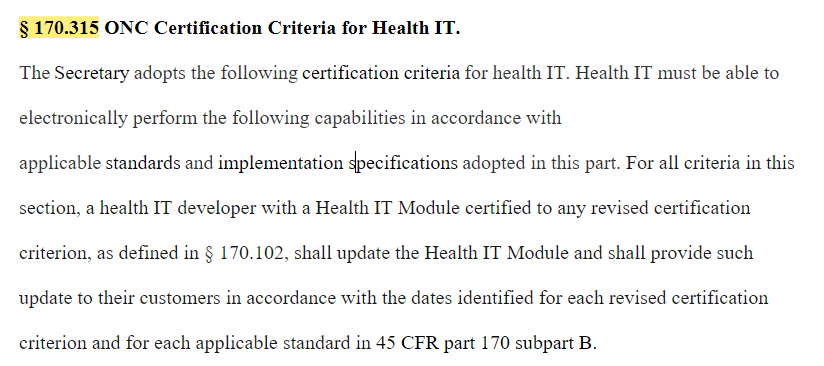
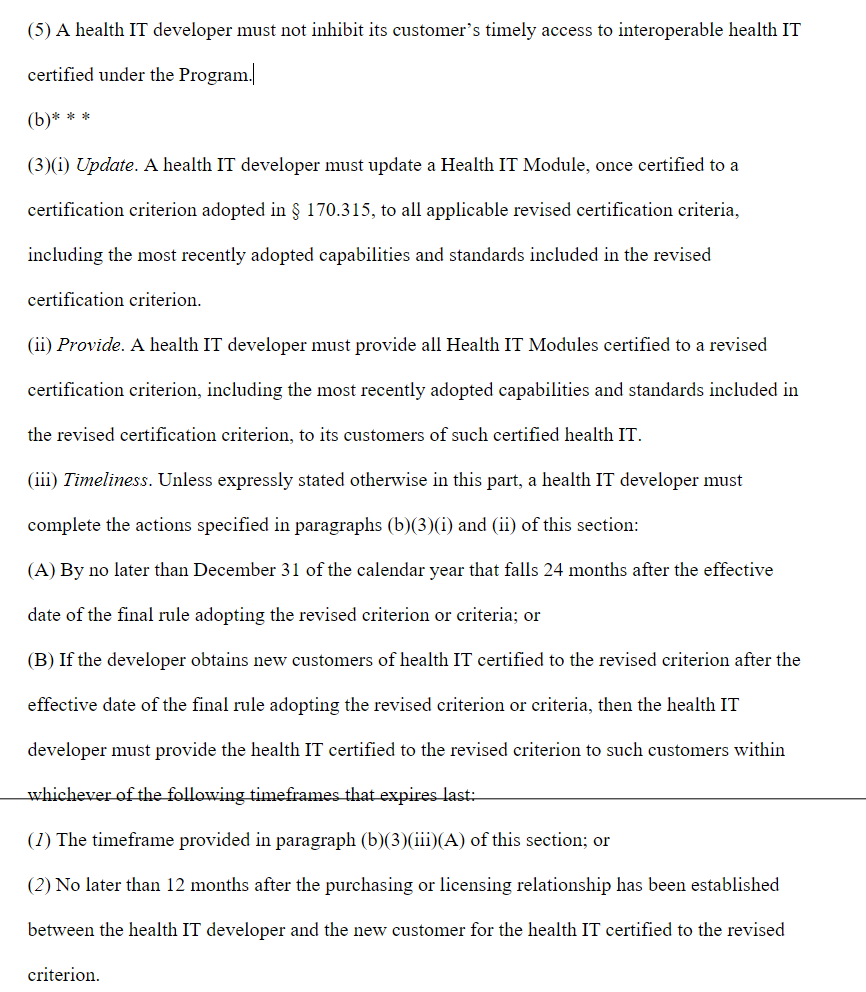
Finally in this first section, #HIT1 proposes "to make explicit in the introductory text in § 170.315 that health IT developers voluntarily participating in the Program must update their certified Health IT Modules and provide that updated certified health IT to customers ... 
OK, Section 1 of the executive summary done, only 4 more sections to go until we get to the real meat. So far I'm on page 27 of 629 in #HTI1. This isn't so bad is it?

;-) 
The next four sections of #HTI1 actually go quickly:

2. Basically proposes that once a component certified, developers have to keep up with @ONC_HealthIT rules for certification, and must provide it in a timely manner.Image
Section 3 of the summary addresses how @ONC_HealthIT corrects an oversight on how continuous real-world testing is tracked.

"by requiring health IT developers to include in their real world testing results report the newer version of those certified Health IT Module(s) ..." 
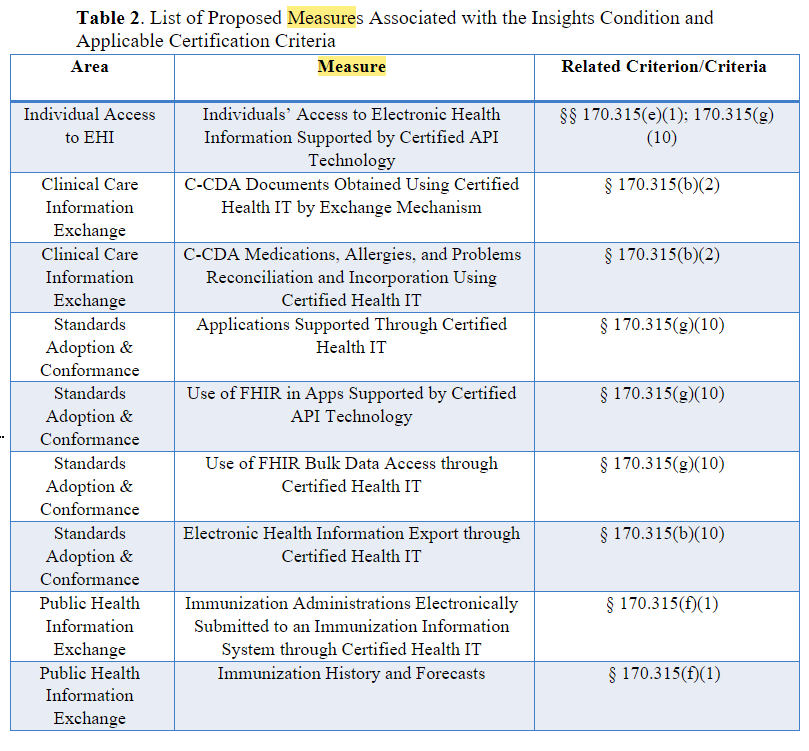
#HTI1 adds 9 CEHRT measures
1. C-CDAs obtained by Mechanism
2. C-CDA reconcilliation
3. Apps Supported
4. Use of FHIR in Apps &
5. " in Bulk Data Access
6. Electronic Health Information Export
7. Immunization Submitted to IIS &
8. " History/Forecasts
9. Individuals’ Access 
The devil will be in the details of those measures. Is what they are asking for reasonable? Perhaps even knowable? The system best able to count C-CDAs may not have a clue about mechanism of exchange. This will be an area for deeper scrutiny of #HTI1 for EHR vendors. 
Table 2 on Page 365 of the word document provides a table of measures:Individual Access to EHI: I...
Section 5 is a continuation of @ONC_HealthIT's efforts to differentiate provider organizations and the like (e.g., supporting consultant organizations) who develop certified apps from commercial entities who develop them commercially in its defining a #HealthIT developer in #HTI1 
And finally under #HTI1, QHINs and their participants get to focus on being networks using QTF and don't have to offer alternatives... or worry about a couple of other details.Image
In other words, QTF / QHIN / TECFA is the way of the future, and we aren't going back ...

#HTI1 
OK, we've finished the #HTI1 executive summary at page 32 of this monstor rule, and are about to get to my favorite part:

.
.
. skipping
.
.

I've just skipped a dozen pages of background and are now reading about the CEHRT program updates.  
That starts around page 44, but with more electronic magic I'm moving ahead to page 599: The rule itself

The executive summary gives me a briefing of what I'm about to review next. From page 44 to 599 is a bunch of explanation of what the regulators writing #HTI1 were thinking. 
By skipping that (but going back to it as necessary), I can avoid their influence for another 30 pages, and "The #HTI1 Rule" is what my folks have to abide by, the preface is explanation and justification for it. 
In the #HTI1 rule, @ONC_HealthIT updates its definitions first (always good practice). 2015 goes away, Base EHR and Certification criteria stay with the year modifer.

Revised certification criteria is defined as one might expect, but with the formality of regulation. 
For some reason, #HTI1 defined "Provide":

"Provide means the action or actions taken by a health IT developer of certified Health IT Modules to make the certified health IT available to its customers."

I'm unsure why "make available for use, supply" was insufficient (Oxford) 
Predictive decision support intervention = tech intended to support decision-making based on algorithms ... that derive relationships from training ... data ... used to produce an output ... related to ... prediction, classification, recommendation, evaluation, or analysis. #HTI1 
This definition is broken. I've written and worked on ML-based systems using training data. I've also read the Alignment Problem by Brian Christian (see amzn.to/3owgBkj), and the thematic overiew in #HTI1 (including Health Equity), and so understand where this is going. 
#HTI1 says "on algorithms or models that derive relationships from training or example data"

Examples:
1. Aggregate data about cause of death & demographics e.g., actuarial tables
2. 10 years of telemetry from speech recognition
3. a high frequency words list from clinical notes 
4. An X-ray image database
5. An EHR database with 10 years of history
6. an extraction of articles from the national library of medicine or other clinical sources
7. The ICD-10-CM index and text.
8-14. All of the aforementioned, annotated by experts.

#HTI1 
All of this is material I've personally worked with to develop algorithms and models. All of it is used to support decision making. All of it in #HealthIT 
My point being, most of what we do that adds values is based on "example data", and precious little of that is related to unexplained behavior in ML systems based on training.

Risk stratification
Natural Language Processing and tagging

Yet, it is also subject to bias... 
The key challenge in this definition for me right now is that it isn't restricting itself to clinical decision making, instead, any decision making. And that's where I think #HTI1 is headed a bit off the rails.

That may change in a few pages. 
But my gut tells me that ANY decision support aide could be considered by a lawyer to be subject to any #HTI1 rule using that definition. That may NOT promote better IT, it could suppress it, because folks scared about regs may avoid innovation after talking their lawyers. 
I'll see how it's used later, but my quick fix for #HTI1 would be to add clinical between "support" and "decision-making", restricting the use of it. It's very much aligned with the original intent, as the #DSI requirements are an alternative CDS approach for the first few years. 
Now we get to some simple stuff, and then raise my blood pressure again, and then go back to simple stuff in the second on standards at 45 CFR 170.20X in #HTI1
#HTI1 moves to C-CDA STU Companion Guide Release 3.
It also adopts FHIR and CDA standards for Electronic Case Reporting. These are solidly grounded, compatible with each other (developed by the same people even)

So far, so good. This is all solid advancement work. 
As much as I hate it that #ECR is way behind on the FHIR implementation side, I think @ONC_HealthIT made a good choice to allow both FHIR and C-CDA here in #HTI1, providing a path forward. 
For 45 CFR 170.207 Vocabulary standards for representing electronic health information,
almost all the advancement is good with ONE solid exception #HTI1
If you guessed that I'm going to start bitching about the stupidity of Sex for Clinical Use #SFCU, you aren't quite right. It's NOT the concept. It's the implementation.

The concept of needing to know about sex-linked traits for clinical care is totally appropriate. 
To tie it all back to two grossly overused terms "Male" and "Female" with meanings differing based on context (Clinical Use, Administrative Use, Lab Use, Imaging Use) operates on the context switching strength of human minds, rather than the clarity found in good terminology. 
A good terminology has a principal that you have a preferred term, it has a definition, possibly some alternative names (possibly in multiple languages), and a code. The DEFINITION does not change based on context. It always means what it means.

#HTI1 
In the proposed use, and selection of the standard for labeling "Sex for Clinical Use" in #HTI1 suggests LOINC codes, but no value set. Fine, I'll use 46909-0 Sex. loinc.org/46098-0/

Is that NOT what you meant? Get specific.

Oh, you mean these? healthit.gov/isa/sites/isa/…
Show me the codes, because using search.loinc.org, I cannot find them.

And the proposed answer sets in that list are a serious crock of **** because they overload the meaning of the terms male and female giving them different meanings in different contexts.

#HTI1 
Am I hot under the collar about how badly #SFCU is currently proposed #HTI1? You bet I am. It's because of how easily as proposed it could have the unintentional effects on LGBTQ+ care seekers who find themselves reading their labs & feeling misgendered on the basis of #SFCU 
That kind of psychological damage is triggering enough to cause death.

Use different, contextually relevant terms to deliver information about sex-linked patient traits relevant for laboratory, imaging, clinical testing or procedure information.

You will save lives. #HTI1 
OK, I'm going to take a short break from that rant on #SFCU in #HTI1. I'm sure you will hear more about it. 
One more note, I said unintended consequences. Because the basis of work of #SFCU is NOT a bad idea. It's a good one. But it needs a real effort, not slipshod use what we already think we know terms.

The reality is, if that's what you came up with, you didn't ask the experts. 
There was a whole meeting in ANSI/HITSP where this topic was discussed in detail more than a decade ago. I've had similar conversations with folks on the lab side, worked for a key company in imaging for a nearly a decade and a half. It's important in ways that M/F don't cover. 
Convene a group of stakeholders (different from the one that came up with the original inadequate proposal) to do better.

I said I was going to take a break from #SFCU. My brain can't. This is too important to family members and friends who could be negatively impacted. 
In #HTI1 this is a better definition than that for #SFCU and shows more of what is necessary:

Financial resource strain must be coded in accordance with, at a minimum, the version of LOINC ® codes ... attributed with the LOINC ® code 76513-1 and LOINC ® answer list ID LL3266-5. 
And now we move on to section 45 CFR 170.299.

Here, in #HTI1 I'm looking for ONE thing really. Is the referenced standard really an official standard. 
An THIS lone item in #HTI1 is not:
(41) HL7 FHIR® Data Segmentation for Privacy Implementation Guide: Version 1.0.0 – current – ci-build, December 1, 2022, IBR approved for § 170.205(o).

ci-builds are NOT approved HL7 standards. 
I SUSPECT, what happened here, is that a publishing deadline was missed on DS4P. The official publication is at hl7.org/fhir/uv/securi…, and is the one that SHOULD be referenced by #HTI1
In a standards advancement program that is updating more than a dozen documents (if memory serves), missing one for #HTI1 is not a big deal. Note though, @ONC_HealthIT called out 2 others not quite ready with latest but should be out by final rule: C-CDA Companion Guide & US Core 
OK, onto the big section, the certification criteria.

#HCI1 clarifies that if you certify in year 1, and the standards advance, you must advance with them, and deliver the updated software to your customers. I suppose you have the option to stop certifying for that criteria... 
... but that is not clear, and the impacts on your customers is also unclear (wrt to CMS and other regulations), nor are the penalties for failure to follow this section. I'm hoping that's covered elsewhere in #HTI1 
I reject this implementation of #SFCU
(F) Sex for Clinical Use. Enable a patient’s sex for clinical use to be recorded in accordance with, at a minimum, the version of the standard specified in § 170.207(n)(3). Conformance with this paragraph is required by January 1, 2026. 
Reserved section 45 CFR 170.315(a)(11) is replaced in #HTI with the #DSI efforts.

These words frighten me:

Module enables ... one or more predictive decision support interventions as defined in § 170.102 based on any of the data expressed in the standards in § 170.213 
It's clear from context that this is clinical decision support, but never stated in that fashion. And that's worrisome, because that lack of clarity opens up this section to whole new ways of interpreting the meaning of decision support. 
Arguably, all decision support systems used in #HealthIT impact care. However, until this rule, they weren't considered to be such in the rule, because they weren't Clinical Decision Support.

I'll go with my original recommendation for #HTI1: Insert clinical in the definition 
How does #DSI compare to prior CDS related content in CERHT in #HTI1?
New:
1. There's an attestation, is it predictive decision support?
2. Documented use of demographics (and obs), or SDOH, or Health Status data
3. 8 items reported about development
4. 5 performance measures 
#DSI #HTI1
1. The attestation makes failures MORE actionable by the regulation.
2. Documented use of data impacting health equity makes sense.

So far, so good. Now for the ugly (but not necessarily bad). 
Here is where some of the complaints begin on #DSI in #HTI1
(2) You must report on development:
(i) features of the intervention and test data.
(ii) process to ensure fairness
(iii) External validation

... 
And (3) update all of the aformentioned via maintenance.

#HTI1

(D) Futhermore, if
(1) it isn't available (for external validity, fairness) must show it is not available.
(2) developed by non-developers of certified Health IT, it could also be shown unavailable in that case 
One concern raised: There's lots of CDS in use that isn't certified that can plug into an EHR system. How is the certified developer responsible for the customer's use of uncertified CDS?

This should NOT be a concern of the CEHRT provider, but nowhere is that made clear.

#HTI1 
And the maintenance aspect includes:
validity and fairness in local data (rather than test data). I'm assuming what this means is an evaluation of ongoing validity and fairness in light of current use with local data, but how can this aspect of #DSI in #HTI1 be assessed? 
#DSI cannot be assessed w/o outcomes. In such testing, the outcomes need to be captured in controlled ways to ensure accuracy in the measures. What if the provider using the #DSI does not follow the same standards for assessing outcomes as used in development.

#HTI1 
This next aspect of #DSI development comes naturally to one that has worked for a vendor of Class 3 medical devices, and that applies to many EHR developers as well, but not all.

Intervention Risk Management #IRM is what you do already if you have a clue. 
Before developing an intervention, and throughout, you do risk analysis (I should do one for #SFCU because it is high risk).

#HTI1 makes that official policy for #HealthIT developers of CEHRT. 
You also do risk mitigation. I've never seen risk analysis without risk mitigation, but then perhaps I've been well trained.

Mitigation may involve cross-checks, fail-safes, et cetera.
#HTI1 #DSI 
Sometimes risk mitigation involves redesign for a less risky solution.

It also involves ongoing monitoring, and examining any anomalies or reported adverse events to see if they are caused by flaws, and then addressing them.

#HTI1 #DSI 
Finally, #HTI1 requires governance of #DSI: DOCUMENTED internal policies for how such systems are built, data is acquired and managed, and the system is designed to be safe, secure, fair, and valid. 
This is very similar to what some organizations already do for their quality management system and to some degree also safety enhanced design processes in 45 CFR 170.315(b)(3 and 4). #HTI1 #DSI 
If you are building a #DSI, and already have a QMS, then the documentation and process around that QMS likely includes some, if not all of what you need for reporting about #DSI.

#HTI1 
Missing in this though, are some essentials on testing for fairness in #DSI, for which no standards are referenced in #HTI1. I'm not sure that the standards have caught up to the science here. 
There's nuance and variance here, and I'm NOT a CDS developer. Yes, the requirements feel like a PIA for developers, and not all providers will see value in them either. I DO think they are important to get people thinking about health equity. #DSI #HTI1 
And the documentation requirements, when you get down to it from an implementation perspective are NOT arduous. I expect competent #HealthIT developers will have this available quickly for new #DSI interventions. It's the existing stuff that's worrisome. #HTI1 
My internet is internot right now, so #HTI1 tweets are being posted under one bar conditions 
And now internet is spelled with two e's, so I'm back with my read through of #HTI1.

We left off at #DSI, and are starting up again now, next up it patient requested restrictions. 
Patient Requested restrictions is rather straightforward in #HTI1.

For any data expressed in USCDI enable a user to flag restrictions for subsequent use or disclosure as set forth in 45 CFR § 164.522; and

Prevent flagged data from being included in a use or disclosure. 
As previously mentioned, FHIR has vocabulary to support such flags in Resource•meta•security. See hl7.org/fhir/R4/resour… and hl7.org/fhir/R4/securi…

For authentication purposes, purpose of use is likely a scoped context, but there are cases where break glass may be needed. 
I'm thinking @johnmoehrke probably has something about how to include a break-glass assertion in a FHIR query. It can work as a scope via SMART/OAuth, but perhaps there should be an alternative in the query to say "this is for emergency use".

#HTI1 
For ECR, honestly, I think that @ONC_HealthIT should change the wording from "consistent with" to "conforming to":
---
B) Create a case report consistent with at least one of the following standards:

(1) The eICR profile of HL7 FHIR eCR IG ...
or
(2) ... of the HL7 CDA eICR IG 
As expected, #HTI1 applies safety enhanced design requirements on #DSI. I will note that your Quality Management System **already** applies to certified components 
There's minor updates to (g)(10) related to linking that rule to the new standards selected in 215(a) (b)(1) and (d). This used to be just 215(a).

(b)(1) is FHIR US Core
(d) is Bulk Data Access (a.k.a. Flat FHIR).

#HTI1 
Under 170.402 Assurances, there's new language about having to upgrade components to match the current rule.
What's missing from #HTI1 is what should happen if a developer decides with withdraw a component rather than upgrade it because for some reason they are unable to update.Image
Under 170.404 APIs in #HTI1 "Certified API Developer must publish, at no charge, the service base URLs and related organizational details" using the FHIR Endpoint resource.
Now we get to Insights in 170.407 of #HTI, this is going to be a bit longer, as the details are important.

As previously mentioned, there are 9 measures:
See the table at
If you have more that 50 hospital users or 500 clinician users you must report on each of the 9 measures according to #HTI1 if you have a module certified to the specified criteria in the previous table. 
For #HTI1 Patient Acceess Insight 1 you must report:
Numerator 1: Number of patients w/ an encounter who accessed PHI through 3rd-parties using (g)(10), a patient portal via e(2), or vendor supplied app using (g)(10)
Numerator 2: Number accessed PHI regardless of encounter status 
#HTI Patient Access
Denominator 1: Number of patients who had an encounter in the reporting period.
Denominator 2: Number of patients who had an encounter and accessed via one of 3 methods.
Denominator 3: Number of patients who access PHI regardless of encounter status. 
NOTE: These measures are defined in the preamble of #HTI1 and DO NOT show up in regulatory text. Thus they are sub-regulatory. @ONC_HealthIT says you must report according to their specifications in the rule, but the specifications are not part of the regulation. 
But as I read the measure definitions in #HTI1 for Patient Access, they don't actually make sense because the numerators and denominators seem to be defined identically, and they don't specifically call out any stratifications, but it's clear that they want strata by access type. 
Here's the @ONC_HealthIT intent in #HTI1:
1. % of individuals with an encounter who access EHI by the type of method
2. % of individuals with an encounter who access EHI by at least one type of method
3. % of all individuals who access EHI by at least one type of method 
I'd want in #HTI1 insight 1:
1. # individuals w/ encounter during the reporting period.
2. # individuals w/ encounter & accessed PHI, stratified by method: Portal, 3rd party API, vendor app
3. # w/encounter accessing by any method.
4. 1-3 above, regardless of encounter status. 
Note in that stratified by method of access for #HTI1 Insight 1 is OVERLAPPING strata. An individual can appear in multiple strata. This is legit, just not often used feature of measures.
My #2 could be combined with #3 by addition of 4th stratum to say "any method". 
And I missed above that you also need to count # of individuals who COULD have access to EHI by any method type to compute the necessary percentages.

That COULD needs defining. Is is % of patient population? If so, how does one attribute an individual to a provider. #HTI1 
I see my GI specialist once every 3 years. I'm still his patient. I should be part of his denominator.

There needs to be a way to clearly define this, as it may also vary by specialty. I think CMS has some rules regarding attribution of patients to providers for VBC. #HTI1 
Going through the #HTI1 insights measures is tedious, because I have to math every one of them and then put on my measure developer hat and reword them.

I'm putting that on the back burner for now.

The rule is, you have to report. ONC will tell you how later. 
And #HTI1 need good advice about how to report on these 9 measure and how to make it clear. They've done an OK job, but lacking the actual measures makes it difficult. Be sure to comment on the preamble section III.F. Insights Condition and Maintenance of Certification p312-379 
Essentially, the 312-379 pages is all requests for comment about how to build good measures in #HTI, and it appears to need some work.

It also looks as if different people wrote sections for different measures, some consistency is needed across this material. 
Finally, I'd want to understand how and where these Insight measures for #HTI1 will be published. 
So, after jumping back into the #HTI1 preamble to skim 67 pages of text, I'm back to page 657.

Woo-hoo! More skipping but only two pages as not much has changed for § 170.523 Principles of proper conduct for ONC-ACBs. I just need to make sure it makes sense as a customer ... 
More skimming and skipping, but basically what I've already said about changes to information blocking covers what's in the actual rule.

#HTI1 
Things to come back for in new threads on #HTI1:
#DSI Decision Support Interventions
#HTInsights HTI1 Insight Measures
#SFCU Sex for Clinical Use follow-ups 
Hey @threadreaderapp please rollup my #HIT1 thread for myself and others.