The HL7 Clinical Decision Support Workgroup has been looking into the behavior of a Virtual Medical Record. One of the topics of discussion yesterday was on the use of code and actionNegationInd in the information model (actionNegationInd replaces negationInd to flag acts that didn't or shouldn't occur.) The problem with this approach isn't that it is wrong, just that it doesn't match up with the typical way that decision support processing obtains information.
When negation indicators are stored separately from codes for the actions, you have to look in two places to determine whether something was or should be done, rather than wasn't or shouldn't be done. Let's give an example of the issue here. If you wanted to see if a patient had a prior history of ischemic heart disease, a naive implementation might check thus:
historyOfIschemicCardiomyopathy = false
For (problem in patient.problems)
if (problem.code = "Ischemic Cardiomyopathy")
then historyOfIschemicCardiomyopathy = true, exit loop
if (historyOfIschemicCardiomyopathy == true)
then Execute Clinical Decision Support Rule
This would work MOST of the time. Where it would fail would be cases where actionNegationInd was true, indicating "No Ischemic Cardiomyopathy". The right way to check for this is:
historyOfIschemicCardiomyopathy = false
For (problem in patient.problems)
if (problem.code = "Ischemic Cardiomyopathy"
AND problem.actionNegationInd = "false")
then historyOfIschemicCardiomyopathy = true, exit loop
if (historyOfIschemicCardiomyopathy = true)
then Execute Clinical Decision Support Rule
It would only look at those cases where Cardiomyopathy had not been rejected. If you think that this isn't really a problem, I can point you to a very well known case that hit the Boston Globe because a diagnosis that was meant to be "ruled out" wound up in the patient's problem list for exactly this kind of reason. Someone forgot to cross-check the code against how it was meant to be used.
But a better way to handle this would be to look only at confirmed cases first, as in the following:
historyOfIschemicCardiomyopathy = false
For (problem in patient.confirmedProblems)
if (problem.code = "Ischemic Cardiomyopathy")
then historyOfIschemicCardiomyopathy = true, exit loop
if (historyOfIschemicCardiomyopathy == true)
then Execute Clinical Decision Support Rule
This code would not confuse a rejected case with a confirmed one. If you wanted to search for rejected cases, you might look at patient.rejectedProblems.
The other point that we discussed in the meeting was "what is a problem list". From the HL7 Patient Care perspective, you have a "Concern", which represents an item that is the subject of concern of a physician. That could be a problem, an allergy, a current medication that the patient is on which requires monitoring, a past procedure (e.g., status post cholecystectomy), et cetera. Other providers view the problem list as containing only those diagnoses that are currently active, and yet others might including findings or symptoms that are not yet diagnosed (e.g., lower back pain), and others might include the problem history as well, or at least recent history. There are a whole slew of terms that we need to identify. One way to go about this is to look at a variety of clinical decision support rules and guidelines and look for what those concepts are. The problem list is obviously one of them, but others include family history, social history, current medications (what does current mean), medication history, allergy lists, et cetera. Yes, we could wind up in a discussion of what the word "means" means, as well, but at least that way, we can be very clear about the behaviors expected of the VMR.
So another part of this we need to address are defining these concepts in a way that makes sense from the perspective of a clinical decision support implementation. The definitions need to be formal enough that we can test the behavior of a VMR against them.
I've used the term behavior a couple of times here, and it is an important one. The point of the VMR is that it provides a way for clinical decision support systems to access clinical information from patient medical records. The information is already available in a number of different forms, e.g., through HL7 Version 2 messages, Version 3 messages, CDA and CCD documents, from ePrescribing systems in NCPDP SCRIPT, from payers in X12N messages, et cetera. Part of what VMR does is bring this information to the clinical decision support system in a consistent fashion. This isn't static modeling, rather, it is dynamic, addressing particular behaviours that the VMR supports when you ask for information.
The VMR operations are at a much finer grain than what you would see in a typically messaging solution, and that is just fine. There's no reason why an entire message or document wouldn't be consumed by the VMR in one great big swallow. It's how the VMR responds based on what was in that content that is the subject of discussion.
What I've been talking about in this post is User Interface design, but not in a way that we often think about it. What we need to look at more in HL7 is how the implementers use the standards we are developing, and how we can make their jobs simpler. An accurate representation of information is not very useful if it requires a PhD to understand it. We need to use our knowledge to make it easier for people to use the information in the correct way. That requires a review of how they use it, and a design that makes that easy.
Showing posts with label VMR. Show all posts
Showing posts with label VMR. Show all posts
Friday, November 5, 2010
Friday, August 20, 2010
VMR FAQs
Today I gave a presentation on VMR to the EHRA and fell completely flat on my face. Either I totally didn’t understand my audience, or as my colleague described to me, just simply started off in the wrong direction. It didn’t help that I had a technology failure with my modeling tool (I’ll blame it on Friday the 13th) and had a complete mess of a model (autoformatting and routing should be banned) an hour before the presentation.
As a result, I put together this simple FAQ to maybe undo the damage, and provide a simple example. I’m going to elaborate on this over the coming weeks.
What is a VMR?
The Virtual Medical Record is an object model according to definition 2 provided on Wikipedia:
How do I use the VMR?
In order to use the VMR, you need an implementation of it in a platform specific environment. That implementation provides the various classes and interfaces described in the object model, and may provide other capabilities also. The mechanism by which the object model is implemented is not specified by the VMR. What the VMR does specify is how the implementation must behave when information is requested, or services are accessed.
What data sources does the VMR use?
It is up to the specific VMR implementation. As I previously stated, these could be data sources like a healthcare providers electronic medical record, a patients personal health record, or any number of other sources of healthcare information for the person. This information could be stored in CCD or CDA format, could be send to the VMR as HL7 Version 2 messages, DICOM Information Objects, or X12N transactions.
What does the VMR look like?
The VMR looks like a UML model with documentation on the various classes and interfaces, and on their methods and properties.

The collection of clinical statements stored in the VMR can be accessed through VMR methods that filter the list of clinical statements. These methods allow more direct access to conditions, allergies, medications, immunizations, vital signs, lab results, orders, et cetera.
Why person and not patient?
A person acts in a role of patient with a number of different healthcare provider organizations. The VMR is not limited to data from only one healthcare provider. Furthermore, it could also include information that the person entered into their own PHR, and they could have no relationship with any specific healthcare provider.
How would I use the VMR?
The first presumption is that someone has defined a set of rules (called a platform binding) which describe how the classes, interfaces, methods and properties described in the VMR Object Model are translated into the various platform (or programming language) dependent features. The next is that someone has actually implemented the VMR for that platform.
Let’s take an example that many of you are familiar with, an EMR system. To implement a VMR using that EMR system, you would:
And then implement a clinical decision support rule about determination of eligibility for a mammogram as follows:
This is a rather simplified example of a rule I’m presently working on to describe this concept. A more elaborate version of the rule checks to see if they’ve have a complete bilateral mastectomy or two complete unilateral mastectomies first, before determining that the patient is eligible, in order to determine whether they still need to worry about mammography. A patient without breasts would not usually need a mammogram (but might need other testing). This example completely ignores the underspecified concept of concept, which I talk about in a separate blog posting.
As a result, I put together this simple FAQ to maybe undo the damage, and provide a simple example. I’m going to elaborate on this over the coming weeks.
What is a VMR?
The Virtual Medical Record is an object model according to definition 2 provided on Wikipedia:
A collection of objects or classes through which a program can examine and manipulate some specific parts of its world. In other words, the object-oriented interface to some service or system. Such an interface is said to be the object model of the represented service or system. For example, the Document Object Model (DOM) [1] is a collection of objects that represent a page in a web browser, used by script programs to examine and dynamically change the page. There is a Microsoft Excel object model [2] for controlling Microsoft Excel from another program, and the ASCOM Telescope Driver [3] is an object model for controlling an astronomical telescope.The reference to the W3C Document Object Model is especially relevant, because it is an object model that many software developers are familiar with, and upon which the current draft work in HL7 is built upon.
The VMR is not a “wire format” for communicating patient healthcare information between disparate systems. It is also not a set of classes or interfaces implemented in any specific programming language. It is instead a computational independent representation of how one can interact with a health information system to access medical information about a single patient. That representation describes how the classes and interfaces behave, and what information and services they provide. The representation of the object model is in UML.
How do I use the VMR?
In order to use the VMR, you need an implementation of it in a platform specific environment. That implementation provides the various classes and interfaces described in the object model, and may provide other capabilities also. The mechanism by which the object model is implemented is not specified by the VMR. What the VMR does specify is how the implementation must behave when information is requested, or services are accessed.
What data sources does the VMR use?
It is up to the specific VMR implementation. As I previously stated, these could be data sources like a healthcare providers electronic medical record, a patients personal health record, or any number of other sources of healthcare information for the person. This information could be stored in CCD or CDA format, could be send to the VMR as HL7 Version 2 messages, DICOM Information Objects, or X12N transactions.
What does the VMR look like?
The VMR looks like a UML model with documentation on the various classes and interfaces, and on their methods and properties.
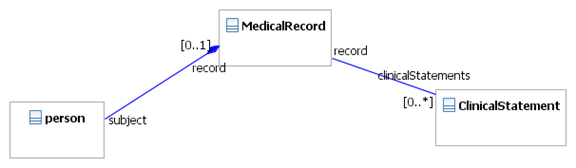
Figure 1 Core of the VMR
At the very core of the VMR is a class called the Medical Record. The medical record is an collection of clinical statements associated with one person. These clinical statements may come from an EMR, a PHR, a Clinical Data Repository, a specialized HIT application, an immunization registry, et cetera, or it may be a composition of information available from a number of disparate systems.The collection of clinical statements stored in the VMR can be accessed through VMR methods that filter the list of clinical statements. These methods allow more direct access to conditions, allergies, medications, immunizations, vital signs, lab results, orders, et cetera.
Why person and not patient?
A person acts in a role of patient with a number of different healthcare provider organizations. The VMR is not limited to data from only one healthcare provider. Furthermore, it could also include information that the person entered into their own PHR, and they could have no relationship with any specific healthcare provider.
How would I use the VMR?
The first presumption is that someone has defined a set of rules (called a platform binding) which describe how the classes, interfaces, methods and properties described in the VMR Object Model are translated into the various platform (or programming language) dependent features. The next is that someone has actually implemented the VMR for that platform.
Let’s take an example that many of you are familiar with, an EMR system. To implement a VMR using that EMR system, you would:
- Select a programming language, e.g., JavaScript (or more accurately, ECMAScript, but I don’t want to confuse everyone).
- Create a set of programmable objects following the rules of the binding for JavaScript.
- Create a set of objects that allow a user “read-only” access to information stored in your EMR system.
- Create a set of objects that allow a user to create new clinical statements that may or may not be stored in your EMR system (that’s an implementation decision, not one that VMR specifies).
- Provide some way for an end user to write JavaScript code which uses those exposed objects.
Class Person {
  PN Name; // HL7 V3 Person Name
  TS birthDate; // HL7 V3 Time Stamp
  CD gender; // HL7 V3 Concept Descriptor (Code)
  MedicalRecord  record;
};

Class MedicalRecord {
  Person owner;
  List statements;
  void add(ClinicalStatement);
  VMRImplementation implementation;
};

Class Concept {
   BL matches(ClinicalStatement s);
};

Class ClinicalStatement {
  II id;
  CD code;
  TS effectiveTime;  // A simplification for the example, could be IVL_TS
  MedicalRecord source;
  Person subject;
};

Class VMRImplementation {
  ClinicalStatement createAct(CD actCode); // Also a simplification
}
And then implement a clinical decision support rule about determination of eligibility for a mammogram as follows:
var age = now() – record.owner.dateOfBirth;
if (record.patient.gender.code == “F” &&  age > AGE40YEARS && age < AGE70YEARS)
  record.add(record.implementation .createAct(MAMOGRAMELIGIBLE));
This is a rather simplified example of a rule I’m presently working on to describe this concept. A more elaborate version of the rule checks to see if they’ve have a complete bilateral mastectomy or two complete unilateral mastectomies first, before determining that the patient is eligible, in order to determine whether they still need to worry about mammography. A patient without breasts would not usually need a mammogram (but might need other testing). This example completely ignores the underspecified concept of concept, which I talk about in a separate blog posting.


Thursday, August 12, 2010
Unclear on the Concept
The HL7 Clinical Decision Support workgroup met today to discuss again models for the Virtual Medical Record. We are circling around a proposal that I made a couple of weeks back for a model. The essenstial model of the VMR is a List of ClinicalStatements associated with a Person, accessible by Concept. There, I said it in one sentence.
A core piece of this model is a class that right now I've called Concept‹T›, which is a parameterized class. Concept‹T› is abstract and has one defined method: Boolean contains(T object). This method returns true if the object implies the concept, or if the set of all instances of the concept can be said to contain the object.
So the very core becomes:
The Concept class is a critical abstraction in the VMR model. As you may recall, the purpose of the VMR model is to provide a representation of the clinical information used to reason with in Clinical Decision Support. A lot of clinical decision support can be boiled down to a pattern/action paradigm "if pattern X then action Y". The idea of patterns is that these are classifiers which identify items matching a set of rules. Look at the definition of Concept above. It has one method, which basically allows you to ask the question: Does X match the pattern embodied by this Concept?
The Concept‹T› class makes it possible to talk about and use a particular concept (e.g., Problem, Medication, Allergy, Immunization) without ever having to define what it is or how it is implemented. The VMR can operate regardless of how Concept‹T› is defined. It also makes it possible to extract from any clinical statement other clinical statements in a certain relationship to the original (e.g., Manifestations and Causes, Treatments and Reasons). But, it completely hides the mechanism by which these are implemented.
Take for example, problems. In past discussions of the VMR model, it has been clear that there needs to be a way to represent the list of problems for the patient. It's clear that the problems are themselves a type of clinical statement. What isn't clear is how the VMR makes the distinction between, let's say, a problem and more specifically an allergy; or between a medication and an immunization. The point of using Concept‹T› in the model is that it doesn't matter. Assuming you have the Concept named PROBLEM that is a feature of the VMRImplementation, you can always find anything that is a PROBLEM.
So, we can now define a method for MedicalRecord by which problems are returned (other methods might be more efficient, but this is one that is guaranteed to work).
We can also defined an algorithm that would support the List‹T› extract(Concept‹T›) operation on the List class. It simply creates a new list, iterates over the members of the original list, and if one of those members is contained within the concept, it is added to the new list, which is returned at the end of the iteration. In code it looks something like this:
These definitions are easy to implement and describe, even if they aren't the most efficient or best implementations. It makes it quite easy to create a functional test to verify that a VMR implementation is correct.
There are a number of benefits to Concept‹T› in the VMR. You can have a particular concept like "Blood Pressure" be defined as a set of clinical statements where one and only one of them contains a systolic measure, and one and only one other contains a dyastolic measure, and both are in pressure units. This is a detailed clinical model:
Another case could make use of value sets and clinical terminology services, as in the following rough-and-ready example:
The above implementation could instantiate a CodedConcept using a value set for all possible LOINC codes representing an HGA1C measure.
You can mix and match different types of Concepts and build larger concepts out of smaller ones. A Concept could represent "one of the last 3 Creatine Measures in the last six months". Using it, you could extract the measures that you wanted as follows:
Some have pointed out that GELLO has a way to represent that. Indeed, and you could do the following:
We talked on the call about the concept of persons having diabetes. This points out that while we've been discussing Concept‹ClinicalStatement› we can also have Concept‹Entity› or Concept‹Person›. The concept of persons with diabetes could be defined as Person where medical record contains diagnosis of diabetes in last 2 years, or use of injected insulin for more than three months or 3 HGCA1 measures > 7 in a 1 year period. The larger concept of Patient with Diabetes can be built on smaller concepts: HGAC1 Measures, Injected Insulin, and Diabetes Diagnosis.
The point is, the VMR DOESN'T care how concepts are implemented, and is in fact, unclear on the concept of Concept.
A core piece of this model is a class that right now I've called Concept‹T›, which is a parameterized class. Concept‹T› is abstract and has one defined method: Boolean contains(T object). This method returns true if the object implies the concept, or if the set of all instances of the concept can be said to contain the object.
So the very core becomes:
class SimpleMedicalRecord {

  List‹ClinicalStatement› statements;

  Person subject;

  VMRImplementation implementation;

};


class Concept‹T› {

  Boolean contains(T object);

};


class List‹T› {

  int count;

  T item(int index);

  List‹T› extract(Concept‹T› concept);

};


class ClinicalStatement {

  II id;

  Code code;

  List‹ClinicalStatement› has(Concept s);

  MedicalRecord owner;

  Person subject;

};
The Concept class is a critical abstraction in the VMR model. As you may recall, the purpose of the VMR model is to provide a representation of the clinical information used to reason with in Clinical Decision Support. A lot of clinical decision support can be boiled down to a pattern/action paradigm "if pattern X then action Y". The idea of patterns is that these are classifiers which identify items matching a set of rules. Look at the definition of Concept above. It has one method, which basically allows you to ask the question: Does X match the pattern embodied by this Concept?
The Concept‹T› class makes it possible to talk about and use a particular concept (e.g., Problem, Medication, Allergy, Immunization) without ever having to define what it is or how it is implemented. The VMR can operate regardless of how Concept‹T› is defined. It also makes it possible to extract from any clinical statement other clinical statements in a certain relationship to the original (e.g., Manifestations and Causes, Treatments and Reasons). But, it completely hides the mechanism by which these are implemented.
Take for example, problems. In past discussions of the VMR model, it has been clear that there needs to be a way to represent the list of problems for the patient. It's clear that the problems are themselves a type of clinical statement. What isn't clear is how the VMR makes the distinction between, let's say, a problem and more specifically an allergy; or between a medication and an immunization. The point of using Concept‹T› in the model is that it doesn't matter. Assuming you have the Concept named PROBLEM that is a feature of the VMRImplementation, you can always find anything that is a PROBLEM.
So, we can now define a method for MedicalRecord by which problems are returned (other methods might be more efficient, but this is one that is guaranteed to work).
Class MedicalRecord extends SimpleMedicalRecord {

List‹Problem› problems() {

return this.statements.extract(this.implementation.PROBLEMS);

}

};
We can also defined an algorithm that would support the List‹T› extract(Concept‹T›) operation on the List class. It simply creates a new list, iterates over the members of the original list, and if one of those members is contained within the concept, it is added to the new list, which is returned at the end of the iteration. In code it looks something like this:
List‹T› extract(Concept‹T› concept) {

List newList = new List‹T›();

for (int i = 0; i < this.count; i ++) if ( concept.contains(this.item(i)) ) newList.add(this.item(i)); return newList; }
These definitions are easy to implement and describe, even if they aren't the most efficient or best implementations. It makes it quite easy to create a functional test to verify that a VMR implementation is correct.
There are a number of benefits to Concept‹T› in the VMR. You can have a particular concept like "Blood Pressure" be defined as a set of clinical statements where one and only one of them contains a systolic measure, and one and only one other contains a dyastolic measure, and both are in pressure units. This is a detailed clinical model:
Class DetailedClinicalModel extends Concept‹ClinicalStatement› {

... properties and methods associated with a DCM ...

};
Another case could make use of value sets and clinical terminology services, as in the following rough-and-ready example:
Class CodedConcept‹CodedObject› extends Concept‹CodedObject› {

II valueSetId;

Boolean contains(CodedObject test) {

return CTS.getValueSet(valueSetId).contains(test.getCode());

}

};
The above implementation could instantiate a CodedConcept using a value set for all possible LOINC codes representing an HGA1C measure.
You can mix and match different types of Concepts and build larger concepts out of smaller ones. A Concept could represent "one of the last 3 Creatine Measures in the last six months". Using it, you could extract the measures that you wanted as follows:
measures = VMR.statements.extract(LAST3CREATINEMEASURESINLASTSIXMONTHS);Some have pointed out that GELLO has a way to represent that. Indeed, and you could do the following:
Class GelloDefinedConcept extends Concept‹T› {

  String GelloExpression;

  Boolean contains(CodedObject test) {

    return GelloEvaluator.evaluate(GelloExpression, this);

  }

}
We talked on the call about the concept of persons having diabetes. This points out that while we've been discussing Concept‹ClinicalStatement› we can also have Concept‹Entity› or Concept‹Person›. The concept of persons with diabetes could be defined as Person where medical record contains diagnosis of diabetes in last 2 years, or use of injected insulin for more than three months or 3 HGCA1 measures > 7 in a 1 year period. The larger concept of Patient with Diabetes can be built on smaller concepts: HGAC1 Measures, Injected Insulin, and Diabetes Diagnosis.
The point is, the VMR DOESN'T care how concepts are implemented, and is in fact, unclear on the concept of Concept.
Wednesday, August 4, 2010
Standards Activity around Clinical Decision Support
The next week for me is about, in large part, clinical decision support, and I hope to figure out just a bit more about where it is going. I've had to spend a couple of hours each of the last couple of days thinking about it. There is quite a bit and yet not quite enough is going on with CDS these days. The holy grail of CDS is to build a repository of CDS algorithms that can be identified and applied to the appropriate patients, but we still aren't there yet. Except for Meaningful Use, Clinical Decision Support is the most often searched for topic hitting this space.
Here's just a brief summary of some things that are going on:
AHRQ is working with Thomson Reuters to develop a way to describe a CDS algorithm. This particular project is a bit cart before the horse because the real problem is NOT how to describe logic (for that we have programming languages), but how to describe the data needed to solve the problem.
HL7 start work on a respecification of GELLO, as a "profile" of the OMG Object Constrain Language (OCL), instead of a derivation from it a bit more than a year ago. GELLO is a side-effect free declarative language for Clinical Decision Support that has quite a number of very useful properties for clinical decision support applications. This work may help. There are only a few commercialized implementations of GELLO that extend from the original OCL base. But there could be a lot more implementations of OCL that could be used without extension once the new specification is completed. The increased availability of GELLO (using the 2.0 specification) should make implementation of clinical decision support logic more widely available. Even so, we don't have any lack of programming languages to express logic in, declarative or procedural.
Another project going on is the development a repository of CDS algorithms (at the behest of ONC and through RAND), and demonstration of their use. Once again, a repository is good, but until we know how to index the data that we need, we probably don't know what metadata is needed in the repository. It should be interesting to see where this work is headed though.
HL7 is working on a Domain Analysis Model for the Virtual Medical Record. This is critical work but is still very much in development. The VMR is to the electronic health records as the W3C DOM is to XML. These models will be critical in any eventual expression of clinical decision support logic.
IHE has developed at least three different profiles (QED, CM, and RFD), all of which should help us to integrate clinical decision support services into healthcare applications. These IHE profiles provide implementations of a functional CDS service, and are also congruent with recent HL7/OMG work on Clinical Decision Support Services.
And at the same time, NQF is developing data models for quality measures. These same data models need to be coordinated with other work in CDS to be baked in clinical processes described in guidelines at the very beginning.
Another area of interest is the finalization of the order sets standard in HL7. Order sets are prepackaged collections of activites to perform for patients meeting a particular criteria.
There's a lot going on, and everyone seems to be headed in a slightly different direction. But what we are seeing is a natural divergence in an important new phase in healthcare. If the same development cycles follow here as everywhere else in IT, there will be an eventual convergence, but it is clearly a little way away.
The divergence is just a little bit frustrating for anyone trying to follow everything that is going in. In fact, if you think you are succeeding in this area, drop me a line and I'll give you a few more threads to follow. There are a few gaps left, but introducing more work before some of it is completed just isn't an effective way to keep everything moving forwards.
And of course, in all of this, we are still really talking about just the tip of the iceberg. Clinical decision support is more than just the black box that answers questions. See my first post on the topic for a summary of what is included in CDS.
Thursday, July 15, 2010
Virtual Medical Records, HL7 Models and Simplification
As I've previously reported, there are a number of different activities in HL7 regarding simplification. One of these activities is around the development of a model for the virtual medical record (VMR) to use in the Domain Analisys Model. The VMR concept has been around for more than a decade, but has yet to really be standardized.
The HL7 Clinical Decision Support workgroup is currently exploring the US Federal Health Information Model.
I have (as usual), a somewhat different view of what the VMR should be. The VMR to me is to the medical record as the Document Object Model is to XML and HTML. It is described by a UML model with a set of classes, interfaces and the relationships between them, and then has bindings to various programming languages and formats (Java, JavaScript, PERL, C++, PHP, XML, et cetera).
All HL7 Version 3 models derive from the HL7 V3 Reference Information Model, Data types and vocabulary. I don't see this changing in the VMR, but I do forsee changes to how we would develop a model for it. As I've been exploring this area, I see some things missing from the current HL7 methodology. The first of these is interfaces. Interfaces represent an excellent way to capture common design capabilities. There are two examples of "interfaces" that should be used in the VMR. The first of these is the "Annotatable" interface. A class that implements this interface supports the ability to add annotations to an information item (a class in the model) that has an author, data enterer, date of authorship, and free text. This interface represents a way to access annotations described in the A_Annotation (Universal) COCT_RM590000UV CMET that is used in several places in HL7 Version 3.
Here's a bit of pseudo-code defining Annotation and the Annotatable interface.
class Annotation extends Act {
String readwrite Text;
List readonly Authors;
List readonly DataEnterer;
Act readonly Subject;
}
interface Annotatable {
List readonly Annotations;
}
The Annotatable interface can be implemented by any Act. It provides access to the list of annotations on that act. Each annotation provides access to the text, authors, data enterer, and the act that is the subject of the annotation.
The Severity interface is similar, except that it provides access to a single Severity class that represents the severity of a concern, allergy, or reaction.
I'm using about ten sources for modeling content. The most important is probably the clinical statement pattern. Other important sources are the standards and draft standards in the Care Record domain, and domain specific content in the Clinical Genomics pedigree topic, Orders and Observations, Pharmacy and Medications, and Immunization. Another important modelling sources is of course the HL7 Continutity of Care Document. This latter document helps to define the major categories of information that I would expect to appear in the Patient class. I think the US Federal Healthcare Information Model will help identify some of the neccessary relationships, but it's just at much to detailed a level.
Below is a list of just some of the classes that I've found thus far (and my work is nowhere near complete):
Some of these will wind up being split (e.g., Substance Administration will eventually show up as Immunization and Medication) in the model), others will be renamed (e.g., Record Target to MedicalRecord or some such).
Once I get the list to a point where I think it is complete, I'll begin developing a set of UML diagrams. There'll be some interesting effects as I go through this work. The use of packages and interfaces is not something that's not often been done in the HL7 Version 3 models. Using the W3C DOM as a model has gotten me thinking about what I know (UML modeling) and the V3 RIM, and applying it. I've gone from someone who has an outsider's view of HL7 to having a detailed insider's view, and gotten lost in the woods in the process (as I suspect many of us in HL7 have). Using another standard that I know well like the DOM has given me a new map to work with.
There are quite a number of techniques that the DOM uses in its models that could vastly simplify HL7 Version 3. The idea that there could be a standard way to interact with the medical record that is consistent across not just serialization, but also dealing with dynamic behaviors is getting to be pretty interesting. I'm already imagining that there will be a base class that supports XML and Text representations, and other features that support declarations of conformance (templates) and validations, and ...
Packaging will make it easier to separate and scope these different concerns (e.g., conformance and validation). Having identified the appropriate package for a class or interface will enable use to determine whether different parts of the VMR are in or out of scope for a particular project.
The HL7 Clinical Decision Support workgroup is currently exploring the US Federal Health Information Model.
I have (as usual), a somewhat different view of what the VMR should be. The VMR to me is to the medical record as the Document Object Model is to XML and HTML. It is described by a UML model with a set of classes, interfaces and the relationships between them, and then has bindings to various programming languages and formats (Java, JavaScript, PERL, C++, PHP, XML, et cetera).
All HL7 Version 3 models derive from the HL7 V3 Reference Information Model, Data types and vocabulary. I don't see this changing in the VMR, but I do forsee changes to how we would develop a model for it. As I've been exploring this area, I see some things missing from the current HL7 methodology. The first of these is interfaces. Interfaces represent an excellent way to capture common design capabilities. There are two examples of "interfaces" that should be used in the VMR. The first of these is the "Annotatable" interface. A class that implements this interface supports the ability to add annotations to an information item (a class in the model) that has an author, data enterer, date of authorship, and free text. This interface represents a way to access annotations described in the A_Annotation (Universal) COCT_RM590000UV CMET that is used in several places in HL7 Version 3.
Here's a bit of pseudo-code defining Annotation and the Annotatable interface.
class Annotation extends Act {
String readwrite Text;
List
List
Act readonly Subject;
}
interface Annotatable {
List
}
The Annotatable interface can be implemented by any Act. It provides access to the list of annotations on that act. Each annotation provides access to the text, authors, data enterer, and the act that is the subject of the annotation.
The Severity interface is similar, except that it provides access to a single Severity class that represents the severity of a concern, allergy, or reaction.
I'm using about ten sources for modeling content. The most important is probably the clinical statement pattern. Other important sources are the standards and draft standards in the Care Record domain, and domain specific content in the Clinical Genomics pedigree topic, Orders and Observations, Pharmacy and Medications, and Immunization. Another important modelling sources is of course the HL7 Continutity of Care Document. This latter document helps to define the major categories of information that I would expect to appear in the Patient class. I think the US Federal Healthcare Information Model will help identify some of the neccessary relationships, but it's just at much to detailed a level.
Below is a list of just some of the classes that I've found thus far (and my work is nowhere near complete):
| Class | RIM Class Type | Specialization |
| Allergy Intollerance Concern | Act | CONC |
| Allergy Intollerance List | Act | LIST |
| Annotation | Act | OBS |
| AssessmentComponent | Act | OBS |
| AssessmentScore | Act | OBS |
| Author | Participation | AUT |
| CarePlan | Act | PCPR |
| Causes | Participation | CAGNT |
| Consumable | Participation | CSM |
| Custodian | Participation | CST |
| Document | Act | DOC |
| Fullfills | ActRelationship | FLFS |
| Goal | Act | OBS |
| Guideline | Act | PCPR |
| Healthcare Facility | Role | SDLOC |
| Informant | Participation | INF |
| Legal Authenticator | Participation | LA |
| Medication | Role | ADMM |
| Organization | Entity | ORG |
| Patient | Role | PAT |
| Place | Entity | PLC |
| Precondition | ActRelationship | PRCN |
| Procedure | Act | PROC |
| Reaction | Act | OBS |
| Reason | ActRelationship | RSON |
| Record Target | Participation | RCT |
| ReferenceRange | ActRelationship | REFV |
| Related Party | Role | ROL |
| Substance Administration | Act | SBADM |
Some of these will wind up being split (e.g., Substance Administration will eventually show up as Immunization and Medication) in the model), others will be renamed (e.g., Record Target to MedicalRecord or some such).
Once I get the list to a point where I think it is complete, I'll begin developing a set of UML diagrams. There'll be some interesting effects as I go through this work. The use of packages and interfaces is not something that's not often been done in the HL7 Version 3 models. Using the W3C DOM as a model has gotten me thinking about what I know (UML modeling) and the V3 RIM, and applying it. I've gone from someone who has an outsider's view of HL7 to having a detailed insider's view, and gotten lost in the woods in the process (as I suspect many of us in HL7 have). Using another standard that I know well like the DOM has given me a new map to work with.
There are quite a number of techniques that the DOM uses in its models that could vastly simplify HL7 Version 3. The idea that there could be a standard way to interact with the medical record that is consistent across not just serialization, but also dealing with dynamic behaviors is getting to be pretty interesting. I'm already imagining that there will be a base class that supports XML and Text representations, and other features that support declarations of conformance (templates) and validations, and ...
Packaging will make it easier to separate and scope these different concerns (e.g., conformance and validation). Having identified the appropriate package for a class or interface will enable use to determine whether different parts of the VMR are in or out of scope for a particular project.
Friday, June 27, 2008
Clinical Decision Support
Some problems are so complex that you have to be highly intelligent and well informed just to be undecided about them. – Laurence J. Peter
Clinical decision support is of great interest right now in the United States. In September of 2007, the American Health Information Community released prototypes of six use cases, almost all of which call for clinical decision support in some way. Earlier this week, I spent about 45 minutes on the phone explaining the current state of clinical decision support standardization to a contractor working for ONC. It was an important call, even though unscheduled, and so I gave up about half the unscheduled time I had left in the day to the topic.
One reason for the interest in clinical decision support is that a number of activities can be streamlined through the use of these tools, improving care and reducing healthcare spending. These tools enable clinicians to access relevant information to provide safe and effective care. Having access to relevant information is critical. The volume of knowledge necessary to provide safe and effective care to patients is such that no human can know all that is necessary. This knowledge is growing at an extremely rapid pace. MEDLINE, a database of clinical research citations provided by the US National Library of Medicine adds hundreds of thousands of citations to its database annually.
Another reason for interest in clinical decision support is that these tools might enable automation of mandated reporting under various State and Federal regulations. A great deal of paper flows inside healthcare facilities in order to keep up with these reporting requirements. It takes a great deal of manual effort to keep this information flowing. Even when the reporting is done electronically, the information does not often originate from electronic sources, and must be manually gathered.
As the starting quote alludes to, clinical decision support is an incredibly complex problem. Before I dive into the details, I'd first like to describe what clinical decision support is. A common interpretation of clinical decision support is that it involves invoking an application (or interface or service), providing it with data, and having it invoke some action like alerting a provider or returning a treatment plan or suggestion for care (as in the case for drug interaction tools). This is just one of many different ways that clinical decision support is implemented.
Clinical decision support encompasses a variety of tools that assist healthcare providers in providing safe and effective care to patients. These tools take a variety of forms, including flowsheets, assessment instruments, drug interaction knowledge bases, vaccine forecasting tools, genetic risk assessment tools, chronic disease management solutions, population stratification tools, and quality measures.
- Flowsheets are designed to make the most relevant information available to healthcare providers quickly and easily to enable clinical decision-making.
- Assessment instruments support clinical decision-making by gathering certain information supplied by a provider or the patient, and using that information to compute results that can help providers implement appropriate care plans based on overall assessment scores.
- Drug interaction databases are probably the most common example of clinical decision support tools. These databases keep track of interactions between a drug and other drugs, allergies or conditions, and report potential difficulties when providers are ordering medications.
- Vaccine forecasting tools take information about a patients current allergies, conditions, medications, and vaccination history, and propose plans for immunizations that should be received and when.
- Chronic disease management solutions collect data on patients enrolled in a chronic disease management program, either through remote monitoring; telephone interviews, or electronic submissions from portals or provider EHR systems. These solutions review the gathered information and suggest various actions to take to facilitate management of the disease, including the scheduling appointments, patient contacts, et cetera.
- Genetic risk assessment tools gather information about a patient; including their medical history, family history, and genetic test results, and assess the patient's risk for genetically related diseases.
- Other tools allow populations to be ranked for disease risk to identify groups that may need alternate levels of care.
- Quality measures are clinical decision support tools that can be used to identify areas that need attention in a clinical practice.
All of these tools provide clinical decision support. Some are applied in the context of a single patient, while others apply to populations.
No sensible decision can be made any longer without taking into account not only the world as it is, but the world as it will be. – Isaac Asimov
As the body that is responsible for selecting standards for the AHIC use cases, HITSP needs to take into account:
- existing standards,
- current works in progress,
- the impact of selected standards within and across use cases.
In March of this year, the HITSP Population Perspective TC and Care Management and Health Records TC hosted a Clinical Decision Support day at our face-to-face meeting. During that day, we heard from several experts in the area of clinical decision support, including developers of some of the clinical decision support standards described below. As a result of these discussions we learned a great deal about clinical decision support, including some of the information already provided in this blog.
 In our model, we viewed Clinical Decision Support as a black box, through which we have three different kinds of inputs, and several different types of outputs. The inputs and outputs are of interest to HITSP because they represent areas where standards are needed to support interoperability. The three different inputs include:
- Algorithms, or knowledge about how to make inferences or assertions based on existing instance or world knowledge.
- Instance data describing the specific case that is being address by the clinical decision support application.
- Ontological or "world knowledge", representing facts about the world, such as what drugs interact badly, or how body parts are related, or the relationships between genes and diseases.
Standards exist for each of these three areas, but also a need for more work to make these standards implementable in the healthcare environment. The puzzle is still missing a few pieces.
Algorithms
Several standards exist to support clinical decision support algorithms that need to make yes/no answers. More work is needed in this area to integrate those standards into a set of coherent tools that can be used together.
Arden Syntax
Arden Syntax is perhaps the oldest and most well known standard used for clinical decision support. Arden Syntax originated in 1989 at the Arden Homestead. In 1992, version 1.0 became an ASTM standard. It transitioned to HL7 and version 2.0 became an ANSI and HL7 standard in 1999. The HL7 Clinical Decision Support workgroup is responsible for maintaining the standard. The current version of Arden Syntax is 2.7, which passed HL7 Ballot in May of this year.
Arden Syntax is designed for use by clinicians with little or no formal training in programming. The benefit of this design is that it makes it easy for clinicians to verify the clinical accuracy of a particular medical logic module that is written in that language. Hundreds of medical logic modules have been created for Arden Syntax and are available from the CPMC Medical Logic Module Library.
A key problem in Arden Syntax is known in clinical decision support standards circles as the "curly brace" problem. In short, Arden does not define how an implementation of the language integrates with the healthcare application using it. Arden Syntax leaves that integration to statements that appear within pairs of curly braces { and } inside a medical logic module.
GELLO
GELLO has its ancestry in other expression languages and tools for clinical decision support, including GLIF and GLEE. GELLO is an object-oriented language designed to:
- Extract information from electronic health records,
- Compute decision critieria,
- and abstract or derive summary information.
GELLO is based on the Object Constraint Language developed originally by IBM and now part of the UML Standard. GELLO is not a proper subset of OCL, nor is it a pure extension as it explicitly leaves out some capabilities of OCL. However, developers familiar with OCL should find GELLO syntax readily accessible.
GELLO, like OCL is a declarative, rather than procedural language. The simplest way to explain a declarative language is by example. PROLOG and SQL are declarative languages. You describe the result you want to the SQL or PROLOG interpreter, and it decides the best way to obtain the result. The same is true in OCL and GELLO. Declarative programming requires a different way of thinking when expressing a decision problem. When you describe how to make a decision, most people express the decision making process procedurally.
The GELLO language is sufficiently different from OCL that it does require a grammar to be specified. HL7 had previously published a grammar for the GELLO language. However, that grammar has several defects that needed to be corrected. Some ambiguities in either the published grammar or the GELLO language specification have resulted in differing implementations of the language.
The HL7 Clinical Decision Support workgroup is presently working on a new release of the grammar intended to correct these deficiencies. In this context there are several discussions within that work group on whether GELLO should be defined as a subset of OCL, or should be defined in a way that would allow it to be mapped to OCL. One benefit of this approach might be an increase the availability of GELLO language implementation. There are several existing implementations of OCL in existence, including several supported by open source.
There is also an open source project that is developing GELLO tools (see http://www.gello.org/), however no applications or software are available for download as of today.
Like Arden Syntax, GELLO does not explicitly define how GELLO is integrated with an electronic health record. However, GELLO can easily be integrated with any HL7 RIM-based data model due to the object-oriented nature of the language. A simple data model is given as an example in Annex D of the HL7 GELLO language specification. GELLO is intended to be used with something called the vMR or Virtual Medical Record, which is described in more detail in the next section.
Instance Data
With regard to instance data, one of the problems that needs to be resolved is how to represent the information needed to support clinical decisions support applications, and how to exchange that information between applications needing to provide clinical decision support services.
Virtual Medical Record
In 2001, Johnson, Tu, Musen and Purves published a paper titled "A virtual medical record for guideline-based decision support" which can be found in the Proceedings of the AMIA Library . This often-referenced paper describes the concept of the Virtual Medical Record, or vMR that can be used to support guideline-based decision support. The concept of the virtual medical record is so often referenced in clinical decision support circles that I found it surprising that this wasn't defined by HL7 as a standard already. However, in January of this year, the HL7 Clinical Decision Support work group submitted a project to create an implementation guide for the virtual medical record, and expects to complete this work in the months ahead. This project will recommend a data model to use with the vMR, based on existing HL7 standards. One proposal for this model has already been made and recommended by several members of HL7 and co-chairs of various HL7 working groups. That recommendation is to use the HL7 Care Record and Care Record Query draft standards for trial use (A DSTU is essential a "prototype" standard, released for implementation testing).
The Patient Care Coordination Domain of Integrating the Healthcare Enterprise recently released an update to the Query for Existing Data (QED) profile, which makes use of the aforementioned standards, and a new profile know as the Care Management (CM) profile, using those same standards.
HL7 Continuity of Care Document
On of the recent things we've learned about the HL7 Continuity of Care Document or CCD is that templates can be extremely powerful. Having defined a few dozen templates in the CCD, we now find those same templates appearing in numerous other standards and implementation guides from HL7, IHE, Continua and CDA for Common Document Types projects. The benefit for clinical decision support to this proliferation of the CCD templates is that we are finding the same templates being reused over and over again to record the same kinds of information. That degree of consistency is absolutely necessary when you want to apply decision support to information that may be coming from different healthcare IT applications deployed all over the country.
The IHE Patient Care Coordination Technical framework uses the CCD templates as the basis for much of its material. Where the CCD has defined a particular template for use, IHE has either used it directly, or used and further constrained it in its technical framework. One profile that makes surprising use of CCD templates is the Query for Existing Data profile described next. The Care Management and Health Records TC in ANSI/HITSP is looking at a similar approach in the HITSP component specifications, as that committee is already responsible for four specifications that make use of the IHE PCC profiles to exchange content.
Query for Existing Data
The IHE Query for Existing Data integration profile explains how to use the HL7 Version 3.0 Care Record and Care Record Query DSTUs to query an EMR for clinical information. This profile also makes use of the Continuity of Care Document templates, but enforcing the rules of those templates on the clinical statements returned by the query transaction. The QED profile supports the ability for a clinical decision support system inside an enterprise to query for specific clinical data from that enterprises EHR system.
Care Management
The IHE Care Management (CM) integration profile uses the same standards as QED, but for a different purpose. In this integration profile, the HL7 Version 3.0 Care Record messages play an extremely important role. They allow systems that IHE describes as "Guideline Managers" to publish parts of a guideline. The part of the guideline that is published is the list of specific clinical data they downstream systems are interested in receiving. These descriptions are given in enough detail so that EHR applications can automatically determine what information updates need to be sent and when. These information updates can also be provided using existing HL7 Version 2 messages to support legacy applications.
HL7 Decision Support Service
The HL7 Service Oriented Architectures workgroup is presently working on implementations of the Decision Support Service Functional Model DSTU. One possible implementation for this service would utilize the HL7 Care Record DSTU previously mentioned several times to generate a vaccine forecast for a patient. The way this service would work would be to publish a Care Record Event which contained the necessary information to generate a vaccine forcast using the Care Record message. The response message from the DSS would be another Care Record Event that contained two pieces of information:
- A validated list of immunizations
- A care plan containing a proposed vaccination schedule for the patient.
This follows the general structure needed for many clinical decision support problems (e.g., drug interaction checking). The care plans produced by the service can describe different treatment alternatives, provide the reasons for the suggested treatments and the goals and risks asociated with each.
World Knowledge
Ontological or world knowledge often appears in terminology systems, such as SNOMED CT and RxNORM, which require frequent updates as new world knowledge is provided. Standards are needed to support the exchange and update this information on a routine rather than exceptional basis.
IHE ITI Sharing Value Sets
Enter the Sharing Values Sets (SVS) profile supplement published recently by IHE for public comment. This profile is intended to provide a mechanism to for applications needing value sets to obtain them repositories that maintain them. This will allow common value sets to be maintained in central locations. One use for value sets in clinical decision support is to identify specific sets of values that describe an aggregate concept that a clinical decision support system needs to act upon. An example would be the set of values that are used to identify reportable or notifiable conditions from a reference vocabulary such as SNOMED CT. In this example, a limited subset of SNOMED CT codes could be maintained as a value set to identify a set of conditions that require reports to be made to state or Federal public health officials. The benefit of this to interoperability is that these value sets can then be accessed by a large number of applications systems as needed.
Summary
There is a great deal of activity going on through various standards organizations in the area of clinical decision support. Not all of the pieces are ready today, but it is no accident than many of the pieces of the puzzle are starting to fit into place. Those of us who spend a great deal of time in healthcare standards are paying attention, and making sure that the relevant standards bodies do as well.
There is still a great deal of work that needs to be done in the area of Clinical Decision Support. Future discussions on this topic within AHIC and ONC should continue to include those of us who have been working on these standards.
Let's get coordinated!
-- Keith
P.S. In the interest of full disclosure, I've been intimately involved with many of the aforementioned standards activities in IHE and ANSI/HITSP to some degree also in HL7. I am the principle editor of the IHE Query for Existing Data and Care Management profiles, and have been involved in many of the dicussions on GELLO and the Virtual Medical Record within HL7, and co-chair the CMHR TC in ANSI/HITSP.
Subscribe to:
Posts (Atom)