Showing posts with label Health System Education. Show all posts

Thursday, April 25, 2013

Wish me Luck

What can one person do? Quite a bit.  Have you ever seen Regina Holliday's artwork, or listen to ePatient Dave talk?

My own "pet project" is Health System Literacy Education.  I was inspired by what I could teach my youngest daughter to develop an outline for the content.  I worked within my town last year on a health literacy project sponsored by one of the community grants made available through my community health network.

Now it is time to put the grant together.  This morning I took a couple of hours off my day job to talk with other CHNA members about should go in the proposal.  This afternoon I talk to my local head of public health who has also expressed interest.  And this evening I go (with my eldest daughter) in battle gear to an information session for proposal writers to drum up support.

Last weekend my eldest and I spoke to a number of folks about what needs to go into the educational content, and drummed up some content experts to help develop materials.

I don't know what will happen, but already I've drummed up just enough excitement to see this idea move on to the next stage.  Wish me luck.

Oh, and if you want to help with content, or support, or anything else (even just to wish me luck), drop me a message or comment below.

Wednesday, October 3, 2012

Think Globally, Act Locally

One of the challenges in standards development is staying connected to the end users.  That's why I try every year to write some code using the standards that I or someone else has worked on.  It keeps me connected. For the same reason, I also try to participate in local healthcare related events.

I spent this morning at my local Community Health Network Alliance meeting.  In Massachusetts, there are 27 of these organizations.  They are funded by a "tax" on healthcare capital spending in the region.  This is the second quarterly meeting I've attended.  I had to miss out on the last one due to some international activity (I think it was HL7 or IHE).

This is a great way to connect with what is happening in healthcare in my community, and also a great place to network with community leaders.  Among the attendees of this mornings meeting were a number of people in local school systems and advocacy agencies that could help me push forward this idea.

The organization will be putting forth grant opportunities in the early part of next year, and I intend to put together a coalition working on my personal pet project.  There are two kinds of grants: Community Engagement grants ($1K - 3.5K), and Impact grants (up to $10K).  I'll be looking at developing a project that will have two phases:

Phase 1 will likely seek a Community Engagement Grant to:

  1. Identify community middle and high schools interested in developing and piloting a health system literacy education program.
  2. Developing pilot course materials.
  3. Develop a community engagement program around the course materials.
  4. Pilot the materials and engagement program in one or more of those schools.
If phase 1 is successful, phase 2 will look at how to roll this out across more communities in the state.

The timing is challenging.  Grant applications are due in May, which means that we'd have a very short period to put together materials that could be piloted in schools by September.  I'm hoping most of the real development work would be volunteer efforts, and that funding could go towards getting a patient activist to present at the community engagement event.  It's possible also that one or more of the advocacy organizations would be willing to chip in.

Someone asked me how I'd do this, and if I had the spare time.  For this, I'd make the spare time.  A program like this could go viral.

Monday, June 4, 2012

Crashing a Party

June 5th Update: Click the link for a summary of what happened at this Not so Secret White House Meeting with e-Patients.


Today I get to do something really cool with my eldest daughter Abigail.  She's been learning from me how to be a patient for some time now.  Today, she's sitting in a room in the White House Conference Center with Dave DeBronkart, Regina Holliday, Hugo Campos, Farzad Mostashari, Todd Park, Peter Levin, Lygeia Ricciardi and quite a few other notables.  Literally a who's who in the zoo of patient engagement at the international and national level.  How she and I got to be here is an interesting story.

It starts with a reunion of The Walking Gallery that is happening this evening.  When I found out when it was, and checked calendars, I realized that this was the opportunity I had been waiting for.  So I reserved two places, and got my daughter and I airline tickets to go.

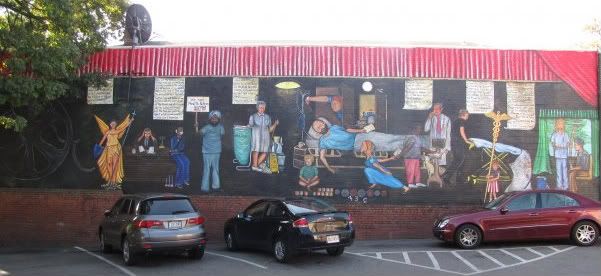
Abby had started following Regina on twitter the day she saw my jacket.  She's been wanting to be part of the movement ever since she heard Regina's story. The story behind 73 cents is that powerful.  My family and I made a point to stop by the mural the last time we were in DC together.

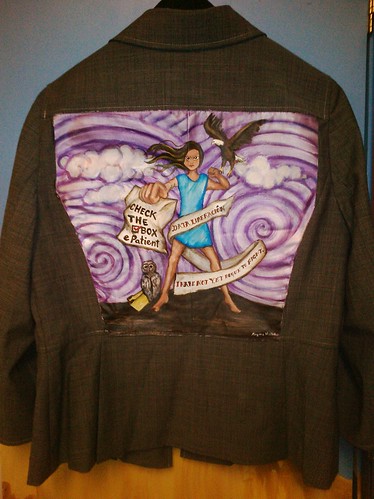
When I told Abigail she was going, she was thrilled.  She began designing her jacket a couple of months ago.  And now she's showing off her latest piece of fashion at the moment, which is hot off the racks from the most fashionable patient designer in Washington DC, to some of the biggest names in the movement in the US.

We had a minor edit to the design last week though.  A few days ago, an e-mail about one of her parting comments gained quite a bit of attention over at e-patients.net.  So much so that Abigail and Regina decided that it needed to be added to her jacket design for Epic Win! which you see to the left here.

Abby tells us a bit about her jacket:  "There is this imposing figure, saying "I'm going to fight for this.  It's important."  The Eagle represents America, we fight for what is right.  The owl is about wisdom and understanding.  He's got a box of medical records next to him that he's getting ready to read.  The swirls just keep going.  This is not a battle that is going to end.  We're not going to give up until we've got it right, until we've got what we want.

Check the box was just something I said at the time without thinking about it.  I didn't really know what it could mean.  But it was a really cool idea.  What if you really could do this, to say "I want to be engaged, help me do this!"  Check the box is about patients wanting to help, to take care of themselves.  Choosing to be engaged."

Abigail is here to learn.  She spent an hour on the phone yesterday with Dave and I talking about Patient Engagement, and Healthcare Standards.  We brought Dave's world and my world together on the speakerphone, while my daughter listened on, fascinated and confused.

But how did we get here?

A few weeks ago I got an e-mail that started off something like this...

On behalf of the White House, the Office of the National Coordinator for Health IT within the Department of Health and Human Services, and the Department of Veterans Affairs, I invite you to participate in an expert roundtable that will propel patient access to health data forward by identifying and prioritizing areas where technical standards and best practices are needed. ...

It was signed by Todd Park and Farzad Mostashari.

I was thrilled... then disappointed when I recalled that I had no travel budget for this trip, and it was probably too late to get an exception.  But then I realized that I would already be in DC that day with my daughter.  I explained the situation to Farzad via a Twitter DM, and asked if she could come to.  She was offered a seat as an observer, which I'm been given to understand are very hard to come by.  So Abby is "crashing the party".

How did I get here?  I'm not exactly sure, but it might have something to do with a discussion I had with Lygeia at HIMSS on educating children, or it might have been some work on Query Health, or it might have been ... who knows?

It's nice for me to not have to crash the party.  But just in case, I think I'll print out a copy of my invitation...

     Keith

P.S.  Do you want to hear something really funny?  Abby knows what the National Coordinator does, but when I had to explain "Chief Technology Officer", she didn't quite get it.  But when I told her who his boss was, she thought that was pretty cool.

Friday, May 25, 2012

Check the Box for ePatient

My children are at it again, this time my eldest daughter who is 14.  The last time we were at the pediatrician's office, she told them to "Check the Box for ePatient" when we stopped by to request her records.  It's a pretty simple request, but I'm sure they didn't really get it.  But I think they could.

I thought a little bit more deeply about this last night.  As a marketing campaign to patients, this has viral potential.  "Check the Box for ePatient" is about as easy as "Click the [Blue] Button", and it's a way to easily communicate to your provider that you want to be engaged.

Now, having checked the box, what will the provider do differently?  Actually, there shouldn't be anything different in the way they treat you as they would any other patient, but play the game with me.  What do you as a patient expect out of a provider having told them you want to be engaged?  And what is different about you from their other patients?  What should they be able to expect from you?


Friday, November 25, 2011

Will Healthcare ever grow up?

My daughters are both growing up.  Yesterday morning, my eldest attended a high school football game as a guest member of the marching band.  They asked the Middle school flag teams to march with the band for Thanksgiving day. As she grows up, she is learning more and more about how to care for herself (and others).  Afterwards, she was cooking a dish for the thanksgiving meal we are about to share with friends.

She knows that she needs to see a doctor regularly, she knows how to ask for her records, and how to read them to some degree.  Here time horizon is also expanding.  We played Monopoly last night, and as she kept running short on funds, she kept thinking about the kinds of financial decisions she'd be making on her own in college ... hmm, pizza now, or groceries for the week?  In short, she's beginning to learn what she needs to support herself as an adult.

Over the last hundred years, healthcare has advanced from something that only the rich could really afford, to something that was considered to be an essential component of every person's basic needs.  Over that same time, the costs of healthcare have grown, seemingly without bound, and it is now regressing back to something that only the rich and/or well-employed (and healthy) can really afford.

I find myself wondering what kind of healthcare system my daughters will have to teach their children about.  Will it be something that they, as digital natives, find familiar and reassuring and part of their usual lives, or will it be even more frustrating, expensive and cumbersome than it is today?  I'm hoping for the former, but it is so hard to predict where we will be in twenty years.

Our political leaders often cannot seem to think beyond the next election, our financial sector cannot even seem to think beyond the next quarter or maybe as far as the next year, and our healthcare system within the 18-month average horizon that an insurer needs to care about a patient, or the deadline for the next regulatory hurdle affecting payment?

These are the time frames in which children think, next month, next Christmas, next birthday, next school year, when I get to the next school, et cetera.  As a parent, I had to start thinking about college for my kids when they were born.  That is the kind of time frame that adults have to think in.  What will healthcare leaders be thinking like when my daughter is an adult?  Like her, or like her children?

I'll keep pushing because our healthcare system needs adults right now to keep pushing.  And if we keep it up, eventually it might just grow up, just like children do.  I'm optimistic, but still not certain.

Friday, September 2, 2011

Start with the Children #2

What would a curriculum to teach children about our healthcare system look like?  I'm thinking the audience is an 11th or 12th grade health class.  I figure that we get about 8-12 classes in a typical term, depending on the school system, each about 45-55 minutes long.  One of the challenges mentioned on today's #HITsm chat was the fact that engaged patients are still "the elite".  My thesis is that we don't teach the right skills to people.  Building upon my first Start with the Children post, I'm wondering if there is something that can be done about that.

Your rights (1-2 classes):
  • Rights to obtain medical records from your healthcare provider and to keep your health information correct, private and secure.  
  • Class assignment, write a letter to your healthcare provider requesting a copy of your records.  
  • Determine if your healthcare provider is aware of and participating in meaningful use.
  • Your rights to obtain emergency treatment.
  • Your rights to protest decisions about necessary treatment with your insurance company.
  • Your right to a second opinion.
  • Your rights to obtain health insurance.
Visiting your Doctor (3 classes):
  • What are the different types of medical professionals and what do they do?
  • What are vital signs and what do they say about your health?
  • How to report signs and symptoms effectively.
  • Asking questions
    • How will this treatment affect me?
    • What other treatment options are there?
    • How will the results of this test affect my care?
    • What is our plan?
  • What to do if you don't agree with your doctor.
  • How to read your medical records. 
  • Picking a doctor or hospital
Dealing with your insurer (2 classes):
  • Picking an insurance plan
    • What kinds of plans are there, and how do they differ?
  • Determining what treatments are covered and what are not
  • How to communicate with your insurer.
  • Pricing treatments and tests
  • Handling Disputes
Dealing with your pharmacist (1 class):

  • Not sure what to include here.

Dealing with an employer (1 class):
  • What to tell an employer about your health, what they can ask and cannot. (maybe covered in your rights)
  • How you employer might be able to help you with healthcare issues.
  • Healthcare related benefits and their value
If someone wants to help me develop a curriculum for my hometown, I'd be happy to approach the school superintendent with it. I think it could also be used for adults with a few modifications.  Any takers?

Tuesday, July 19, 2011

If you want to change a culture, start with its children

My kids are brilliant. If you don't believe me, just ask my wife.

-- Anonymous
Well, they are. Let me give you an example. Weekend before last, my youngest daughter (9) woke up on Saturday morning with an earache. I heard her crying in the living room and went to see what the problem was. She told me it felt like someone put a bowling ball in her ear. She had been swimming the day before and couldn't get all the water out, so I was pretty sure she had an ear infection. I called the pediatrician, but they don't open until 9:00 am on Saturday, so I called my practice's urgent care center, and they opened at 8:00am. Since it was about a 40 minute drive, I gave her some ibuprofin to help with the pain, and off we went.

To make the ride easier for her, I engaged her in conversation. She wanted to know what was going to happen at the office, and I explained how it worked. You didn't need to make an appointment, you just showed up. They would take her history, and the doctor would take her vital signs, record them in the EMR (she knows what that is because it is what daddy does), and then look at her ear, and probably prescribe some antibiotic and maybe some ear-drops to help with the pain. Then I told her that since her doctor is a "Meaningful User" of HIT, she could get a print-out of her record. Next I explained that everyone has a right to get a copy of there medical records, and that by law, in most cases, the doctor or the hospital has to give them to her (or in her case, her parents). And then I explained that since her doctor was already in Meaningful Use, she would not have to wait a long time to get them.

"We can ask them for the record, do you want it?" I asked her. "Yes, I want it." She told me. "When we're done, you can look at it. And if there is anything wrong with it, you can tell them to fix it. They have to respond to you, and tell you at least if they are going to or not." I told her. "It's the law. There is this thing called HIPAA (not HIPPOs), that makes sure you can do that." "OK." She said.

By the time the visit started, her ear only felt like it had a baseball in it (or so she reported). And during the visit, I asked the doctor if he could print out her record for her. He said he would as soon as he finished writing it up. He then dug out his iPhone and started calculating her dose. I asked him what app he was using for that. He told me, and I laughed, and said, I have that same app on my iPad. "Are you a practioner?" He asked. No, just a healthcare IT geek with an iPad I said. He computed her dose, order the antibiotics, and we talked about whether he should prescribe ear-drops for pain management. "Given that she woke up crying," I said, "let's go ahead and do that."

So he placed that order too. He then handed me a printed set of patient instructions regarding her treatment that described her problem and how it was being treated, and what we should do if it didn't work. He came back a few moments later with the completed visit report and hand it to her (not me -- which was the whole point for me). We left to go to the pharmacy to pick up her meds.

On the way there, she read through her record. She asked me questions about what stuff meant. When we got to the vital signs section, she said: "Daddy, it says here that they took the Oxygen off my right hand, but they used my left." So, I told her that she was good to spot that and that she needed to write them a letter to tell them about the mistake. I figured that this was a great way to drive home the lesson.

When we got to the pharmacy, we had to go through the "Insurance Card" rigamarole because I gave her nickname rather than her legal name to the doctor, and they didn't have her on file (or so they thought). We fixed that. Then the pharmacist told me that the insurance was going to cover the anitbiotics, but not the ear-drops. "OK, thats fine," curious, but not interested in battling with the pharmacist. He then went to fetch an "Ear-wax removal kit". I looked at it and said, "No, that's wrong." I asked my daughter to run out to the car to get her records. She ran out and back, and we showed the pharmacist what the doctor's records had said. Then he showed me the e-prescription that they recieved. There was a mismatch. The drug listed in her chart was "Ear Drops (some chemical name with percentage in solution)", but what was on the printed version of what had been recieved via the ePrescription message just ended before the parenthetical clarification, just: Ear Drops.

So my daughter learned that having her records helped with stuff like that, too.

Then I called the office, to tell them about the mixup, but they apparently don't have a procedure to deal with that kind of error report. I know who to talk to there, so I'll fix that later.

Last Sunday, while I was reading, I heard my daughter working out the letter with her mother that she is going to send to the place that saw her. I'm going to write one too and send it with her letter. We'll address it to the HIPAA compliance officer, so that I know it will get the appropriate attention.

My daughter won't forget this lesson, and she's learned something exceedingly valuable that will help her when she is responsible for her own healthcare, something that not many people are really aware of. Last Saturday, I got to spend an hour with @Lygeia and several other patient advocates at Health Foo. We talked about how to get patient engagement. I recalled parts of this story to the group, and pointed out that by the time a person leaves high school, they are able to balance a check-book and write a resume, but they are not at all trained to deal with doctors, choose an insurance policy, or manage their own interactions with the healthcare system. These are necessary life skills that we need to teach our children. Because if you want a society to change, you need to start with its children. So, you might think that its funny that ONC is going to use cartoons to teach Health IT, but I really don't. I think its brilliant, just like my daughter.

-- Keith

Update: Not to be outdone by her sister, my eldest went to the pediatrician's this morning. Diagnosed with Swimmer's ear and Otis Media. She's picking up an electronic copy of her records mid-week on disk! When asked why she wants them, "I wanna be an e-patient!" she said to them. I think we need to declare a week for e-pediatric patients.