Monday, August 23, 2010

FW: Reminder: PCC Call for Proposals Now Open and Invitation to PCC Planning Meeting October 19-20, 2010

Dear PCC Colleagues,
Reminder: The IHE annual planning cycle opened August, 2010 and continues through October 2010.   This e-mail describes the planning cycle process, including the face-to-face meeting in October and the PCC Planning Webinars that lead up to that meeting.
IHE PCC Call for Proposals: Interested parties are invited to submit proposals for new Profiles for the Patient Care Coordination (PCC) Domain to be considered for development in the 2011-2012 cycle of the IHE PCC Domain. Additionally, all IHE members are invited to forward this announcement to their committee mailing lists and other interested persons.
The deadline for submission of a proposal for new Profiles is September 17th, 2010 at 11:59 pm CST.  
Proposals must follow the structure and format of the Brief Proposal Template attached, specifically addressing the following:

  1. What is the problem you propose to solve by this proposal, and how is that problem expressed in practice? (eg. a use case)
  2. How would fixing this problem improve health care in practice?
  3. What specific components of standards could be used to solve this problem?
  4. Include some indication of the business case surrounding the situation if possible. For example, is there an economic motivation for addressing this problem immediately?
  5.  Identify one or more potential editor(s) in the event that the proposal is selected for further evaluation and possible development. 


Please use the attached Brief Profile Template to submit your proposal. Email Completed Proposal documents to both PCC Planning Co-Chairs and HIMSS secretariat: 
§  Michael J. McCoy, MD: MMcCoy@che.org

§  Keith Boone:                      keith.boone@ge.com
§  HIMSS Secretariat:          IHE@himss.org


Invitation to attend IHE PCC Planning Committee meeting: Tuesday & Wednesday, October 19-20, 2010


Please save these dates on your calendar by opening the October ICS calendar invite that is attached to this email.

Dates: October 19 – 20, 2010

Location: Radiological Society of North America

820 Jorie Boulevard , Oak Brook, IL  60523 Phone: (630) 571-2670


The PCC Planning Committee will hold its 2010 planning meeting on October 19-20, 2010 at the RSNA headquarters in Oakbrook, IL.  A preliminary agenda of our activities will be sent out after the September 17th deadline, however, history has indicated that our time during the days is flexible and depends on the nature and number of profile proposals. The PCC Planning Committee will vote on the final selection of short-listed proposals at this meeting to move forward for submission to the PCC Technical Committee.


We urge those who propose profiles to attend the Planning Committee meeting either in person or by phone. In-person advocacy has proven to be especially effective in getting profile proposals understood and accepted.  We have a relatively short window for turn-around of the detailed proposals for the items selected for this year's cycle so acceptance of proposals depends heavily on the Planning Committee's consensus about the market needs, relative priorities, and level-of-difficulty of all profile proposals at this face-to-face meeting.
IHE membership is required to attend or participate in the PCC Planning face-to-face meeting, and to submit votes on October 19-20, 2010. If you are unsure your organization is an IHE member, please check the membership list. If you would like to apply for membership, please visit this webpage. 

In order to participate in meetings, you must first be a delegate of an approved IHE member organization.  Membership is granted only to “organizations,” and each member organization names delegates to participate in various domain committees.  Please check the membership list to ensure your organization is a bona fide member of IHE. If not, then you can apply for membership (it’s free) using this webpage.
PCC October face-to-face Planning Meeting participation: Any member is entitled to send a delegate to attend a meeting. However in order to vote, the member (organization) must have earned (and maintained) voting privileges prior to the designated meeting.  The rules around voting privileges are articulated on the IHE website.

PCC Planning Webinars (Prior to the face-to-face): PCC will schedule four Planning Webinars prior to the October meeting to allow authors to present their proposals to the PCC Planning Committee in advance of the face-to-face. This procedure also allows all Planning Committee members to re-estabilish their voting rights. We have established specific procedures for the Planning Webinars, so please make sure you understand and follow the instructions below to ensure you will have the right to vote at the meeting. 
1.       PCC Planning Webinars have been tentatively set for the dates listed below. The exact dates and times will be sent out as soon as possible. We will populate the schedule of presentations immediately following the September 17th submission deadline.

§  The PCC Planning Webinars will run during the following weeks:

·         September 27 – October 1, 2010

·         October 4 – October 8, 2010

·         Webinars will be two hours long with 6- 15 minute profile presentations


2.       These webinars will be considered decision meetings.  We will attempt to reach consensus (rather than hold a formal vote) at each webinar as to the validity of each individual proposal, including whether it makes sense to request proposal authors to combine initiatives where overlaps exist.  No proposals will be rejected at this stage, only aligned with one another, and only where appropriate.
    1. In order to ensure voting privileges at the face-to-face meeting, we will require each member (organization) to attend a minimum of 2 (out of the 4) webinars that precede the meeting.  We will be taking careful attendance at each webinar to ensure proper execution of this process.  Please ensure you clearly understand this requirement.

    1. Committee rosters can be viewed on the IHE FTP site at: PCC Rosters

PCC Planning Webinar Procedures:  Each webinar will be organized as follows (this will vary slightly depending upon how many proposals we will be reviewing):
1.       The two hour time allocation will be divided into six, 15 minute time-slots, with 30 minutes for introductory remarks and follow-up discussion.
2.       Each 15 minute timeslot will be allocated to a profile proposal… the first 10 minutes will be taken up by a presentation by the proposal author, with the remaining 5 minutes reserved for discussion and any disposition (if required).  In order to maintain equity across all presenters, we will constrain each presenter to this requirement!
3.       Each 10 minute presentation will be constrained to a maximum of five (5) PowerPoint slides, presenting your proposal concisely and completely.  We have taken the liberty of supplying a presentation template that you may choose to use, and this can be found in the following folder on the IHE ftp site at: ftp://ftp.ihe.net/Document_templates/Planning%20Documents_2009/
4.       A sample webinar agenda is shown below (note that we will assign presenters/topics to each timeslot after the September 17th submission deadline):
Sample - IHE PCC Planning Committee Webinar #1 (of 4)

October 4, 2010 • from 1 pm- 3pm Central Time


Call-in toll-free number (US/Canada): 866-469-3239
Access code:922 746 120
Item
Description
Time

(min)
1
Introduction
10
2
Presentation #1 (topic, presenter)
Discussion
10
5
7
Presentation #6 (topic, presenter)
Discussion
10
5
8
Wrap-up discussion, disposition
20

5.       The final webinar will be reserved for presentation/discussion on any proposals that have been combined or otherwise re-worked as a result of discussion during the first three sessions.  We will ensure that the agenda for this session is published with as much advance notice as possible.
6.       Each of the four webinars will be recorded with links published, so members can view (or review) the profile proposals prior to the October face-to-face meeting. We will also publish an agenda, together with procedures, for our face-to-face meeting.

IHE PCC Planning Webinar Dates:

  • Webinar #1 & 2:  September 27 – October 1, 2010 – Dates and times TBD.
  • Webinar #3 & 4:  October 4 – October 8, 2010 – Dates and time TBD.


The agenda’s for these Webinars will be sent out after the September 17th, 2010 deadline.

If you have any additional questions please contact the PCC Planning Co-Chairs.

Thank you for your participation and support of IHE.

Sincerely,
Keith Boone and Michael McCoy
IHE PCC Planning Co-Chairs


My Summer Sojourn

My Summer Sojourn
It seems as if everyone else is writing about their summer vacations (See the posts from John Halamka [Geek Doctor] and John Moore [Chillmark Research]).  Since I'm now back in the office now after 8 weeks, I thought I'd write about my summer travels as well.  I spent most of that 8 weeks working from the back of an RV [with days off at significant stops], while the rest of my family toured the country.  This trip started over a conversation about sushi.  I told my wife that the next time we all were in Phoenix, there was a sushi restaurant I needed to take the family to.  Her reply was that we should drive there this summer.  So we did in a 35' RV.


My mother joined us for this trip; she being the owner-operator of the RV and the Jeep we towed behind it. She and my wife Meg did all the RV driving, since I was working from the back. I connected to the office and interwebs using a Verizon USB 760 Wireless modem. I found that to use it while driving it worked better with an attenna (~$40). I still think the software sucks but at least I could be connected. My cell phone can also be tethered and I have service from AT & T so there were very few places wher I couldn't be connected to the web via one or the other personal device. On one occasion though I had no coverage on either device, but local wireless was available and we weren't moving, so it didn't put to much of a crimp in my work (Skype was very helpful).
The trip included stops at:
  • Niagra Falls, ON;
  • Toronto, ON;
  • Indianapolis, IN;
  • Wisconsin Dells, WI;
  • Wall, SD;
  • Mt. Rushmore, SD;
  • Custer State Park, SD;
  • Crazy Horse Monument, SD;
  • Cody, WY;
  • Yellowstone National Park, WY;
  • Mt. Ranier, WA;
  • Mt. St. Helens, WA,
  • Portland, OR;
  • Ilwaco, WA;
  • Columbia River and the  Pacific Ocean, WA;
  • Salt Lake City; UT;
  • Red Canyon, UT;
  • Bryce Canyon; UT;
  • Grand Canyon, AZ;
  • Phoenix, AZ;
  • The Petrified Forest and Painted Desert, AZ;
  • Broken Arrow, OK;
  • Casey, IL;
All told, we spent 8 weeks, visited 7 national parks [Mt. Rushmore, Mt. Ranier, Mt. St. Helens, Yellowstone, Bryce Canyon, Grand Canyon, Petrified Forest], ate sushi in 6 states, took pictures with 5 cameras, visited family in 4 states, had 3 breakdowns, visited 2 museums, and had 1 amazing helicopter ride over the Grand Canyon.

We drove over 10,000 miles and took an average of one picture about every 3.5 miles.

We all want to do this again, but my girls (ages 12 and 8) said emphatically... NOT NEXT YEAR! I have to agree, I need a vacation from their vacation.
   Meg, Keith, Abigail and Gretta in Bryce Canyon

P.S.  We visited 21 States and Canada on this trek.


Friday, August 20, 2010

VMR FAQs

Today I gave a presentation on VMR to the EHRA and fell completely flat on my face. Either I totally didn’t understand my audience, or as my colleague described to me, just simply started off in the wrong direction. It didn’t help that I had a technology failure with my modeling tool (I’ll blame it on Friday the 13th) and had a complete mess of a model (autoformatting and routing should be banned) an hour before the presentation.

As a result, I put together this simple FAQ to maybe undo the damage, and provide a simple example. I’m going to elaborate on this over the coming weeks.
What is a VMR?

The Virtual Medical Record is an object model according to definition 2 provided on Wikipedia:
A collection of objects or classes through which a program can examine and manipulate some specific parts of its world. In other words, the object-oriented interface to some service or system. Such an interface is said to be the object model of the represented service or system. For example, the Document Object Model (DOM) [1] is a collection of objects that represent a page in a web browser, used by script programs to examine and dynamically change the page. There is a Microsoft Excel object model [2] for controlling Microsoft Excel from another program, and the ASCOM Telescope Driver [3] is an object model for controlling an astronomical telescope.
The reference to the W3C Document Object Model is especially relevant, because it is an object model that many software developers are familiar with, and upon which the current draft work in HL7 is built upon.

The VMR is not a “wire format” for communicating patient healthcare information between disparate systems. It is also not a set of classes or interfaces implemented in any specific programming language. It is instead a computational independent representation of how one can interact with a health information system to access medical information about a single patient. That representation describes how the classes and interfaces behave, and what information and services they provide. The representation of the object model is in UML.

How do I use the VMR?
In order to use the VMR, you need an implementation of it in a platform specific environment. That implementation provides the various classes and interfaces described in the object model, and may provide other capabilities also. The mechanism by which the object model is implemented is not specified by the VMR. What the VMR does specify is how the implementation must behave when information is requested, or services are accessed.
What data sources does the VMR use?
It is up to the specific VMR implementation. As I previously stated, these could be data sources like a healthcare providers electronic medical record, a patients personal health record, or any number of other sources of healthcare information for the person. This information could be stored in CCD or CDA format, could be send to the VMR as HL7 Version 2 messages, DICOM Information Objects, or X12N transactions.
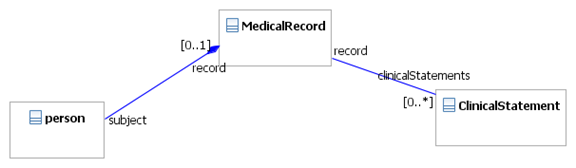
What does the VMR look like?
The VMR looks like a UML model with documentation on the various classes and interfaces, and on their methods and properties.

Figure 1 Core of the VMR
At the very core of the VMR is a class called the Medical Record. The medical record is an collection of clinical statements associated with one person. These clinical statements may come from an EMR, a PHR, a Clinical Data Repository, a specialized HIT application, an immunization registry, et cetera, or it may be a composition of information available from a number of disparate systems.
The collection of clinical statements stored in the VMR can be accessed through VMR methods that filter the list of clinical statements. These methods allow more direct access to conditions, allergies, medications, immunizations, vital signs, lab results, orders, et cetera.

Why person and not patient?
A person acts in a role of patient with a number of different healthcare provider organizations. The VMR is not limited to data from only one healthcare provider. Furthermore, it could also include information that the person entered into their own PHR, and they could have no relationship with any specific healthcare provider.

How would I use the VMR?
The first presumption is that someone has defined a set of rules (called a platform binding) which describe how the classes, interfaces, methods and properties described in the VMR Object Model are translated into the various platform (or programming language) dependent features. The next is that someone has actually implemented the VMR for that platform.
Let’s take an example that many of you are familiar with, an EMR system. To implement a VMR using that EMR system, you would:
  1. Select a programming language, e.g., JavaScript (or more accurately, ECMAScript, but I don’t want to confuse everyone).
  2. Create a set of programmable objects following the rules of the binding for JavaScript.
    1. Create a set of objects that allow a user “read-only” access to information stored in your EMR system.
    2. Create a set of objects that allow a user to create new clinical statements that may or may not be stored in your EMR system (that’s an implementation decision, not one that VMR specifies).
  3. Provide some way for an end user to write JavaScript code which uses those exposed objects. 
So, in a VMR, we could look at four classes (defined abstractly below):

Class Person {
  PN Name; // HL7 V3 Person Name
  TS birthDate; // HL7 V3 Time Stamp
  CD gender; // HL7 V3 Concept Descriptor (Code)
  MedicalRecord  record;
};

Class MedicalRecord {
  Person owner;
  List statements;
  void add(ClinicalStatement);
  VMRImplementation implementation;
};

Class Concept {
   BL matches(ClinicalStatement s);
};

Class ClinicalStatement {
  II id;
  CD code;
  TS effectiveTime;  // A simplification for the example, could be IVL_TS 
  MedicalRecord source;
  Person subject;
};

Class VMRImplementation {
  ClinicalStatement createAct(CD actCode); // Also a simplification
}

And then implement a clinical decision support rule about determination of eligibility for a mammogram as follows:

var age = now() – record.owner.dateOfBirth;
if (record.patient.gender.code == “F” &&  age > AGE40YEARS && age < AGE70YEARS)
  record.add(record.implementation .createAct(MAMOGRAMELIGIBLE));

This is a rather simplified example of a rule I’m presently working on to describe this concept. A more elaborate version of the rule checks to see if they’ve have a complete bilateral mastectomy or two complete unilateral mastectomies first, before determining that the patient is eligible, in order to determine whether they still need to worry about mammography. A patient without breasts would not usually need a mammogram (but might need other testing). This example completely ignores the underspecified concept of concept, which I talk about in a separate blog posting.

Top O' the Week

OK, so I didn't get around to messing with the code to deal with top of the year or all time yet.  There have been a few other things on my mind...

The top post of this week is, yes, you guessed it, the Meaningful Use Standards Summary.  It's lovely that post is still getting a lot of readers, but eventually that well has to dry up.  It didn't help that I took Monday off this week (long story).

The top of the month is a slightly different story.  While the Meaningful Use Standards Summary still leads the pack with nearly 1000 page views, the next two posts are neadly tied for second place at around 350 views each: 
While they say no news is good news, I'm pleased about the standing of the Motorcycle Guy Ad Hoc Harley Awards in my stats.  Those posts ALWAYS get good readership.

And my favorite hash tag this week is #newNHINNames

   Keith

Thursday, August 19, 2010

Mission Creep

I was on a call this morning discussing the evaluation and selection of material that could be used in a new standard.  I did something uncommonly done, which was reject the idea on the basis that the SDO was not the right SDO to develop the work.  This is a common problem with healthcare standards development organizations.  Many of us (members of the SDO) obviously have the general IT skills necessary to create standards which can be used in IT (and have already done so in SDOs if the morning meme is any indication).

However, the question that needed to be raised was whether it was appropriate for THIS SDO to do so.  My main concern is that any such standard needs to be something generally available in off-the-shelf general IT software, not just in "healthcare IT" specific applications.  While THIS SDO could develop something, it wouldn't actually meet the needs of the organization if it did so.  At that point that THIS SDO developed it, it would become a standard in the wrong home.  That would NOT result in the deployment of the standard in off-the-shelf software, which is part of what the SDO really needs.

This isn't the first time this has occured.  I've seen it happen before in IHE, HL7, and ASTM E31.  It's a case of not just scope creep, but mission creep.

Standards Meme

This meme is for you standards geeks out there...
  1. What was your first encounter with a standard where you were aware that it was a standard?
  2. What was the first standard you liked?
  3. What was the first standard you hated?
  4. Your favorite standards organization?
  5. The first publication you commented/voted upon?
  6. The first standard/implementation guide you participated in developing?
  7. The most influential/important standard you participated in developing?
Here are my answers:
  1. ANSI C
  2. ANSI C
  3. FORTRAN 77
  4. W3C followed closely by HL7
  5. W3C DOM Level 2 (in HL7 in was CDA Release 2)
  6. Again, DOM Level 2 (and in HL7 it was Care Record Summary)
  7. Influential -- DOM Level 2, but important, CDA Release 2
I'd love to see yours in comments...

   Keith

Tuesday, August 17, 2010

Antonyms and Meaningful Use

Andrew asks: "What is the difference in the content to be included in the 'clinical summary' for each visit, in contrast to the 'Electronic Copy of Health Information'?  And goes on to suggest that: "Both of these items require either the CCR or HITSP/C32. Some of us agree they are to contain the same data as it is a summary of that point in time and the phrase 'for each visit' is not relevant."

There are two places to look for details on this information:
  1. 45 CFR Part 170 Meaningful Use Standards Final Rule
  2. 42 CFR Parts 412, 413, 422, and 495 Meaningful Use Incentives Final Rule  
The Standards Final Rule will tell you what a Certified EHR Product must do.  The Incentives Final Rule wil;l tell you what an EP or Hospital must do when exchanging information.

To keep your customers happy, an EHR product needs to be able to support what is required for certification, as well as what is required for a provider to obtain incentive payments.

Page 158 of the Incentives Final Rule describes what is meant by "Electronic Copy of Health Information".  The following is taken from the PDF of the display text for that rule [emphasis mine].
Comment: Commenters requested clarification of the term “health information” or alternatively a list of elements required to satisfy the objective.


Response: Subject to the withholding described above, an EP, eligible hospital, or CAH should provide a patient with all of the health information they have available electronically. At a minimum, this would include the elements listed in the ONC final rule at 45 CFR 170.304(f) for EPs and 45 CFR 170.306 (d) for eligible hospitals and CAHs as required for EHR technology to become certified.
Just for reference I'll include the referenced sections from 45 CFR 170.304(f) and 170.306(d) from the Standards final Rule below [emphasis mine]:

§170.304(f) Electronic copy of health information. Enable a user to create an electronic copy of a patient’s clinical information, including, at a minimum, diagnostic test results, problem list, medication list, and medication allergy list in:


(1) Human readable format; and
(2) On electronic media or through some other electronic means in accordance with:
(i) The standard (and applicable implementation specifications) specified in §170.205(a)(1) or §170.205(a)(2); and (ii) For the following data elements the applicable standard must be used: (A) Problems. The standard specified in §170.207(a)(1) or, at a minimum, the version of the standard specified in §170.207(a)(2); (B) Laboratory test results. At a minimum, the version of the standard specified in §170.207(c); and (C) Medications. The standard specified in §170.207(d).
§170.306(d)

(1) Enable a user to create an electronic copy of a patient’s clinical information, including, at a minimum, diagnostic test results, problem list, medication list, medication allergy list, and procedures:
(i) In human readable format; and

(ii) On electronic media or through some other electronic means in accordance with:

(A) The standard (and applicable implementation specifications) specified in §170.205(a)(1) or §170.205(a)(2); and
(B) For the following data elements the applicable standard must be used: (1) Problems. The standard specified in §170.207(a)(1) or, at a minimum, the version of the standard specified in §170.207(a)(2); (2) Procedures. The standard specified in §170.207(b)(1) or §170.207(b)(2); (3) Laboratory test results. At a minimum, the version of the standard specified in §170.207(c); and (4) Medications. The standard specified in §170.207(d).


(2) Enable a user to create an electronic copy of a patient’s discharge summary in human readable format and on electronic media or through some other electronic means.
And just in case you were wondering, §170.205(a)(1) references CCD and HITSP C32 and §170.205(a)(2) references CCR.  §170.207 contains the vocabulary standards and is not relevant to THIS discussion.

Looking closely at the objectives being referenced for Eligible Providers [emphasis mine]:
[pp 769] (d) Stage 1 core criteria for EPs. An EP must satisfy the following objectives and associated measures, except those objectives and associated measures for which an EP qualifies for an exclusion under paragraph (a)(2) of this section specified in this paragraph :

           ...
[pp 772] (12)(i) Objective. Provide patients with an electronic copy of their health information (including diagnostics test results, problem list, medication lists, medication allergies) upon request.
(ii) Measure. Subject to paragraph (c) of this section, more than 50 percent of all patients who request an electronic copy of their health information are provided it within 3 business days.
(iii) Exclusion in accordance with paragraph (a)(2) of this section. Any EP that has no requests from patients or their agents for an electronic copy of patient health information during the EHR reporting period.
And for Eligible Hospitals or CAHs [emphasis mine]:
[pp 777] (f) Stage 1 core criteria for eligible hospitals or CAHs. An eligible hospital or CAH must meet the following objectives and associated measures except those objectives and associated measures for which an eligible hospital or CAH qualifies for a paragraph (b)(2) of this section exclusion specified in this paragraph:
      ...
[pp 780] (11)(i) Objective. Provide patients with an electronic copy of their health information (including diagnostic test results, problem list, medication lists, medication allergies, discharge summary, procedures), upon request.
(ii) Measure. Subject to paragraph (c) of this section, more than 50 percent of all patients of the inpatient or emergency departments of the eligible hospital or CAH (POS 21 or 23) who request an electronic copy of their health information are provided it within 3 business days.
(iii) Exclusion in accordance with paragraph (b)(2) of this section. Any eligible hospital or CAH that has no requests from patients or their agents for an electronic copy of patient health information during the EHR reporting period.
Problem, medication and allergy lists can certainly be provided in the HITSP C32 (or the CCR), as can summary information on test results and procedures.  Discharge summaries are another story, which long-time readers of this blog already understand.  ONC did finally get the memo (I was one of the "few commenters"), because the Standards Final Rule has this commentary starting on page 167:
Comments. A few commenters noted that neither the CCD nor CCR contain an applicable section for discharge summary. One commenter recommended that because the provision of an electronic copy of discharge instructions was required by another certification criterion, that discharge instructions should be removed as an element in this electronic copy.


Response. We reviewed commenters’ concerns and agree that there is no applicable section for a discharge summary. Therefore, we have revised this certification criterion to reflect that while the other data elements can be conveyed using the patient summary record standards (CCR or CCD), we are not requiring the use of any standards for the discharge summary section. In order to support the meaningful use objective and measure, however, we note that we do expect Certified EHR Technology to be capable of providing a electronic copy of a discharge summary like a patient summary record, in human readable format and on electronic media or through some other electronic means.


Other electronic means could include, for example, the discharge summary represented as a CCD plus the "Hospital Course" CDA section or provided as a PDF. We have revised the certification criterion accordingly.
So, how does this help answer Andrew's question?

To be certified for an inpatient setting, you need to be able to support the rule under §170.306(d)(2) as well §170.306(d)(1), which means that you need to be able to support exchange of Discharge Summaries.  You probably know my views on that, but if you don't read If I had a Hammer and the Redux which report them.

That means that the difference between a "Clinical Summary" and "Health Information" includes at least the Discharge Summary for EHRs in an inpatient setting.  For ambulatory settings, the difference is still vague.  It seems as if you could use the Clinincal Summary to support the requirements for certification for both Clinical Summaries and Health Information.  BUT:  From my perspective, I'd also expect to get the rest of the ORIGINAL test reports in human readable form, which would include Imaging or other study reports, and lab test results.

Why?  Because summaries are just that, and for my PERSONAL health records, I want not just summaries, but also DETAILS.  I suspect that other patients will feel the same way, and that Eligible Providers will want to provide their patients with details.  The details of an ECG report, lab report, or other test result or procedure just don't belong in a summary document.  

From my viewpoint, the antonym of summary is detail, and visa versa.

So, if you want to get away with the minimum for meaningful use for ambulatory care, you can probably just send the summary.  But to be really meaningful to your customers and their patients, you'll have to do better than that.

    Keith

DISCLAIMER: I am neither a lawyer, nor a representative of CMS or ONC.  These are my personal opinions about the wording in these regulations.  I would advise you to obtain your own expert legal advice before acting on the information reported above.  You assume any of the risks in using these opinions for decision making.