Showing posts with label SMART. Show all posts

Thursday, January 30, 2020

Fine-grained access control with SMART on FHIR

One of the few things that people are aware of is that SMART on FHIR enables, but does not explicitly specify how to support access controls on patient data.  Folks who are familiar with the OAuth 2.0 specifications will readily understand that the principle mechanism by which access is requested and controlled is through scopes.  A scope is a named thing that describes something that the application desires access to.  Within the OAuth 2.0 flow, the client app requests one or more scopes, and the authorization flow grants access to a possibly limited subset of those scopes (or the full set of requested scopes).  You can see this in action in certain app workflows for Apps working with Twitter or Facebook where you are requested for a set of capabilities (e.g., e-mail address, contact lists, the ability to post on your behalf), and you can reject one or more of these, but the application still works (possibly with limited functionality).

SMART on FHIR specifies a flow in which the user authorizes the app (see Authorized App in the diagram below).
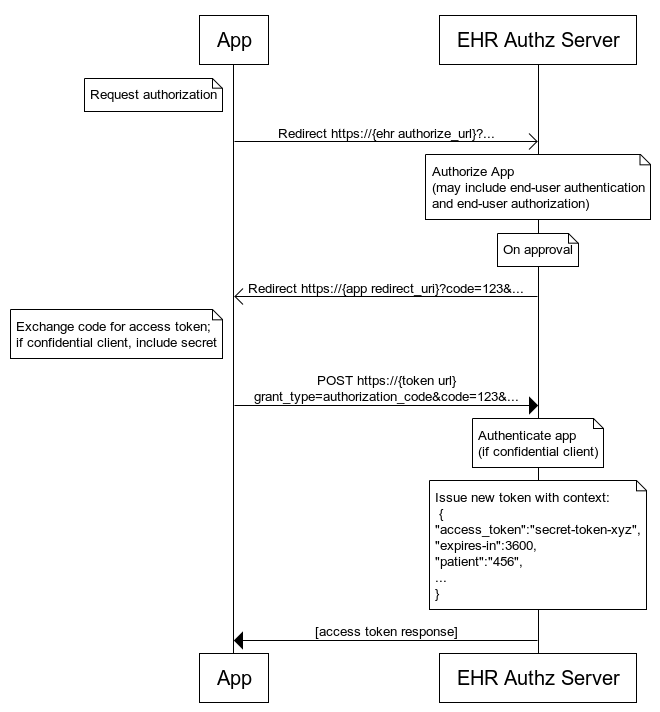


The expectation is that the application will first authenticate the user, and then request them to authorize certain accesses to resources they control.  Normally these requests are related to specific scopes.  In SMART on FHIR, there are a defined set of standard* SMART on FHIR scopes.  Common scopes might related to the proposed rule might be things like Patient/Observation.read (the ability to read any Observation), or Patient/Condition.read.  Other scopes it defines include things like Patient/Appointment.write (the ability to create or update an appointment).

But implementers of API services don't have have to limit themselves to just the SMART scopes.  They can offer the patient the ability to further restrict what data the application can access.  For example, consider the case where I might want to use an application that does some useful stuff with my blood pressure, height, weight, cholesterol, A1C and blood pressure data, but it also does stuff with other lab results that I don't want it to access?  Could I limit the access?  Well, I personally cannot, but the implementer of the API service CAN offer me the ability to restrict Observations to a set of common results (or even let me create a list of LOINC codes).

How would this work?  The EHR Authorization server would have to be smart (as well as SMART), and offer me opportunities to support not just restricting scopes, but to also gather additional information from me about other restrictions I want to place on the data.  It could then store that information in memory and associates it with the code it returns to the client application.  When the client application exchanges that code for an access token, these additional restrictions can be recorded in claims on the access token it returns.

Then, when the application makes a request, the API server can check to see that the request is consistent with the claims in the access token.  And when the APP makes a request that the patient wanted blocked, it can do one of several things:  The first is to act as if the data that the application requested simply isn't present, and otherwise act normally.  This is a good case because it won't intrude on application integration because there will always be cases where data it asks for isn't present, and so it will deal with it.  The second thing the API server could do is report an error, in which case the application itself might break (good ones won't break), or have reduced functionality because some query it thought it combine fails.

The beauty of this is that it allows the API server implementer to go beyond just SMART on FHIR scopes, still work according to the standard, and yet provide the patient with more control over what information is accessed on a PER application basis.  This App can have access to my weight, that one (which makes stupid remarks when it goes up or down) cannot.  Furthermore, there's nothing that says this access need remain.  If I'm a really clever implementer, I can simply associate the restrictions with a claim in the token that points somewhere to the patient preferences for what the app using that token can access, and the patient  can later change those preferences.

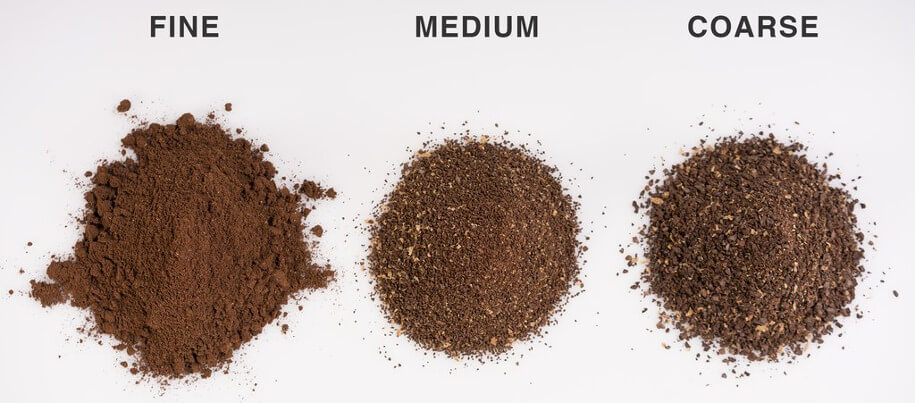
So there you have it, how to have fine-grained access control in SMART on FHIR.  And while everyone might think fine-grained is better, recent research seems to indicate otherwise (at least for espresso).


     Keith


* OK, Draft Standard, as SMART on FHIR is not yet quite a full-fledged standard, but you get the point.

Thursday, October 11, 2018

Challenges using SMART on FHIR for Multi-Vendor Authorization

Challenge by Nick Youngson CC BY-SA 3.0
One of the challenges for application developers in implementing SMART on FHIR is that of metadata endpoint discovery.  In order to initiate the SMART on FHIR authorization flow, the application developer needs to know the metadata or Conformance endpoint for the FHIR Server it is going to communicate with.  However, this endpoint is going to vary based on the vendor supplying the FHIR Server, the version of FHIR that is supported, and possibly even the healthcare organization deploying it.

The problem here is in the use of metadata as a way to discover the authorization endpoint, when in fact, the challenge for application vendors is configuring to support multiple endpoints with the same application.  If you use MyChart or other apps to access your health records (as I do), you can see how this plays out when you go to login as a patient.  The first step of your login process has you identify your state and healthcare practice (this shows up in other applications as well).  I'm certain that somewhere in that application and others like it, that selection process is doing something to resolve the practice specific endpoint details.

In a single vendor environment, it's pretty easy to address this, but when developing an application to support multiple environments, this can be quite challenging for the application developer.

NO, this isn't a claim that we need a global SMART on FHIR endpoint directory (although that is one way to resolve this issue).  It's more a statement that we've combined the process of conformance inspection with the problem of endpoint discovery.

Think about it: If your authorization endpoints are different, it is also likely that FHIR conformance associated with those endpoints could be different.  Why should they both use the same mechanism.

This creates a challenge for patients, because it means that App developers are likely unable to support as broad a variety of endpoints as they'd like simply due to the configuration challenges presented to them.

Smart SMART developers will obviously work around this.  One possibility is to modify the Launch sequence so that the application first asks the patient where their practice is located through some sort of internally managed directory, so that the application first selects the practice, and then the directory resolves the authorization endpoints AND the actual FHIR conformance endpoint the application can use to customize its operations based one what capabilities are available.

This would allow patient facing SMART applications to support multiple versions of FHIR from multiple provider organizations.

There are a lot of other challenges.  Like anyone else, you have to get your product into the vendor's App store, and there's a lot more vendors than one has to typically deal with for smart phone applications (two covers a lot of territory here, whereas you need 5 or 6 for EHRs to get the same coverage).  And of course, you also have to get your app into the smart phone stores too.  Those aren't problems I'm going to try to solve here.

   Keith

Thursday, April 19, 2018

Additional SMART on FHIR Authorizations


I sent something similar to this to the HL7 Security workgroup today:

This strikes me as an interesting use case for SMART or similar OAuth2 based authentication.

The use case is thus:

Through an API, a user wants to include certain kind of information into the record.  A given example might be an uncoded medication.  The provider organization wants to ensure that any uncoded medications have a SEPARATE provider authorization before entry, specific to the API call that attempted the request.  For example, in a system that I am familiar with, if using the EHR client, when an uncoded medication is attempted to be entered, the provider is requested to verify their intent (via a button click).  In another case, to “sign” a document, it requires them to re-enter their password information.

An authorization protocol that might work with a server and 3rd party applications wishing to adhere to these rules would be one in which:

API call which failed due to these sorts of rules would generate a user override authorization request token and pass it back to the caller in an extension to the OperationOutcome resource.  Such a token may also need to be communicated in an out-of-band manner to an authorization endpoint (but could also just be a signed JWT).  The code associated with the OperationOutcome might indicate that additional user authorization is required.

The application would call the authorization server with this token to request user authorization to complete the API request via a web-based UI that used redirection much in the same way that SMART on FHIR does today.  It might also include its current user's access token, although that seems unnecessary since the token supplied by the application would seem to be enough validation of the user.

The authorization server would interact with the user to request their authorization to complete the request.  On receipt of the user authorization (either by clicking yes, or reauthenticating, or whatever), it would provide an override token to the calling application.  Such token could then be passed in to a repeat of the API call.  The API call would find the same problem, but having been given the override token, would be able to accept the request.

Such a protocol might also include in the given override request token a signal with regard to the degree of user reauthentication/authorization necessary.  For example, many systems that have a physician “sign” a document, require the physician to reauthenticate to the application, whereas other override responses are simply a button click (e.g., uncoded medication).

An application that is aware of these special cases might also want to have a way to short circuit the API failure part of the request loop, and preemptively obtain provider authorization.


Your thoughts?  Is this a reasonable thing to consider?


   Keith

Wednesday, September 6, 2017

The Good, the bad and the ugly (HL7 Ballots)

Polling StationHL7 Balloting just closed this last hour.  Here's my recap of what I looked at, how I felt about it, and where I think the ballot will wind up from worst to best.  Note: My star ratings aren't just about the quality of the material, its a complex formula involving the quality of the material, the likelyhood of it being implemented, the potential value to end users and the phase of the moon on the first Monday in the third week of August in the year the material was balloted.

VMR (Virtual Medical Record) 
  1. HL7 Implementation Guide: Decision Support Service, Release 1 - US Realm (PI ID: 1018)
  2. HL7 Version 2 Implementation Guide: Implementing the Virtual Medical Record for Clinical Decision Support (vMR-CDS), Release 1 (PI ID: 184)
  3. HL7 Version 3 Standard: Decision Support Service (DSS), Release 2 (PI ID: 1015)
  4. HL7 Virtual Medical Record for Clinical Decision Support (vMR-CDS) Logical Model, Release 2 (PI ID: 1017)
  5. HL7 Virtual Medical Record for Clinical Decision Support (vMR-CDS) Templates, Release 1 - US Realm (PI ID: 1030)
  6. HL7 Virtual Medical Record for Clinical Decision Support (vMR-CDS) XML Specification, Release 1 - US Realm (PI ID: 1016)

This had a total of six artifacts on the ballot.  Together they get 1 star for being able to pass muster to go to ballot.  As a family of specifications, this collection of material looks like it was written by a dozen different people across multiple workgroups with three different processes. What is sad here is that the core group of people who have been working on this material for some time (including me) is the same across much of this work, and it all comes out of the same place.  VMR was always an ugly stepchild in HL7, and these specifications don't make it much better.  Don't lose hope though, because QUICK and CQL are significant improvements, and the FHIR-based clinical decision support work such as CDS Hooks is much more promising. All appear to have achieved quorum and seem likely to pass once through reconciliation.

Release 2: Functional Profile; Work and Health, Release 1 - US Realm (PI ID: 1202)   
Yet another functional model.  Decent stuff if that is what excites you.  I find functional models boring mostly because they aren't being used as intended where it matters.  Pretty likely to pass.

HL7 Version 2.9 Messaging Standard (PI ID: 773) 
The last? of a dying breed of standard.  Maybe? Please? Not enough votes to pass yet, but could happen after reconciliation (which is where V2 usually passes).

Pharmacist Care Plan  
  1. HL7 CDA® R2 Implementation Guide: Pharmacist Care Plan Document, Release 1 - US Realm (PI ID: 1232)
  2. HL7 FHIR® Implementation Guide: Pharmacist Care Plan Document, Release 1 - US Realm (PI ID: 1232)
Another duo, missing the overweight architectural structure of VMR, but certainly adequate for what it is trying to accomplish.  The question I have hear is about its relevance.  Except in inpatient settings, I find the notion of a pharmacist care plan for a patient to be of very little value at this stage.  In fact, we need more attention on care planning in the ambulatory setting.

These are for comment only ballots and the voting reflects it.  While not likely to "pass", the comment only status guarantees that these will go back through another cycle.  Based on the voting, the material needs it.

HL7 Guidance: 
Project Life Cycle for Product Development (PLCPD), Release 2 (PI ID: 1328)  
HL7 continues to ballot its own processes.  What makes this one funny is that this particular ballot comes out of a workgroup in the Technical and Support Services steering division, which previously rejected another group in that divisions balloting a document because T3SD (their acronym) doesn't do ballots (BTW: That's a completely inadequate summary of what really happened, some day if you buy me a beer I'll get _ and _ to tell you the story.  Better yet, buy them beers).

It's a decent document, and likely to "pass".

HL7 CDA® R2 Implementation Guide: 
International Patient Summary, Release 1 (PI ID: 1087) 
I could get more excited about this particular piece of work if it weren't for the fact that it's all about getting treatment internationally, rather than being an international standard that would eliminate some of the need to deal with cross border issues.  But, it's the former rather than the latter, so only three stars.  A lot of the work spends time dealing with all the tiny little details about making everyone happy on every end instead of getting someone to make some decent decisions that enable true international coordination.

This one is tight, will likely pass in reconciliation, and is getting a lot of international eyes on it.  It's good stuff.

UDI Implementation: 

  1. HL7 Domain Analysis Model: Unique Device Identifier (UDI) Implementation Guidance, Release 1 (PI ID: 1238)
  2. HL7 CDA® R2 Implementation Guide: Consolidated CDA Templates for Clinical Notes; Unique Device Identifier (UDI) Templates, Release 1 - US Realm

By itself, neither one of these might have gotten four stars.  Together they do.  UDI needs a lot of explaining for people.  These documents help.

While the balloting looks tough (the second document is "failing" to pass by a 2/3 majority), it's all about doing what DOD, VA, and others want to ensure interoperability between them.

HL7 CDA® R2 Implementation Guide: 
Consolidated CDA Templates for Clinical Notes; Advance Directives Templates, 
Release 1 - US Realm (PI ID: 1323)  

This is a useful addition to what we can do today with Advance Directives, and a great example of how to deal with backwards compatibility right, and they almost nailed it perfectly (my one negative comment on this item is a fine point).

Not a lead-pipe cinch but surely the issues in this one will be resolved during reconciliation.

HL7 CDA® R2 Implementation Guide: 
Quality Reporting Document Architecture Category I (QRDA I) Release 1, 
STU Release 5 - US Realm (PI ID: 210) 
Useful, necessary, and boring, but of great value.  Sometimes it pays to be boring.
Definitely a lead-pipe cinch to pass.  Third highest in positive votes, with 0 negatives.

HL7 Cross-Paradigm Specification: 
Allergy and Intolerance Substance Value Set(s) Definition, Release 1 (PI ID: 1272) 
ABOUT. DAMN. TIME. An allergy value set we can all use. Nuf said.
The interesting back story here is who is voting negative (who cares) about this.  It looks like a lot of VA/DOD interoperability is going to get decided through standards. I'm pretty certain this stuff is going to get worked out, which has tremendous value to the rest of us.

HL7 FHIR® IG: SMART Application Launch Framework, Release 1 (PI ID: 1341) 
I spend the most time commenting on this one.  I'm looking forward to this seeing this published as an HL7 Standard and in getting some overall improvements to what I've been implementing for the past year or so.

There's definitely some good feedback on this ballot (which means likely to take a while in reconciliation), even though it seems very likely to pass.

HL7 Clinical Document Architecture, Release 2.1 (PI ID: 1150) 
This was the surprise of the lot for me.  I expected to be bored, having said CDA is Dead not quite four years ago.  I was, pleasantly so.  There was only one contentious issue for me (the new support added for tables in tables). They got to four stars by making sure all the issues we've encountered over the past decade and more were addressed. They got an extra star by making it easy to find what had changed in the content since CDA R2.  All in all, a pleasant surprise. CDA R2 still reigns supreme, but I think CDA R2.1 might very well become regent until CDA on FHIR is of age.
Oh yeah.  It passed, so very likely to go normative, which will make discussions about the standard in the next round of certification VERY interesting.

   Keith


Tuesday, August 15, 2017

Beyond Boundaries Day 1 Takeaways

Information Blocking: The glass is either half empty or half full with regard to interop progress, depending upon where you stand to benefit.  Best data is two + years old, hard to understand if it is even relevant.  Progress is happening, best presentation showed the upward trends.  We need more/better data with real-time measures.  John Everson has the best presentation and backup for his assertions about progress.

Vocabulary (Semantics): If it isn't critical to care provided it is not as important.  Most of our discusssion was around SNOMED CT, LOINC and RxNorm (aka SOLOR).  ICD? CPT? Not necessarily relevant to clinical care.  VSAC is good.

Interoperability Networks and Infrastructure: I find it telling that among 6 of the 8 "nationwide networks" participating in the discussion, half of them are making progress on connecting to each other (Carequality, Commonwell and Surescripts) and are working towards the one network/multiple carriers model and the others are not quite there yet.

APIs: Perhaps the most boring and exciting panel yet, in that everyone is agreed that SMART on FHIR is the way to go.  Focus beyond that is in part where some would focus attention differently.  Essential the battle about the standard is over, the contest seems to be about who might pick up the implementation guide honorary mention, and the front runner (Argonaut Project) wasn't even on the panel... (Though Micky was the moderator of the next one).  FWIW, SMART is out for ballot on the standards track in HL7 this cycle

Third Party Uses: Standards we know (IHE, HL7 V2, V3, FHIR) = Cool, FHIR = Very Cool.  We R doing kewl stuff.  Noted complete absence of X12N from the discussion, even in payer channels where that might be natural to consider.

Some final notes: Tomorrow I am on the starting panel: Fit for purpose, and then we will hear from dietarty/nutritional, LTC, and Behavioral Health providors in a session titled "Across the Continuum", with wrap up from a panel moderated by John Halamka, and including Clem McDonald, Walter Sujansky and Aneesh Chopra.  I didn't see either John or Aneesh today, but both Clem and Walter made their presence known today.  


Monday, August 14, 2017

More Thoughts on OAuth2 Dynamic Client Registration in SMART on FHIR

Avinash Shanbhag writes:


Hi Keith

We had a question for you,  on your blog on “Dynamic Registration”, which I tried to post on the blog, but, somehow I don’t see it posted (Not sure, if you have ONC/HHS email filter on the commentsJ).


==== Excerpt from Blog ==

Think about the fact that the application on your phone and the same application on your wife's phone, even though they are talking to the same endpoint, don't necessarily know about each other, and so if using Dynamic Registration probably get assigned separate client_id and client_secret values.
==== Upto here ===

From the above excerpt, it seems to indicate that each instance of App would get a separate Client ID/Secret. Is that really true? Our understanding is that the client ID/Secret is generated at the “App” level, same as any manual or self-service registration process would do;  and once done, the same ID (and secret if Confidential App) will be used by each instance of the App. So, in a sense, dynamic registration is no different than manual registration other than the obvious fact that this is done via API.

Here’s link to the SMART team’s web page that describes both the manual and dynamic approach

Could you clarify if we misunderstood your point, or if our understanding of the dynamic registration spec is wrong? If my post gets published, feel free to comment publicly.

Thanks in advance and looking forward to seeing you at the Interop Forum tomorrow!

Regards
Avinash


If this is the dynamic registration call (extracted from the link above):

POST /register HTTP/1.1
Content-Type: application/json
Accept: application/json
Host: authorize-dstu2.smarthealthit.org

{
   "client_name": "Cool SMART App",
   "redirect_uris": [
     "https://srv.me/app/cool"
   ],
   "token_endpoint_auth_method": "none",
   "grant_types": ["authorization_code"],
   "initiate_login_uri": "https://srv.me/app/launch.html",
   "logo_uri": "https://srv.me/img/cool.png",
   "scope": "launch launch/patient launch/encounter patient/*.read user/*.* openid profile"
}
Here are some of the problems I see in it:


  1. There's nothing in the above that allows me to trust the application registration content in any way.

    Anyone can use this same data to register an application.  The application itself runs on the patient's device.  If giving the same data gives back the same client_id and client_secret, then these items really aren't secret.  Anyone get the redirect_uri, the initiate_login_uri, and the logo_uri and the client_name.  How does one get these?  Build a FHIR Endpoint and ask the application to register itself against your endpoint.  It will gleefully tell you what it uses to register itself.
  2. Knowing what an application uses to register itself, one can easily determine what client_id and client_secret is assigned to that application.

    This can be done by building an application that follows the dynamic registration protocol using the values extracted via the exploit I explain in #1 above.
  3. There's nothing linking this registration back to a responsible party EXCEPT for an https: URL or three.

    I have 30 or 40 HTTPS urls I control, and all I needed was an email address to create one.  I think that providers need to take some precautions to safeguard healthcare data, and that means that there needs to be some way to trace it back to a responsible entity. That's a little bit more than what is required to create an https URL.  Also, not all redirect or login URIs would be to the Interwebs.
  4. Use of token_endpoint_auth_method assumes public apps are supported (applications that cannot manage a client_secret), and that client_secret won't be used.

    I'd prefer to put a "somebody else's problem field" around application identity management if I could.  Otherwise, I have to deal with a lot more infrastructure that I want, but some identity providers barf at this today (you know who you are).  Either I have to use an identity provider that supports public apps, or I can restrict support to private apps.  The latter seems to be preferable given the infrastructure needed to manage application identities.

    In the example given, there's no reason why this application needs to be public, given that it's redirect and login URIs are "on the web".

Clark Kent cosplayerSo, client_id and client_secret, if created and maintained on a per-registration basis, needs something extra to ensure that you can safely consolidate multiple registrations to a singular client_id and client_secret for any application registering with the same information.  Otherwise, to have these values actually be an id and a secret that MEAN anything, you have to do more work.  What good is a secret if everyone can know it.

That's where I get into the "too much infrastructure" problem, because now we start introducing stuff like PKI to be able to verify publishers of software statements, or external trust bundles (a la DirectTrust or NATE or ...) and ...

Dynamic registration might be the way forward, but it doesn't appear to be ready yet for prime time.

   Keith


Friday, August 11, 2017

Thoughts on OAuth2 Dynamic Client Registration in SMART on FHIR

Some weeks I'm just slow.  I probably spent a week trying to figure out how to deal with Client registration for SMART on FHIR applications.  One of the things I discovered in the process after I did the math:

Think about the number of different applications that patients could use.  Oh, maybe a 100 if we are lucky.  Most of us will use one or two. I know from previous experience the average number will be around 1.1 (at least at first).

Think about the number of patients a provider sees in a year.  Say they have a panel of 2-3 thousand patients, they probably see somewhere between 1/4 to 1/2 of these annually.  Call it an even 1000.

Think about the fact that the application on your phone and the same application on your wife's phone, even though they are talking to the same endpoint, don't necessarily know about each other, and so if using Dynamic Registration probably get assigned separate client_id and client_secret values.

Now, look at a 100 provider practice, and understand that some of the providers in that practice see the same patients that other providers do.  So 100 * 1000 * 50% (for overlap) 50,000 patients seen in that practice (NOTE: These are rough numbers, what is important is the magnitude).

Now, just think about the fact that if every 50% of the patients each use an application, and each one

requires its own client_id and client_secret, you now have 25,000 client_id and client_secret values for what, maybe 100 applications.  And if any of those applications are busted (meaning they register more often than they need to because someone missed something in the spec), you could have some applications registering daily or hourly or whatever the expiration time is on the authorization token, and now that number could really balloon.

Is this realistic?  Is it valuable?  Is it worth having to manage? Would it not be better to have 100 client secrets and client ids which you could then manage if necessary?

I know ONC is promoting use of Dynamic Client Registration, but I look at the cost of doing that, and I am quite certain that there really is a better way.  It's interesting that Twitter, Facebook, Google and many other API publishers outside of healthcare haven't been using OAuth 2.0 Dynamic Application Registration.

I'm wondering, is Dynamic Application Registration really Smart?

   Keith


Tuesday, June 20, 2017

Handling Extra OAuth2 Authentication Parameters

I'm deep into spec'ing out an OAuth 2 implementation, which means that I have to give all the detailed rules about what to do with parameters sent to the authorization endpoint of an OAuth2 server.  The question arose, what do we do with parameters that aren't recognized.  Fortunately, OAuth2 clearly resolves this issue for us (and for you):

In the section describing the OAuth2 Authorization endpoint, what OAuth2 says is
"The authorization server MUST ignore unrecognized request parameters."
There's a very good reason for this.  It allows profilers of OAuth2 to add parameters with additional specified behaviors.  You won't find the SMART on FHIR "launch" parameter anywhere in the OAuth2 spec. For those endpoints that do recognize it, they can do something useful with it.

The same thing works for unrecognized scopes.  If you don't recognize it, it isn't an error, just ignore it and it should go away (the application that sent it should be expected to behave correctly when it is ignored).

Postel's law rules.

Wednesday, June 14, 2017

Thinking about Client Application Configuration for OAuth2 Authorization Grant Flow

In trying to understand how to implement the OAuth2 protocol, it helps to consider what both parties have to do.  It's kind of like playing chess, after you reach a certain level, you have to consider the plans for both black and white.

If you are implementing a client, you can probably get away with just worrying about your opening, but as a server, you have to think about how clients are architected.

In the Authorization Grant flow (the subset of OAuth2 supported by SMART on FHIR), the client has three different components that need to work with the server's two endpoints.


  1. The "login" component of the client provides the user's experience for interacting with the server, supporting the servers ability to request login credentials, authorization and in SMART on FHIR, patient selection UI.  
  2. The application service component is responsible for taking the authorization grant (or auth code) and converting in into an access token for the remainder of the work it needs to perform.
  3. Finally, the redirect URL endpoint is the piece in the middle that acts as the glue between the user interface at the front-end, and the service component under the covers.

Thinking about these three client components as three separate but coordinating components, with different sets of capabilities makes is much clearer how OAuth2 is supposed to work, or at least did for me today.

I suppose if you've actually implemented an OAuth2 client first this would be obvious.  Duh.  I'm not always smart the first time.