What if we all picked one day in 2015, any day, so long as it is a normal working day for doctors and said, "on this day, I will ask my doctor about the cost of ____." I would call this "National Cost of Care Awareness Day," and we would have it on April 1st (thanks Margalit for both suggestions).
And we would promote it widely. And everyone would call their doctors, and their doctors would say "I don't know" more times in one day than they've ever said perhaps in an entire year. And maybe we could ask our insurers the same question.
So, I've made the proposal, who will back it? Who besides me will promote this? And more importantly, who will do it?
Keith
Showing posts with label S4PM. Show all posts
Showing posts with label S4PM. Show all posts
Wednesday, November 26, 2014
Tuesday, April 23, 2013
Wouldn't it be interesting if ...
"Wouldn't it be interesting if ..." the tweet starts. And continues: "... there were a standards development organization founded/ran by patients?"
There is an idea in here that is absolutely right, and an implementation that isn't ideal.
Let's start with what is right. What is right is that patients are the ultimate consumer of what we do in Health IT, and they absolutely need to be at the table and well represented.
What is wrong is simply that standards are about consensus among all stakeholders. Any standards process that gives one body more representation or control than another is broken, even if it does so with the best of intentions.
I've been involved with standards efforts where one stakeholder group had more power than others (even today this is still true in S&I Framework -- just ask yourself who sets the agenda), and can tell you that it can be challenging. Been there, done that (on both sides). Certainly it is "comfortable" to be with the stakeholder group in power, but it doesn't lead to the best outcomes for all.
The harder thing, but probably more useful to do is to become influential in an existing community. Been there, done that. If you can manage it, it results in more success. Rather than attempting to compete on dramatically unequal footing, what you wind up doing is co-opting the existing community on your own terms. You have to start softer. You aren't trying to change the world all at once (see reboot or re-boot). Just trying to get the direction shifted a little bit, then a bit more. Until eventually, well, you get the idea.
This is happening to some degree inside HL7. There are people who are seeking change, and making it happen (e.g., Mobile Health, Quality, Free IP and other initiatives), bringing in other stakeholders to help. The balance of power is shifting. Directions are changing.
The biggest challenge for patients in all of this is understanding how they/we can participate. Some are techno-geeky, like me, but with non-healthcare backgrounds (also how I started). Others are non-techno geeky. Others have a healthcare background. And others, are simply just frustrated with the way things work today.
The biggest challenge for organizations wanting to engage patients is figuring out what it means to be a representative of that stakeholder group. The usual classifications here don't necessarily work. The minimal requirements for classification of stakeholders (according to section 2.3 of ANSI Essential Requirements) is:
There is an idea in here that is absolutely right, and an implementation that isn't ideal.
Let's start with what is right. What is right is that patients are the ultimate consumer of what we do in Health IT, and they absolutely need to be at the table and well represented.
What is wrong is simply that standards are about consensus among all stakeholders. Any standards process that gives one body more representation or control than another is broken, even if it does so with the best of intentions.
I've been involved with standards efforts where one stakeholder group had more power than others (even today this is still true in S&I Framework -- just ask yourself who sets the agenda), and can tell you that it can be challenging. Been there, done that (on both sides). Certainly it is "comfortable" to be with the stakeholder group in power, but it doesn't lead to the best outcomes for all.
The harder thing, but probably more useful to do is to become influential in an existing community. Been there, done that. If you can manage it, it results in more success. Rather than attempting to compete on dramatically unequal footing, what you wind up doing is co-opting the existing community on your own terms. You have to start softer. You aren't trying to change the world all at once (see reboot or re-boot). Just trying to get the direction shifted a little bit, then a bit more. Until eventually, well, you get the idea.
This is happening to some degree inside HL7. There are people who are seeking change, and making it happen (e.g., Mobile Health, Quality, Free IP and other initiatives), bringing in other stakeholders to help. The balance of power is shifting. Directions are changing.
The biggest challenge for patients in all of this is understanding how they/we can participate. Some are techno-geeky, like me, but with non-healthcare backgrounds (also how I started). Others are non-techno geeky. Others have a healthcare background. And others, are simply just frustrated with the way things work today.
The biggest challenge for organizations wanting to engage patients is figuring out what it means to be a representative of that stakeholder group. The usual classifications here don't necessarily work. The minimal requirements for classification of stakeholders (according to section 2.3 of ANSI Essential Requirements) is:
- Producer
- User
- General Interest
A fourth category that often shows up is "government", from the perspective of regulators or imposers of the standard. Producers and users (usually purchasers) often have an obvious financial stake that makes it possible for them to obtain funding to participate in the development of standards. Government too has a way to fund its participation. But patients most often fall into the "general interest" category, and from that perspective, often don't have a funding source for participation.
More often than not, other non-profit organizations devoted to representation of patients or consumers will often show up, and do have funding. But these organizations aren't the same as the stakeholders (and in fact, there are SOME I would NOT have represent me, because I don't agree with their perspective).
I like the idea of patient scholarships, but it isn't clear how that would work, or what the proper governance is.
The final challenge is how to address the fact that we can all fit ourselves (as I did in this post on Patient-Centric Health IT) into the "General Interest" category. While each of us can fit into that category, we have different perspectives based on our involvements as producers or users or other categories as well. And we all balance those differently. General interest in this list is almost an "other" category, as in Not Otherwise Specified.
What may be important are the various "declarations" that a participant can make:
- Do you spend money or resources to implement or conform to the standard?
- Do you receive money or resources to implement or conform to the standard?
- Are you in a position to require use of those standards in a particular market?
I find it difficult for many who would argue that they are representatives of patients who can say yes to either 1 or 2 as being strictly representative of the "patient" stakeholder group.
So, wouldn't it be interesting if, we were to find a way to enable patients more participation in the development of standards? Certainly it would be. But, I think the journey will possibly be more interesting than the destination.


Tuesday, April 9, 2013
Bullshit Headlines
I hate it when journalists put a bullshit headline or spin on a story to attract attention. Here are a few that caught my attention recently:
Here's the original article title with a link:
Accenture Survey Reveals Most US Doctors Believe Patients Should Help Update Their Electronic Health Records, But Shouldn’t Have Access to Their Full Record
And here's the most significant quote from the announcement:
Thank you Accenture for providing an accurate title. Unfortunately, our media seems to harp on bad news.
The good news:
The bad news? It appears that some of the media doesn't know how to make any money from good news. These headlines aren't on articles from obscure media outlets, either.
Could it be better? Damn right. But badly harping on what is bad isn't going to make it better. If you really wanted to harp on the bad parts of this news, I ask you, where is the reporting on the patient outrage at this report. Or perhaps the investigative reporting on why providers aren't offering what they say that they approve of?
Surely you could find a patient or two to interview about access to records, and the importance of it, and what we need to do to get better as a nation (if not, I can link you to a double dozen and more). Or maybe you could talk to some healthcare providers on either side of this story. Come on. Get with the program. And next time, give me some real headlines with the real news.
-- Keith
P.S. And yes, this headline is SEO optimized, just to double down on the point.
- Doctors not eager for you to touch your own health records
- Electronic Health Records: Doctors Want to Keep Patients Out
- Most U.S. Doctors Would Limit Patient EHR Access
- MOST DOCS DON’T WANT YOU TO SEE YOUR FULL ELECTRONIC MEDICAL RECORD
- Most Doctors Prefer Not Sharing Records with Patients
- Few Physicians Say Patients Should Have Full EHR Access
Here's the original article title with a link:
Accenture Survey Reveals Most US Doctors Believe Patients Should Help Update Their Electronic Health Records, But Shouldn’t Have Access to Their Full Record
And here's the most significant quote from the announcement:
A new Accenture survey shows that most US doctors (82 percent) want patients to actively participate in their own healthcare by updating their electronic health records. However, only a third of physicians surveyed (31 percent) believe their patients should have access to their full health record (see Figure 1). These findings were consistent among 3,700 doctors surveyed by Accenture in eight countries: Australia, Canada, England, France, Germany, Singapore, Spain and the United States.
Thank you Accenture for providing an accurate title. Unfortunately, our media seems to harp on bad news.
The good news:
- 4 out of 5 doctors want you to have access to update your health records,
- 96% believe patients should have some access to their record,
- and 3 in 10 believe that patients should have access to their FULL record.
The bad news? It appears that some of the media doesn't know how to make any money from good news. These headlines aren't on articles from obscure media outlets, either.
Could it be better? Damn right. But badly harping on what is bad isn't going to make it better. If you really wanted to harp on the bad parts of this news, I ask you, where is the reporting on the patient outrage at this report. Or perhaps the investigative reporting on why providers aren't offering what they say that they approve of?
Surely you could find a patient or two to interview about access to records, and the importance of it, and what we need to do to get better as a nation (if not, I can link you to a double dozen and more). Or maybe you could talk to some healthcare providers on either side of this story. Come on. Get with the program. And next time, give me some real headlines with the real news.
-- Keith
P.S. And yes, this headline is SEO optimized, just to double down on the point.
Wednesday, January 9, 2013
Patient-centric HealthIT
A question came up on the Society for Participatory Medicine's e-mail list the other day. Basically, it boiled down to how we would define Patient-centric Health IT.
As a patient, I have some pretty clear ideas about this. To get at them, let's look at what I consider to be valuable:
As a patient, I have some pretty clear ideas about this. To get at them, let's look at what I consider to be valuable:
- My Health
- My Money
- My Time
- Access to My Information
- Access to other information that is pertinent to any of the above
Here's my initial set of requirements. Patient-centric Health IT makes it possible for me:
[1,2] To understand how much my health issues are costing me currently, and how much it could cost me in the future.
[2] To understand what my costs are for different treatment options at different locations.
[1,2,3] To be able to compare and contrast my options for different providers with respect to availability, distance, cost, quality and effectiveness.
[3] To quickly and easily schedule appointments at times that are convenient for me electronically.
[3] To quickly and easily obtain a telehealth consultation for health issues that aren't urgent or emergent.
[1,3] To quickly and easily communicate with my healthcare providers.
[1,2,3] To be able to coordinate my care with my healthcare providers.
[1,3] To quickly and easily access care for urgent and emergent issues.
[3] To quickly and easily fill and refill my prescriptions.
[4] To access my health information electronically, automatically, without any further intervention once I've set it up.
[4] To understand my health information. This could be a lab report, my health record, or any other sort of health data.
[5] To quickly and easily access authoritative health information.
These are the kinds of things that I really enjoy working on, because I can see how it directly benefits me.
Monday, November 5, 2012
Healthcare Dealers
Most computer salesman hate me. They've been trained to a certain way to size up a customer, ask them questions about what they want in a computer, show them a few tricks on the units they've been told to sell, and pitch it. They never sell me anything. I know too much, and drive them off. No thanks, I don't need any assistance, I'm just looking, I tell them. Then I buy what I need with confidence.
My cable company auto-routes me to level 2 support because by the time I'm calling them, I've already rebooted the modem, the router, et cetera, and I've don't tracert, ping and a few packet traces and network captures. Yes, I tell them, I'm certain this is a problem at your end. You aren't responding to DHCP requests.
I don't go to car dealers for service, because they've institutionalized price gouging. I needed a part for lift gates on my wife's car. Installed the pair of parts would cost me $350 at the dealer. I bought the parts on Amazon for $20 (w/ shipping) and installed them in 20 minutes.
I've got a couple of local car repair guys who provide me with great service, and understand the difference between perfect, and good enough, and the value that good enough has when I have to weigh the difference between options. I'll take a $50 weld that fits close enough for my ten-year-old car, rather than replacing the entire door frame for the perfect fit. The difference can only be detected as wind noise past 50 MPH.
I understand these things well enough to make informed decisions about good-enough. In being an engaged patient, I try to understand similar cases for my health, and so do other family members.
It's scary to see that some of the "car dealer" institutionalized gouging going on in some healthcare settings. My wife figured out that that the ice-pack used during each PT visit was costing us $45 dollars each visit (that's an expensive ice-pack), and told them she'd do that at home.
I like my doctor, but it's hard for me to tell whether he's one of the local guys, or one of the "dealers". To figure that out, I need to keep learning. I wish there was a consumer reports for human care.
-- Keith
My cable company auto-routes me to level 2 support because by the time I'm calling them, I've already rebooted the modem, the router, et cetera, and I've don't tracert, ping and a few packet traces and network captures. Yes, I tell them, I'm certain this is a problem at your end. You aren't responding to DHCP requests.
I don't go to car dealers for service, because they've institutionalized price gouging. I needed a part for lift gates on my wife's car. Installed the pair of parts would cost me $350 at the dealer. I bought the parts on Amazon for $20 (w/ shipping) and installed them in 20 minutes.
I've got a couple of local car repair guys who provide me with great service, and understand the difference between perfect, and good enough, and the value that good enough has when I have to weigh the difference between options. I'll take a $50 weld that fits close enough for my ten-year-old car, rather than replacing the entire door frame for the perfect fit. The difference can only be detected as wind noise past 50 MPH.
I understand these things well enough to make informed decisions about good-enough. In being an engaged patient, I try to understand similar cases for my health, and so do other family members.
It's scary to see that some of the "car dealer" institutionalized gouging going on in some healthcare settings. My wife figured out that that the ice-pack used during each PT visit was costing us $45 dollars each visit (that's an expensive ice-pack), and told them she'd do that at home.
I like my doctor, but it's hard for me to tell whether he's one of the local guys, or one of the "dealers". To figure that out, I need to keep learning. I wish there was a consumer reports for human care.
-- Keith
Friday, October 5, 2012
I'm not a data entry clerk either!
I saw a recent discussion over on linked in about PHR usage earlier today. Yesterday I saw an article about physicians complaining about being data entry clerks.
Have you looked at what most PHR provide for patients today? I'm no more a data entry clerk than my physician. Yet, that is what most PHR's reduce me to. I cannot wait for the day when I can download my data into the Application of MY choice, to do with it as I see fit.
I appreciate organizations that give me access in an App of their choice that has some useful features, but I don't want them to be choosing what apps I use.
Keith
Have you looked at what most PHR provide for patients today? I'm no more a data entry clerk than my physician. Yet, that is what most PHR's reduce me to. I cannot wait for the day when I can download my data into the Application of MY choice, to do with it as I see fit.
I appreciate organizations that give me access in an App of their choice that has some useful features, but I don't want them to be choosing what apps I use.
Keith
Tuesday, September 18, 2012
Crowd-Sourcing a Keynote
Last week was busy in the extreme. I think I set a new record for conferences attended in one week, starting with the HL7 FHIR Connectathon Saturday a week ago leading into the HL7 Working Group Meeting, followed by the one-day HealthCamp Boston, and ending with a cameo appearance in e-Patient Dave's Medicine 2.0 closing keynote on Sunday.
Of course, Friday I caught the cold that's been going around my house, and so Sunday, I was doing my best to remain standing for the five minutes at the end of Dave's talk where I reported some of what we learned at HealthCamp on Friday about data access.
I managed to use the video my daughters did twice to briefly introduce Blue Button and the ABBI Project to people who had never heard of it before, once for the Claims Attachments Workgroup at HL7, and a second time for one of the sessions I did at Health Camp.
The Health Camp session was interesting, and was used as input to Dave's closing keynote at Medicine 2.0. Here's my summary of the discussion:
How many of you have relevant records from all of your providers? 0
How many of you have records from one or more of your providers? 2/3rds of the room
How many of you have ELECTRONIC copies of your records from one or more providers? 2
How many could? 4
NOTE: I asked these same questions at Medicine 2.0, the responses were similar. Fewer had records from one or more providers, but more had electronic copies of their records, or availability.
Liability for what happens with the data: Providers and payers are afraid to release it because of HIPAA. If it goes direct to patients OK, but when it goes to an application or service acting on behalf of the patient, this is a problem. They are afraid of what their liability will be. What happens if the service causes a breach?
NOTE: I built this into the proposed policy framework for the ABBI Project.
Fear of over-consumption: Resources are already scarce. What happens to providers when they release all of this data. Won't that take more uncompensated effort on their part.
Patient responses:
Some organizations want to hold on to the data, keep it in the network, because it could enable patients to go elsewhere.
PHR is only a small part of it. Not just the clinical data, but other data available via FaceBook, et cetera (c.f., Regina's Story about Fred's Facebook content that told how he felt). This is feedback.
The Person is the "Domain"
Patients need Access:
Put Disclaimers in the Download: "This is yours, you need to take care of it."
Education, Education, Education
Everyone needs education. What are the patient's rights. What are the payer and provider responsibilities.
Throughout, in developing technology solutions: Remember that Empowerment is the Objective, Interoperability is the method we use to accomplish it.
Dave, Abby (my daughter) and I presented high points of this summary at the end of Medicine 2.0. I was proud of Abby. She said her bit briefly and articulately, and represented the generation for which Medicine 2.0 seems to be targeting. Thanks Dave, for providing her with the opportunity to speak out. She wants the ability to talk to her doctor on Facebook and Twitter. Ye gads! I can barely imagine what her children will want, but it is something we all need to be thinking about, and working towards.
-- Keith
Of course, Friday I caught the cold that's been going around my house, and so Sunday, I was doing my best to remain standing for the five minutes at the end of Dave's talk where I reported some of what we learned at HealthCamp on Friday about data access.
I managed to use the video my daughters did twice to briefly introduce Blue Button and the ABBI Project to people who had never heard of it before, once for the Claims Attachments Workgroup at HL7, and a second time for one of the sessions I did at Health Camp.
The Health Camp session was interesting, and was used as input to Dave's closing keynote at Medicine 2.0. Here's my summary of the discussion:
Patient Empowerment after Three Years: What have we accomplished and Where do we need to go?
Where are we?
You can answer that question:How many of you have relevant records from all of your providers? 0
How many of you have records from one or more of your providers? 2/3rds of the room
How many of you have ELECTRONIC copies of your records from one or more providers? 2
How many could? 4
NOTE: I asked these same questions at Medicine 2.0, the responses were similar. Fewer had records from one or more providers, but more had electronic copies of their records, or availability.
Challenges:
Access to data is not understood as a right. OCR Letter still needed after umpteen years of HIPAA. The P in HIPAA stands for Portablity, but most still believe it is for privacy.Liability for what happens with the data: Providers and payers are afraid to release it because of HIPAA. If it goes direct to patients OK, but when it goes to an application or service acting on behalf of the patient, this is a problem. They are afraid of what their liability will be. What happens if the service causes a breach?
NOTE: I built this into the proposed policy framework for the ABBI Project.
Fear of over-consumption: Resources are already scarce. What happens to providers when they release all of this data. Won't that take more uncompensated effort on their part.
Patient responses:
- I didn't even know I could get it.
- I don't care, and won't care until there is a "sentinel event"
- It takes too much time to get the records, and then go through all of that
- Patients need tools to manage all of the data. It's overwhelming.
Some organizations want to hold on to the data, keep it in the network, because it could enable patients to go elsewhere.
Solutions:
Digital Human Rights to a "Life Record" (e.g., Credit Reporting)PHR is only a small part of it. Not just the clinical data, but other data available via FaceBook, et cetera (c.f., Regina's Story about Fred's Facebook content that told how he felt). This is feedback.
The Person is the "Domain"
- They have sovereignty in their domain
- They can choose what to share and to whom
Patients need Access:
- to the data
- to the standards and APIs
- to provide feedback
- to be an equal participant in the discussion
Put Disclaimers in the Download: "This is yours, you need to take care of it."
Education, Education, Education
- For patients
- For Providers
- For Payers
Everyone needs education. What are the patient's rights. What are the payer and provider responsibilities.
Throughout, in developing technology solutions: Remember that Empowerment is the Objective, Interoperability is the method we use to accomplish it.
Dave, Abby (my daughter) and I presented high points of this summary at the end of Medicine 2.0. I was proud of Abby. She said her bit briefly and articulately, and represented the generation for which Medicine 2.0 seems to be targeting. Thanks Dave, for providing her with the opportunity to speak out. She wants the ability to talk to her doctor on Facebook and Twitter. Ye gads! I can barely imagine what her children will want, but it is something we all need to be thinking about, and working towards.
-- Keith
Friday, September 7, 2012
Patient Empowerment in DC and Baltimore Next Week
ONC keeps scheduling their Health IT Week events the same week as HL7 Meetings, so I never get to go. But, you might be interested in seeing this even live or virtually. Maybe next year they'll schedule it so I can attend both.
If you happen to be near Baltimore next week instead, check out HL7's plenary session on Patient Empowerment, and the followup Ambassador presentations on Meaningful Use.
If you happen to be near Baltimore next week instead, check out HL7's plenary session on Patient Empowerment, and the followup Ambassador presentations on Meaningful Use.
 |
2012 Consumer Health IT Summit Expanding Access to Health Information Due to an overwhelming response, this event has reached capacity. You can view the live webcast at www.hhs.gov/live on Monday at 10 am EDT. At this year's Consumer Health IT Summit we are celebrating the progress the public and private sector have made in making health information more easily available to consumers and engaging them to use their data to improve their care and well being. This year we are taking this movement to the next level. Look for: · Announcements about new policies and federal initiatives · Examples of trailblazing companies that are enabling widespread consumer access to health information · Compelling consumer tools that help people to make use of their data · Creative approaches to motivate and support consumer engagement in health · Exciting developments related to the "Blue Button" The 2012 Consumer Health IT Summit will bring together federal leaders and inspiring trailblazers from the private and non-profit sectors. ONC's Pledge Program has grown more than ten-fold since last year—the 2012 Consumer Health IT Summit is a chance to learn from and share your experiences with others who are leading the charge to empower consumers to be better partners in their health. Speakers will include: Todd Park, U.S. Chief Technology Officer Farzad Mostashari, National Coordinator of Heath Information Technology, ONC, HHS Peter Levin, Chief Technology Officer, Department of Veterans Affairs Lygeia Ricciardi, Acting Director, Office of Consumer eHealth, Office of the National Coordinator for Health Information Technology, HHS A federal panel discussion moderated by Farzad Mostashari will feature: Leon Rodriguez, Director, Office for Civil Rights, HHS Niall Brennan, Director, Policy and Data Analysis, Centers for Medicare and Medicaid Services, HHS Anne Schuchat, Director, National Center for Immunization and Respiratory Disease, Centers for Disease Control and Prevention, HHS Brad Hesse, Chief, Health Communications and Informatics Research Branch, National Cancer Institute A private sector panel moderated by Lygeia Ricciardi will feature: Bill Feller, Vice President of Innovations, UnitedHealth Clay Patterson, Cerner Becky Sykes, CIO, Catholic Health Partners Susie Hull, ANI Alan Blaustein, Co-founder, CarePlanners Details: Monday, September 10, 2012 10:00AM – 1:00PM EDT (NOTE: Breakout sessions will occur from 1:00 – 3:30PM EDT for attendees who are participating in person) Hubert H. Humphrey Building 200 Independence Avenue S.W. Washington, D.C., 20201 View the latest agenda. The 2012 Consumer Health IT Summit is more than a meeting or a conference: it’s a movement – come be a part of it! For more information about this event, please contact Alison Banger at abanger@rti.org. Replace this text with the content of your email message. |
 |
Wednesday, July 25, 2012
The Patient's Workflow
Thinks happen and then thinks happen. And this one has been very interesting to watch unfold in my brain, as I try to tie together eight impossible thinks before dinner.
I've been teaching quality standards this week, covering things like CDA, CCD, CCDA, QRDA, and HQMF as they relate to PQRS and QDM, and various quality improvement initiatives. In discussion of the QRDA Release 2.0, I was explaining how structured documents had created QDM based templates, mostly starting from the CCDA templates to map to the NQF Quality Data Model.
I had a routine physical examination a couple of weeks ago, and my provider successfully met a possible quality measure with me via: Communication from Patient to Patient Recommended. This is QDM speak to say that this was an action he performed, where the category was "Communication", the domain specific attributes were sender=patient and reciever=patient, and the state of action was "Recommended". The recommendation was in relationship to weight loss, where he suggested Weight Watchers, because it isn't just the weekly weigh-ins that help, but rather the communication and support between members that also helps.
In a related development, Farzad tweeted this link to me earlier today. The most interesting idea in the tweet and link was that these are not provider's quality measures, but rather quality measures belonging to a patient. These are MY measures for the quality of care that I'm getting. The link is worth reading because the authors talk about a mechanism whereby they evaluate a measure in relationship to the patient, not the provider.
We've been having some discussions on Patient engagement quality measures for providers at the Society for Participatory Medicine, but let's turn this back around. What are my quality measures?
Where are the quality measures that patients (or consumers) can apply to themselves and their data? Who is developing those? And how will we automate them and deliver them to patients? And how can patients use this information to improve their quality of care?
Somewhere, there has to be some research about patients who get better outcomes because of what they do and can control, and an understanding of the benefits (and costs) that their own actions have with respect to the quality of care they receive. I imagine that most reading this by now are going to focus on health and wellness actions. I'd like to shift your attention away from that, because that's not where I'm headed with this. I'm bombarded by that data all of the time, and I have a pretty good idea what I should be doing from that perspective, and what my health and wellness quality and input data and measurements are.
What I'm really after are those things that have to do with how I as a patient relate to my healthcare system, my doctors, my payers, my employer, et cetera, that could also improve my outcomes within that system. What data should I be tracking for that? What are the measures? What are the guidelines? If I were to be diagnosed with a life-altering disease, I know that one thing I would do is join a patient community. I already have enough information to show me that the value of that action would tremendously improve the quality of care I receive. That's a pretty obvious case, and it's quite similar to what my doctor recommended to me for weight control, save that the patient population is different.
After thinking about this some more, I reminded myself that to improve a process, you need to document it and instrument it to measure quality. And to do this, we need to look at the patient's quality measures from the patient's perspective. Patient engagement and empowerment isn't about focusing on patients, but rather, returning the focus TO patients.
I don't have answers yet, just questions: What is the process from the patient's perspective? What is the patient's workflow? What are the engaged patient's guidelines?
-- Keith
P.S. Even HL7 is looking at what Patient Engagement means for Health IT standards at it's plenary session this fall. I'm looking forward to see what fuel that session brings to this fire (pun intended).
I've been teaching quality standards this week, covering things like CDA, CCD, CCDA, QRDA, and HQMF as they relate to PQRS and QDM, and various quality improvement initiatives. In discussion of the QRDA Release 2.0, I was explaining how structured documents had created QDM based templates, mostly starting from the CCDA templates to map to the NQF Quality Data Model.
"For some things," I said, "we had no CCDA template to represent a concept, such as for the QDM Communication area. So, the workgroup created communication templates that specialize for the different domain specific attributes, sender and receiver. The possible values for sender and receiver include patient and provider (and also information systems, if I remember correctly). So, the workgroup created three templates to support quality measures around provider communication:
- Communication from Patient to Provider
But then my S4PM badge poked me in the chest (which is amazingly difficult, given its sitting in a coat pocket 2000 miles from me), and I wondered a bit more about this idea.
- Communication from Provider to Patient
They didn't include Communication from Patient to Patient, because that doesn't include provider communications."
- Communication from Provider to Provider
I had a routine physical examination a couple of weeks ago, and my provider successfully met a possible quality measure with me via: Communication from Patient to Patient Recommended. This is QDM speak to say that this was an action he performed, where the category was "Communication", the domain specific attributes were sender=patient and reciever=patient, and the state of action was "Recommended". The recommendation was in relationship to weight loss, where he suggested Weight Watchers, because it isn't just the weekly weigh-ins that help, but rather the communication and support between members that also helps.
In a related development, Farzad tweeted this link to me earlier today. The most interesting idea in the tweet and link was that these are not provider's quality measures, but rather quality measures belonging to a patient. These are MY measures for the quality of care that I'm getting. The link is worth reading because the authors talk about a mechanism whereby they evaluate a measure in relationship to the patient, not the provider.
We've been having some discussions on Patient engagement quality measures for providers at the Society for Participatory Medicine, but let's turn this back around. What are my quality measures?
Where are the quality measures that patients (or consumers) can apply to themselves and their data? Who is developing those? And how will we automate them and deliver them to patients? And how can patients use this information to improve their quality of care?
Somewhere, there has to be some research about patients who get better outcomes because of what they do and can control, and an understanding of the benefits (and costs) that their own actions have with respect to the quality of care they receive. I imagine that most reading this by now are going to focus on health and wellness actions. I'd like to shift your attention away from that, because that's not where I'm headed with this. I'm bombarded by that data all of the time, and I have a pretty good idea what I should be doing from that perspective, and what my health and wellness quality and input data and measurements are.
What I'm really after are those things that have to do with how I as a patient relate to my healthcare system, my doctors, my payers, my employer, et cetera, that could also improve my outcomes within that system. What data should I be tracking for that? What are the measures? What are the guidelines? If I were to be diagnosed with a life-altering disease, I know that one thing I would do is join a patient community. I already have enough information to show me that the value of that action would tremendously improve the quality of care I receive. That's a pretty obvious case, and it's quite similar to what my doctor recommended to me for weight control, save that the patient population is different.
After thinking about this some more, I reminded myself that to improve a process, you need to document it and instrument it to measure quality. And to do this, we need to look at the patient's quality measures from the patient's perspective. Patient engagement and empowerment isn't about focusing on patients, but rather, returning the focus TO patients.
I don't have answers yet, just questions: What is the process from the patient's perspective? What is the patient's workflow? What are the engaged patient's guidelines?
-- Keith
P.S. Even HL7 is looking at what Patient Engagement means for Health IT standards at it's plenary session this fall. I'm looking forward to see what fuel that session brings to this fire (pun intended).
Wednesday, July 11, 2012
Pushing Patients Around? Not!
I'm on NeHC's mailing list, and this is the first I've seen anything about this meeting in DC (and I know I'm not the first person to have this response either). If you happen to be a patient, and for some reason, are going to be in DC next week, here is an opportunity to tell them how to get better engaged with patients. My first suggestion would be to provide patients with opportunities to provide input without having to hop on a plane with less than a week's notice.
Given some of the feedback I'm getting from e-patients NeHC seems to be headed down the same path the Partnership for Patients paved a few weeks back. Fortunately, e-patients are not to be pushed around. I'm sure they'll get a good talking too, starting here.
Please, don't let "Patient Engagement" become the next "Green Marketing".
Given some of the feedback I'm getting from e-patients NeHC seems to be headed down the same path the Partnership for Patients paved a few weeks back. Fortunately, e-patients are not to be pushed around. I'm sure they'll get a good talking too, starting here.
Please, don't let "Patient Engagement" become the next "Green Marketing".
|
Consumer Consortium on eHealth Engagement Summit
The Office of the National Coordinator for Health Information Technology (ONC) is a cooperative agreement partner of National eHealth Collaborative (NeHC). On Monday, July 16, 2012 from 10am to 4pm EDT, National eHealth Collaborative (NeHC) will be hosting the Consumer Consortium on eHealth Engagement Summit in Washington, DC. The Engagement Summit will bring together stakeholders with a common interest in engaging consumers and patients with health IT. The Summit will provide a valuable forum for networking and sharing, highlighting industry activities that are advancing the consumer engagement movement, and further developing the coordinated consumer outreach strategy of the Consumer Consortium on eHealth. Attendees will have the opportunity to support the Office of the National Coordinator for Health IT (ONC) in providing feedback on the proposed next phase of content for healthit.gov. The Summit will also feature a panel discussion on best practices for community-level engagement, as well as demonstrations of innovative eHealth tools and apps aimed at engaging patients and consumers. The meeting will take place at the offices of Venable LLP - 575 7th Street NW at the 8 West Conference Center. We invite you to RSVP to attend the Consumer Consortium on eHealth Engagement Summit. Space is limited. Questions? Email consumers@nationalehealth.org. Demo Your Solution at the Engagement Summit! Do you have an innovative solution for encouraging consumer engagement? Provide a demonstration of your solution at the Engagement Summit. Please contact Claudia Ellison, Director of Development at NeHC, at cellison@nationalehealth.org for more information. |
|
 |
Thursday, June 28, 2012
SWBAT Get Their Darn Data
Some of you have already met my daughter, Abigail (aka, @amaltheafairy on Twitter). For others, this will be your first introduction to her. What follows is her first guest post on this blog. The words are her own, with a little editing help from dad.
 Once upon a time there was a girl whose father worked on healthcare standards. He told her allllll about the problems and ways he thought they could be fixed.
That’s something like how it went.
As long as I can remember my dad’s always been teaching me about his job, and what he does, and what it means to be a “standards geek”. He gets to meet these amazing people and work with them. People like Regina Holliday and Dr. Farzad Mostashari. These amazing people and my father were called to a “SECRET WHITHOUSE MEETING” to discuss Meaningful Use Stage 3, problems with Stage 2, and the advances different companies are making to make it easier for people to access their records. At one point, we got to the question of why we are trying to make it easier for people to access their records, but not telling them they can?
It is a fair question. If people aren’t asking for them, and aren’t looking at them then, shouldn’t we work on making sure that they know how to look for them, and know how important understanding their records can be? With that understanding comes better knowledge on how to help themselves. Why not try to put this knowledge into our high school health and wellness curriculum, or better yet put it in a class of its own?
When we are taught something in school, it tends to be something we’ll use. We have a civics class to teach us how to be good citizens, and a class on child care and life science for parenting, all are useful classes for our future. We were never taught to ask for our records, we were never taught that knowing your records could change the way your doctor treated you. We need to know this before it becomes too late. For some, they couldn’t insure their family because they had a preexisting condition. No one told them, that they wouldn’t get insurance because they needed some treatment or medication as a teen or young adult. When were you taught that understanding your records could prevent that and many other situations like that? Even with this understanding, when were you told that a doctor could make mistakes you could catch? Such as, something copied down wrong in your record, something that didn’t happen or a surgery that never took place…
If such a class could be taught in the high schools or maybe even the junior highs and middle schools, the generation to come could learn this. We would take it home, this knowledge, to our parents, who could bring it into caring for our grandparents. It would start a chain reaction with us, tomorrow’s children. What we need to teach in our own schools are some of these major issues with healthcare. Give us the knowledge and the power and I know from experience we will want to act for our own good!
I’ve already discussed this with my dad, Motorcycle Guy, and I’ve even discussed it with my State Representative, Walter Timilty. I’ve told him my idea and I’ve told it to everyone at that “Secret Whitehouse Meeting”, and I’ve even asked some of my friends from school about what they would think of a class like that. So far almost all have thought it was a good idea.
A concern my friends had, like all typical middle-schoolers, soon high-schoolers, was “how hard would a class like that be,” and “how hard would the questions and tests be?” As I was thinking on that, it occurred to me that I don't have the slightest idea as to what the questions would be. Mainly it would be the students’ main rights under HIPAA, and what each part of their records meant, as well as what could be in each part of their records, but I don't know enough to dictate every question on a test or even what could be discussed in class each day.
In my state, the law states that there has to be a curriculum framework for each class. Would we have to create a whole new curriculum for a class on something related to health and wellness or could we just add it to the health and wellness curriculum already in place?
The Massachusetts Comprehensive Health Curriculum Framework, already has what should be covered in 6th--12th grade. I think these are important points:
Everything we need is already in front of us. Why don't we give it a shot and try for a better health care experience! That would be another Epic Win.
^.^ #SWBAT
“People are having medical issues because they don’t know to ask for their records, and when they do, they don’t understand what they’re looking at!” Said her father.
“Well, daddy, how are we supposed to know to do something if we’ve never been taught to do it? I couldn’t do anything without help until I figured it out by myself, and you taught ME to ask for my records. If people have never been taught, why not put it in a school class to teach them?”
That’s something like how it went.
As long as I can remember my dad’s always been teaching me about his job, and what he does, and what it means to be a “standards geek”. He gets to meet these amazing people and work with them. People like Regina Holliday and Dr. Farzad Mostashari. These amazing people and my father were called to a “SECRET WHITHOUSE MEETING” to discuss Meaningful Use Stage 3, problems with Stage 2, and the advances different companies are making to make it easier for people to access their records. At one point, we got to the question of why we are trying to make it easier for people to access their records, but not telling them they can?
It is a fair question. If people aren’t asking for them, and aren’t looking at them then, shouldn’t we work on making sure that they know how to look for them, and know how important understanding their records can be? With that understanding comes better knowledge on how to help themselves. Why not try to put this knowledge into our high school health and wellness curriculum, or better yet put it in a class of its own?
When we are taught something in school, it tends to be something we’ll use. We have a civics class to teach us how to be good citizens, and a class on child care and life science for parenting, all are useful classes for our future. We were never taught to ask for our records, we were never taught that knowing your records could change the way your doctor treated you. We need to know this before it becomes too late. For some, they couldn’t insure their family because they had a preexisting condition. No one told them, that they wouldn’t get insurance because they needed some treatment or medication as a teen or young adult. When were you taught that understanding your records could prevent that and many other situations like that? Even with this understanding, when were you told that a doctor could make mistakes you could catch? Such as, something copied down wrong in your record, something that didn’t happen or a surgery that never took place…
If such a class could be taught in the high schools or maybe even the junior highs and middle schools, the generation to come could learn this. We would take it home, this knowledge, to our parents, who could bring it into caring for our grandparents. It would start a chain reaction with us, tomorrow’s children. What we need to teach in our own schools are some of these major issues with healthcare. Give us the knowledge and the power and I know from experience we will want to act for our own good!
I’ve already discussed this with my dad, Motorcycle Guy, and I’ve even discussed it with my State Representative, Walter Timilty. I’ve told him my idea and I’ve told it to everyone at that “Secret Whitehouse Meeting”, and I’ve even asked some of my friends from school about what they would think of a class like that. So far almost all have thought it was a good idea.
A concern my friends had, like all typical middle-schoolers, soon high-schoolers, was “how hard would a class like that be,” and “how hard would the questions and tests be?” As I was thinking on that, it occurred to me that I don't have the slightest idea as to what the questions would be. Mainly it would be the students’ main rights under HIPAA, and what each part of their records meant, as well as what could be in each part of their records, but I don't know enough to dictate every question on a test or even what could be discussed in class each day.
In my state, the law states that there has to be a curriculum framework for each class. Would we have to create a whole new curriculum for a class on something related to health and wellness or could we just add it to the health and wellness curriculum already in place?
The Massachusetts Comprehensive Health Curriculum Framework, already has what should be covered in 6th--12th grade. I think these are important points:
12.7 Evaluate both the physical effectiveness and cost effectiveness of health care products.I rewrote them the way my teachers for my core subjects used to do it. SWBAT means "Students will be able to".
12.12 Identify information needed to select and maintain relationships with health care providers to meet the needs of individuals and family members.
12.17 Describe the individual's responsibility to be a wise and informed consumer, including how to plan a budget that includes a spending and savings plan.
12.19 Identify procedures for making consumer complaints, such as determining if/when a complaint is warranted, gathering relevant information, and identifying the appropriate agencies to contact.
12.7 SWBAT evaluate both physical effectiveness and cost effectiveness of health care products.The standards for this curriculum could easily be used to include lessons on
12.12 SWBAT identify information needed to select and maintain a relationship with health care providers to meet the needs of individuals and family members.
12.17 SWBAT describe the individual’s responsibility to be a wise and informed consumer, including how to plan a budget that includes a spending and savings plan
12.19 SWBAT identify procedures for making consumer complaints, such as determining if/when a complaint is warranted, gathering relevant information, and identifying the appropriate agencies to contact.
- Access to your health record,
- Understanding and reading your health record,
- Fixing any mistakes in your health record and
- The use of your health record.
Everything we need is already in front of us. Why don't we give it a shot and try for a better health care experience! That would be another Epic Win.
^.^ #SWBAT
Wednesday, June 6, 2012
Engaging with Patients in NwHIN Governance
So now that we have a couple more weeks to respond to the NwHIN RFI, I have some additional thoughts on it to share (even though I thought I was finished).
One of the most important principles in governance in the development of standards and specifications is that all affected parties be able to participate. From a Health IT perspective, this includes regulators of products, developers of products, purchasers of products, and perhaps most importantly, the users and beneficiaries of products. And when we talk about interoperability, there are at least two sides of the coin for many of these groups, because there are senders and receivers, querants and responders, et cetera.
What is most challenging though is for patients to participate in these discussions, in part because:
One of the most important principles in governance in the development of standards and specifications is that all affected parties be able to participate. From a Health IT perspective, this includes regulators of products, developers of products, purchasers of products, and perhaps most importantly, the users and beneficiaries of products. And when we talk about interoperability, there are at least two sides of the coin for many of these groups, because there are senders and receivers, querants and responders, et cetera.
What is most challenging though is for patients to participate in these discussions, in part because:
- Unlike the rest of the stakeholders, patients rarely have funding to participate
- This is not part of their job (there are a couple of pretty well-known exceptions).
- This is not part of their training (although some patients know more about their conditions than many doctors).
There are several organizations that represent patient interests, and which many patients are members of. But those organizations have their own agenda, which is often intermingled with that of the patients they serve. This isn't a diss, it is simple recognition of the way that organizations work.
Patients need to have a voice in NwHIN Governance, especially in setting priorities, evaluating risks and benefits, but they are challenged with respect to funding, time and experience.
How should NwHIN Governance, and the Health IT Standards ecosystem support patient participation?
Let's look at the three components: With regard to training, as I point out, many patients do have "training" sufficient to participate. We heard from several of these "expert" patients at the Patient Access Summit earlier this week, and there are numerous others out there.
The other two issues are time and money. Time means time away from work, family and even treatment. Money includes travel expenses (flights, hotels and meals), as well as lost income from days away from work. The time away is challenging, especially if it raises issues with respect to treatment.
I believe that there should be some sort of fellowship opportunity here that would cover the costs of patient participation in governance activities. This would include modest compensation for participation, and also address and prepay travel expenses. Prepaid travel is important for people who don't have funding, it means they don't have to deal with a lot of hassles with respect to reimbursement -- have you ever had to attend a conference in DC, hotel room prices are killer. It should also include some opportunities for the fellows to engage in related activities and conferences. I don't know how it's funded, but I don't think the amount of funding would be that huge, perhaps $20,000 a year per fellow to cover travel and a modest stipend.
To keep the patient voice fresh, fellows would be appointed every 2-3 years (A single year simply isn't enough time to come up to speed and have an impact), and there could be several, so that new ones rotated in each year.
Selection of patient fellows could be something that was undertaken by the NwHIN governance authority, and the process could be overseen by ONC, perhaps in the office of consumer engagement.
The other two issues are time and money. Time means time away from work, family and even treatment. Money includes travel expenses (flights, hotels and meals), as well as lost income from days away from work. The time away is challenging, especially if it raises issues with respect to treatment.
I believe that there should be some sort of fellowship opportunity here that would cover the costs of patient participation in governance activities. This would include modest compensation for participation, and also address and prepay travel expenses. Prepaid travel is important for people who don't have funding, it means they don't have to deal with a lot of hassles with respect to reimbursement -- have you ever had to attend a conference in DC, hotel room prices are killer. It should also include some opportunities for the fellows to engage in related activities and conferences. I don't know how it's funded, but I don't think the amount of funding would be that huge, perhaps $20,000 a year per fellow to cover travel and a modest stipend.
To keep the patient voice fresh, fellows would be appointed every 2-3 years (A single year simply isn't enough time to come up to speed and have an impact), and there could be several, so that new ones rotated in each year.
Selection of patient fellows could be something that was undertaken by the NwHIN governance authority, and the process could be overseen by ONC, perhaps in the office of consumer engagement.
Tuesday, June 5, 2012
Not So Secret White House Meetings with Patients
Today (actually yesterday at this point) I attended what one tweep this morning described as a "Secret WH Meeting". I can certainly understand this response. The meeting was held in a small room in the White House Conference Center just across the street from 1600 Pennsylvania Ave. It could hold about 50 people. Of those, a little more than half were invited guests, and the rest were ONC, VA, OCR and other government staff.
Plenty of others had tried to get in, but weren't able. ONC staff were making a pretty big deal about being quiet about it until after the meeting, which is why one person referred to it as a secret meeting. I think expectations and public relations could have been handled a little bit better. One advantage about the way that they did handle it was that everyone who was invited showed up.
The point of this meeting was to:

Plenty of others had tried to get in, but weren't able. ONC staff were making a pretty big deal about being quiet about it until after the meeting, which is why one person referred to it as a secret meeting. I think expectations and public relations could have been handled a little bit better. One advantage about the way that they did handle it was that everyone who was invited showed up.
The point of this meeting was to:
- Identify and prioritize a list of standards and best practice activities needed to advance patient and consumer access to health data
- Establish a process for addressing the priority standards activities
- Galvanize participants to engage constructively in this process
Those aren't my words, but those of the organizers.
We heard from Todd Park, Farzad Mostashari and Peter Levin to start with. Leon Rodriguez, Director of the Office of Civil Rights talked to us about a letter TO patients that would help them explain to providers THEIR rights to access THEIR data. I had to tweet a picture of it because OCR didn't have a web link to it (yet). You can see it to your left.
The key point that my daughter made later in the meeting was on that same topic. It's the idea that your rights to your healthcare data needs to be included in the Health curriculum that's being taught to high school students (and I saw lots of people taking notes on what she said). She's attending an agricultural high school next year (she wants to become a vet), and as part of that has to do some summer reading and tests to start earning her OSHA 10 hour card. She points out that one of the first lessons learned in getting that card is what they teach you about an employee's rights. Why shouldn't one of the first lessons learned in Health class be what a patient's rights are? Too right! We've had HIPAA for more than a decade now. Have we really just now learned that patients need help?
The key point that my daughter made later in the meeting was on that same topic. It's the idea that your rights to your healthcare data needs to be included in the Health curriculum that's being taught to high school students (and I saw lots of people taking notes on what she said). She's attending an agricultural high school next year (she wants to become a vet), and as part of that has to do some summer reading and tests to start earning her OSHA 10 hour card. She points out that one of the first lessons learned in getting that card is what they teach you about an employee's rights. Why shouldn't one of the first lessons learned in Health class be what a patient's rights are? Too right! We've had HIPAA for more than a decade now. Have we really just now learned that patients need help?
We heard ePatient Dave, Hugo Campos, Nikolai Kirienko, and Regina Holliday tell their powerful stories. Regina had the room crying again (including me and Farzad), but we cursed not the tears, but the reasons for them. You probably know Dave's stories, and Regina's, but how about Hugo, who has an implanted defibrillator, and wants access to his device data. Or Nikolai, who's spent so many hours as an inpatient (10,000 he estimates) that he is now an expert at it. And so much so that twice he's been right when doctor's haven't about his chronic condition.
I know Leon heard some stories that made his ears perk up. He pointed out after these stories that OCR is an investigative body, and for some of the stories he heard from our patient representatives, he offered to put people in touch with the right investigator. In fact, he even said it might be him.
 There's some new thinking around Blue button as we heard from Farzad and Peter Levin. Forget about "dumb ASCII text", and think more about "a brand meaning patient access". I'll proudly wear a blue button now, because now it means that patient's can have access to something more powerful than digital paper. In fact, there's quite of bit of attention being given to blue button, at many levels. I could tell folks about some of the work that HL7 is doing around Blue button, making it possible to generate the "old style" blue button result using a CCD, or possibly even a CCDA.
We talked about what could be done to further facilitate patient access to data. There was a lot of attention given to OAuth (some of it a bit of magical thinking, but that's OK, I know how to take requirements and turn them into something meaningful even if there's magic involved). One of the new projects that we'll certainly see coming from ONC is how to make "Blue button" data available to patients every day, all of the time, push or pull. There's some working coming out of IHE called Documents for Mobile Health that could be an ideal fit here on the pull side. Direct and "cc: me" could readily address the push side. OAuth could work with the pull side to provide the API that folks in the Cloud have been screaming for, and I think I know how to fit all the pieces together.
We spent a great deal of time on patient identification, authorization and access (almost an inordinate amount). One of the key points made in the discussion is that it is about risks & benefits, and we spend far to little time on the benefits. As Dave and Regina both pointed out, more people die because of lack of access, than are injured because of too much access. Over and over patients made the point that it aught to be up to us to decide how much security and privacy we want over our data, including NONE! Go ahead, e-mail me. The convenience might be worth the lack of security. Given that one of the reasons that Peter has the job he does was a major issue regarding security and privacy (as he reports himself), I can understand why it might be of concern to him.
The fellow from AT&T made an interesting point about identity verification. Everyone with a cell phone number assigned to them by any of the major cell phone providers has already had to show a valid photo ID. That's not necessarily the same level of identity authentication as would be needed for some cases, but could be good enough for many others. This isn't my area of expertise, so I signed John Moehrke up to tell them what they need to know about security and privacy. Unfortunately, it seems that what he probably has to tell them, is something that policy makers simply aren't ready to hear yet.
It was a good meeting, and we all learned quite a bit (including my daughter). I'm glad to be home, and especially glad finally to be getting to bed (now that I've written down the high points). This is the kind of meeting that I hope will be handled differently once we have some idea of what NwHIN Governance will look like. After all, this is really trying to figure out what the next step looks like for the NwHIN, and should be handled using those rubriks. And if you've been cracking the whip to get your comments in, you can relax just a bit. The deadline for comments has been extended to 6/29 (you can see the updated deadline here on regulations.gov)
I know Leon heard some stories that made his ears perk up. He pointed out after these stories that OCR is an investigative body, and for some of the stories he heard from our patient representatives, he offered to put people in touch with the right investigator. In fact, he even said it might be him.

We talked about what could be done to further facilitate patient access to data. There was a lot of attention given to OAuth (some of it a bit of magical thinking, but that's OK, I know how to take requirements and turn them into something meaningful even if there's magic involved). One of the new projects that we'll certainly see coming from ONC is how to make "Blue button" data available to patients every day, all of the time, push or pull. There's some working coming out of IHE called Documents for Mobile Health that could be an ideal fit here on the pull side. Direct and "cc: me" could readily address the push side. OAuth could work with the pull side to provide the API that folks in the Cloud have been screaming for, and I think I know how to fit all the pieces together.
We spent a great deal of time on patient identification, authorization and access (almost an inordinate amount). One of the key points made in the discussion is that it is about risks & benefits, and we spend far to little time on the benefits. As Dave and Regina both pointed out, more people die because of lack of access, than are injured because of too much access. Over and over patients made the point that it aught to be up to us to decide how much security and privacy we want over our data, including NONE! Go ahead, e-mail me. The convenience might be worth the lack of security. Given that one of the reasons that Peter has the job he does was a major issue regarding security and privacy (as he reports himself), I can understand why it might be of concern to him.
The fellow from AT&T made an interesting point about identity verification. Everyone with a cell phone number assigned to them by any of the major cell phone providers has already had to show a valid photo ID. That's not necessarily the same level of identity authentication as would be needed for some cases, but could be good enough for many others. This isn't my area of expertise, so I signed John Moehrke up to tell them what they need to know about security and privacy. Unfortunately, it seems that what he probably has to tell them, is something that policy makers simply aren't ready to hear yet.
It was a good meeting, and we all learned quite a bit (including my daughter). I'm glad to be home, and especially glad finally to be getting to bed (now that I've written down the high points). This is the kind of meeting that I hope will be handled differently once we have some idea of what NwHIN Governance will look like. After all, this is really trying to figure out what the next step looks like for the NwHIN, and should be handled using those rubriks. And if you've been cracking the whip to get your comments in, you can relax just a bit. The deadline for comments has been extended to 6/29 (you can see the updated deadline here on regulations.gov)
Friday, May 25, 2012
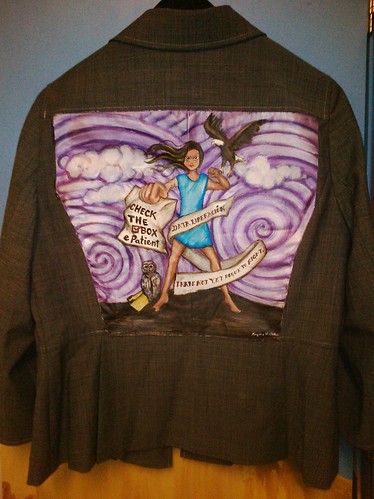
Check the Box for ePatient

I thought a little bit more deeply about this last night. As a marketing campaign to patients, this has viral potential. "Check the Box for ePatient" is about as easy as "Click the [Blue] Button", and it's a way to easily communicate to your provider that you want to be engaged.
Now, having checked the box, what will the provider do differently? Actually, there shouldn't be anything different in the way they treat you as they would any other patient, but play the game with me. What do you as a patient expect out of a provider having told them you want to be engaged? And what is different about you from their other patients? What should they be able to expect from you?
Monday, May 21, 2012
Who Should Represent Patients?
One of the challenges I always have with patient representation in national initiatives is that most organizations that claim to represent patients don't seem to represent me very well. That's one reason why I was thrilled when Lygeia Ricciardi was named to the (self-proclaimed) role of Consumerista at ONC, because she had the chops, but was also independent of organizational influences.
The challenge for me is that many self-anointed patient/consumer advocacy organizations really don't advocate for what I want.
I confirmed today via telephone that letters of recommendation can be sent via e-mail to HITCommittee@gao.gov
To make life simpler, I've written simplified letter of recommendation which you can send (or edit and send) with a few button clicks. I strongly recommend customization. My own letter in support of Regina for this position was similar to what you see below.
-- Keith
P.S. As always, the opinions on this blog represent my own, and not those of my employer or any other organization I might represent.
Update a few short minutes after I posted this:
Ted Eytan submitted a similar letter.
ePatientDave is also willing to serve in that role, and is seeking support (you can STILL use the button below and just alter the text in the body to show your support for Dave). Either way, patients win!
Click here to open the text below in your e-mail application:
Government Accountability Office
441 G Street NW.
Washington, DC 20548
Dear Sirs and Madams:
I am writing in support of Regina Holliday as a patient advocate on the HIT Policy Committee. Regina has heard, painted and told hundreds of patient stories and would be an excellent independent voice for patients on the HIT Policy Committee.
Sincerely,
The challenge for me is that many self-anointed patient/consumer advocacy organizations really don't advocate for what I want.
- I'm not a privacy advocate. While concerned about privacy, I'm not fanatical about it, and I'm probably more well-informed about the risks and dangers than most folks.
- I'm not retired (or even close).
- There's a lot of other categories that I just don't fit.
Recently, the GAO announced an opening for a patient/consumer advocate on the HIT Policy Committee. Today, I saw this blog post by Andy Oram on O'Reilly Radar: Putting the Patient Back into Healthcare recommending Regina Holliday for the position. I couldn't have said it better than Andy did.
I confirmed today via telephone that letters of recommendation can be sent via e-mail to HITCommittee@gao.gov
To make life simpler, I've written simplified letter of recommendation which you can send (or edit and send) with a few button clicks. I strongly recommend customization. My own letter in support of Regina for this position was similar to what you see below.
-- Keith
P.S. As always, the opinions on this blog represent my own, and not those of my employer or any other organization I might represent.
Update a few short minutes after I posted this:
Ted Eytan submitted a similar letter.
ePatientDave is also willing to serve in that role, and is seeking support (you can STILL use the button below and just alter the text in the body to show your support for Dave). Either way, patients win!
Click here to open the text below in your e-mail application:
Government Accountability Office
441 G Street NW.
Washington, DC 20548
Dear Sirs and Madams:
I am writing in support of Regina Holliday as a patient advocate on the HIT Policy Committee. Regina has heard, painted and told hundreds of patient stories and would be an excellent independent voice for patients on the HIT Policy Committee.
Sincerely,
Tuesday, March 20, 2012
Patient Engagement is a two-way effort in MeaningfulUse Stage2
This question came to me via Linked In:
I'll address the last one first. There is an exclusion for lack of broadband access in the rule. It says:
Proving the 10%
Now, back to the first item: On how to prove the 10%. In order to claim "Meaningful Use", the provider must use the certified technology. This is noted in the Discussion of the Relationship of Meaningful Use to Certified EHR Technology in the Incentive rule. In 314(g)(1) of the Standards and Certification rule, the Certified EHR technology must be able to electronically record the numerator for each meaningful use objective with a percentage-based measure. So, how to prove it? Ask your EHR.
Why 10% and 50%?
Why should the measure be 10% if only 50% have access? Actually, that's a logical conjunction not made by the rule. There are two measures: At least 50% must have access, and 10% must do something with that access. A smart provider will be sure to provide as many patients as possible with access.
Is it Fair to Judge providers on what patients do?
 Finally, on the fairness of judging providers based on their patient's behavior: Engagement is a two way street. It takes both parties to create engagement, not just one or the other. Given that the incentive rule is giving providers $ to show that they are doing something meaningful, judging them on a meaningful outcome that shows patients are engaging is certainly fair, at least in my viewpoint.
Arguably, 10% could be challenging for some providers (including specialties). I think the key for this objective is to make a meaningful effort to engage with patients, and you could judge that effort based on the number of responses you get. In marketing, expecting 10% response rate is rather difficult.
I would argue that this objective should be a fixed number, such as 200 patients, rather than a percentage of the patient population. Ten percent will be difficult to reach for some specialty providers, especially for those whose patients will also have access to the same information via their GP. Making the measure a significant number of patients will ensure that all providers attempt to engage meaningfully with their patients without making it overly difficult for specialty providers who are at a disadvantage due to the transitory nature of their patient relationships. Making the number significant (like 200), means that half-hearted attempts at engagement won't do, and it still would achieve the CMS goal of getting patients engaged.
What do you think?
I know CMS is trying to push patient engagement, but how can a practice/provider prove 10 percent and, also, why only 10 percent if it is made available to half of patients?Before I get into details, let's look at what the rule states:
Secondly, this means meeting meaningful use hinges on the patients and is out of the provider’s control. Is that fair? If they are not engaged, they are not engaged. And what if patients are not wired to see and access their records, such as rural areas?
§495.6 (j)(10) Provide patients the ability to view online, download, and transmit their health information within 4 business days of the information being available to the EP.
- More than 50 percent of all unique patients seen by the EP during the EHR reporting period are provided timely (within 4 business days after the information is available to the EP) online access to their health information subject to the EP's discretion to withhold certain information
- More than 10 percent of all unique patients seen by the EP during the EHR reporting period (or their authorized representatives) view, download , or transmit to a third party their health information
§495.6 (l)(8) Provide patients the ability to view online, download, and transmit information about a hospital admission
There are actually four points the querant addresses:
- More than 50 percent of all patients who are discharged from the inpatient or emergency department (POS 21 or 23) of an eligible hospital or CAH have their information available online within 36 hours of discharge
- More than 10 percent of all patients who are discharged from the inpatient or emergency department (POS 21 or 23) of an eligible hospital or CAH view, download or transmit to a third party their information during the reporting period
- How to prove 10%
- Why 10% if only half have access
- Fairness of judging providers on patient behavior
- Lack of Broadband Access
I'll address the last one first. There is an exclusion for lack of broadband access in the rule. It says:
Any EP that conducts 50 percent or more of his or her patient encounters in a county that does not have 50 percent or more of its housing units with 4Mbps broadband availability according to the latest information available from the FCC on the first day of the EHR reporting period may exclude only the second measure.This means that if the provider does not have access to broadband, they can exclude the measure. The problem with this exclusion is that it isn't the providers access that should be the reason for the exclusion, rather it should be the patient access. I'd reword the exclusion as:
Any EP that conducts 50 percent or more of his or her patient encounters in a county, or with patients who live in a county that does not have 50 percent or more of its housing units with 4Mbps broadband availability according to the latest information available from the FCC on the first day of the EHR reporting period may exclude only the second measure.In that way, provider could be excluded based upon where the patients who would need to access the information live, rather than where the provider is located, as well as being excluded if the provider doesn't have access.
Proving the 10%
Now, back to the first item: On how to prove the 10%. In order to claim "Meaningful Use", the provider must use the certified technology. This is noted in the Discussion of the Relationship of Meaningful Use to Certified EHR Technology in the Incentive rule. In 314(g)(1) of the Standards and Certification rule, the Certified EHR technology must be able to electronically record the numerator for each meaningful use objective with a percentage-based measure. So, how to prove it? Ask your EHR.
Why 10% and 50%?
Why should the measure be 10% if only 50% have access? Actually, that's a logical conjunction not made by the rule. There are two measures: At least 50% must have access, and 10% must do something with that access. A smart provider will be sure to provide as many patients as possible with access.
Is it Fair to Judge providers on what patients do?

Arguably, 10% could be challenging for some providers (including specialties). I think the key for this objective is to make a meaningful effort to engage with patients, and you could judge that effort based on the number of responses you get. In marketing, expecting 10% response rate is rather difficult.
I would argue that this objective should be a fixed number, such as 200 patients, rather than a percentage of the patient population. Ten percent will be difficult to reach for some specialty providers, especially for those whose patients will also have access to the same information via their GP. Making the measure a significant number of patients will ensure that all providers attempt to engage meaningfully with their patients without making it overly difficult for specialty providers who are at a disadvantage due to the transitory nature of their patient relationships. Making the number significant (like 200), means that half-hearted attempts at engagement won't do, and it still would achieve the CMS goal of getting patients engaged.
What do you think?
Tuesday, January 31, 2012
The Professional and the Patient
Being a patient is, unlike most other experiences in this world, a life skill, rather than a professional skill. You don't get paid for it (in fact, it has significant personal costs, not just financial). Even people who get paid to represent patients are applying other professional skills (speaking, communications, lobbying, even painting and singing), and are using those skills with existing experiences as either a patient or patient advocate.
This makes for interesting challenges for Healthcare conference organizers. After all, they are designed to cater to a professional audience who can afford to travel and pay conference fees. This is a business concern that conference organizers must address. A recent blog post talks about how one patient representative will NO SHOW on conferences that has:
There are engaged and committed patients and advocates who are willing to participate in conferences around healthcare. But these people (and I include myself in that lot), are not representative of the typical patient. And many patients and advocates don't have a source of funding that allow them to participate as a patient representative.
This all makes for a very difficult dynamic in the overall conversation about healthcare. That dynamic is further complicated by the lack of transparency in healthcare regarding costs.
As an engaged patient, I won't stop attending conferences that have no patients in the program, on the stage, or in the audience. But I will approach the issue with conference leaders to show what the value is of taking that approach. Patients can provide needed input and value to these conferences, and if we can communicate that to conference leaders, we can change how they approach patient engagement. After all, as an engaged patient, my role is to try to figure out how to get professionals to engage back. To break off the communication, especially at this stage, doesn't seem to be a useful tactic.
Keith
This makes for interesting challenges for Healthcare conference organizers. After all, they are designed to cater to a professional audience who can afford to travel and pay conference fees. This is a business concern that conference organizers must address. A recent blog post talks about how one patient representative will NO SHOW on conferences that has:
- no patient IN the program,
- no patient ON the stage or
- no patient IN the audience.
There are engaged and committed patients and advocates who are willing to participate in conferences around healthcare. But these people (and I include myself in that lot), are not representative of the typical patient. And many patients and advocates don't have a source of funding that allow them to participate as a patient representative.
This all makes for a very difficult dynamic in the overall conversation about healthcare. That dynamic is further complicated by the lack of transparency in healthcare regarding costs.
As an engaged patient, I won't stop attending conferences that have no patients in the program, on the stage, or in the audience. But I will approach the issue with conference leaders to show what the value is of taking that approach. Patients can provide needed input and value to these conferences, and if we can communicate that to conference leaders, we can change how they approach patient engagement. After all, as an engaged patient, my role is to try to figure out how to get professionals to engage back. To break off the communication, especially at this stage, doesn't seem to be a useful tactic.
Keith
Friday, January 13, 2012
Give it to ME
I've been reading quite a bit about all of the consumer oriented mobile health apps that have shown up lately. There's been a lot of buzz around this especially given the recent Consumer Electronics Show that just concluded (thankfully). There's also been quite a bit of discussion about a recent mobile health app that works with Health Vault.
All these apps are simply creating new mobile silos of information, or worse yet, requiring us to go through some third party cloud storage in order to manage and view it. I want my damn data and I want you to give it to ME so that I can analyze it. It's my health. Let me do with the data what I want easily, without having to hack my tablet, or use your website. At the very least, give me the ability to export the data to a spreadsheet.
Patients (and consumers) want to use a variety of different applications. We want to be able to collect that data and do stuff with it. Right now, I've got two separate apps, one to track my weight, and the other to track my blood pressure. In order to see the impact of one on the other, I've got to go through quite a bit of gyration just to put it together in one place.
All these apps are simply creating new mobile silos of information, or worse yet, requiring us to go through some third party cloud storage in order to manage and view it. I want my damn data and I want you to give it to ME so that I can analyze it. It's my health. Let me do with the data what I want easily, without having to hack my tablet, or use your website. At the very least, give me the ability to export the data to a spreadsheet.
Patients (and consumers) want to use a variety of different applications. We want to be able to collect that data and do stuff with it. Right now, I've got two separate apps, one to track my weight, and the other to track my blood pressure. In order to see the impact of one on the other, I've got to go through quite a bit of gyration just to put it together in one place.
Thursday, January 12, 2012
Blue Button
Chris W. brings up Blue Button on the Ask me a Question page, and a few weeks ago it popped up again into my radar screen. In case you've been in hiding for the past year, Blue Button is the name of a VA initiative to enable vets to download their clinical information in an ASCII text format from the VA patient portal MyHealtheVet. It's based on a Markle Foundation specification which has gotten quite a bit of attention.
Recently the Office of Personnel Management sent a letter to health plans participating in the Federal Employee Health Benefit Program (FEHBP). I found an interesting quote in the letter (I underlined the interesting part):
Chris's main point is this (and I quote):
The scope of the project is to:
From my perspective, Blue Button is beneficial to patients, but not as big a step forward as it could be. (my S4PM friends may want to disown me for saying so, but hey, that's the way I feel). I'd much rather spend my energy on CDA Release 3 and HTML 5.
Given the importance of this project, I will be paying attention to it, and Chris is so right. Because of all the work that has already been done in CCD, this will be pretty easy. I just wish I could get some focused time on what will really move things forward.
Recently the Office of Personnel Management sent a letter to health plans participating in the Federal Employee Health Benefit Program (FEHBP). I found an interesting quote in the letter (I underlined the interesting part):
Supplying your members with the simple, low-cost and readily available Blue Button function will strengthen your contractual HIT obligations under FEHBP, align with the Meaningful Use standards laid out by Health and Human Services (HHS), and most importantly, empower your members to know their health information and make informed choices based on that information.According to the letter, you would assume that you could download the records in the electronic standard formats suggested by HHS under Meaningful Use. But wait, the Blue Button specification is just ASCII text. It doesn't follow that standard at all, and many provider and payer organizations have already implemented according the HITSP C32 Version 2.5 (one of the two allowed standards under Meaningful Use Stage 1). Sometimes I wish the left hand and the right hand would communicate a little bit better.
Chris's main point is this (and I quote):
... it occurs to me that the effort is promising (for the intended use cases) precisely because of the standardization that HL7 has been driving behind the scenes. That is, the tag sets and value formats (and vocabularies) will have a fairly high level of consistency across organizations right out of the box because of their prior work on adopting a variety of standards internally, and especially HL7 standardsIn fact, there's an HL7 project which is working its way through channels to create an XSL Stylesheet that will translate the semantically interoperable, Meaningful Use conforming HITSP C32 into the Blue Button format. Structured Documents approved it today, and it goes next to the steering division and then the TSC for final approval.
The scope of the project is to:
... produce a sample XSLT schema and background text on usage that will transform a CDA R2 CCD file into a U.S. Department of Veteran Affairs (VA) Blue Button ASCII text file.It's likely going to have to make some sacrifices to fit within the specifications required for Blue Button, because there's more that you can say and do in CDA and CCD that Blue Button accounts for.
From my perspective, Blue Button is beneficial to patients, but not as big a step forward as it could be. (my S4PM friends may want to disown me for saying so, but hey, that's the way I feel). I'd much rather spend my energy on CDA Release 3 and HTML 5.
Given the importance of this project, I will be paying attention to it, and Chris is so right. Because of all the work that has already been done in CCD, this will be pretty easy. I just wish I could get some focused time on what will really move things forward.
Friday, December 9, 2011
Role Reversal
He walked over the where the man was pointing at the screen, looked and asked to see the data. The two of them reviewed the blood pressure results for the last month, looking at the overall pattern, and individual measure results. They compared this month's average on a beta-blocker against the prior month's without it. Scrolling through the months, clearly they could see there were no statistically significant results between the two. Then they looked at the heart rate data. That showed a clear, nearly 10 bpm average drop, so the drug was doing something. Next the two of them looked at weight data for the last 30 days. It's November, and the patient definitely followed the "thanksgiving" pattern of gaining several pounds. Looking back to Halloween, they could even see a bit of a gain trend starting there.
It was pretty clear what was needed. The patient has to drop a few pounds gained over the holidays.
This wasn't fiction, it was real. I was at the doctor's office yesterday, and the guy with the computer was me. Next year, I'll be able to send him that data so he can look at it ahead of time. Have I said recently that I love my doctor?
It was pretty clear what was needed. The patient has to drop a few pounds gained over the holidays.
This wasn't fiction, it was real. I was at the doctor's office yesterday, and the guy with the computer was me. Next year, I'll be able to send him that data so he can look at it ahead of time. Have I said recently that I love my doctor?
Subscribe to:
Posts (Atom)