Showing posts with label EHR. Show all posts

Tuesday, May 29, 2018

On CMS 's Promoting Interoperability Program (the program formerly known as the EHR Incentive Program)

A while back I read through CMS's recent rule changing the EHR Incentive program to the Promoting Interoperability program.  I promised a blog update but for some reason (work), didn't get around to writing it.  I decided to take action and finally sit down and finish it.

The published rule is something like 1800 pages, 36 reams of paper when printed double-spaced (as preprints are).  You can find it at the link above.  It goes by the precise but lengthy title of:

Medicare Program; Hospital Inpatient Prospective Payment Systems for Acute Care Hospitals and the Long-Term Care Hospital Prospective Payment System and Proposed Policy Changes and Fiscal Year 2019 Rates; Proposed Quality Reporting Requirements for Specific Providers; Proposed Medicare and Medicaid Electronic Health Record (EHR) Incentive Programs (Promoting Interoperability Programs) Requirements for Eligible Hospitals, Critical Access Hospitals, and Eligible Professionals; Medicare Cost Reporting Requirements; and Physician Certification and Recertification of Claims

I will only cover two parts: Quality Reporting Requirements, and the Promoting Interoperability Programs.  The first part is interesting because everyone who cares about the second part also has to deal with the quality reporting part.  You can find my raw read-through comments on Twitter.

Quality Reporting Requirements

If you haven't been paying attention to CQL, you really need to be.  The first publication of reporting requirements technical specifications will be this spring (coming REAL soon) for use in 2019 (coming sooner than you think).  According to CMS (and me) "We believe that compared to CQL, QDM logic is more complex and difficult to compute".  CMS will be using a sub-regulatory process to make technical corrections to the measure specifications.  This is good because it means that the quality measure specifications will be able to have more quality without going through a heavyweight process to fix mistakes.  But it also means you have to pay attention.

Hospital measure data will join the myriad of other public data out there, as it will .  Soon we'll be able to compare not just meaningful users and their EHR systems, but also the quality results they'll be able to get from the use of them.  That should be an interesting mashup.  Hey ONC! Are you listening?

A lot of measures are going to be eliminated, either because they are topped out (hospitals are doing so well its not worth measuring any more), duplicative, or cost too much to produce for value received or ...  There's are lists of the measures that CMS is proposing to remove in the rule.  While everyone is happy about measures being removed, just remember that also means that there are fewer choices to succeed with...

Promoting Interoperability Programs

Why did they change the name?  Well, they remind us in the rule that the EHR Incentive part of the program is about over for anyone participating (we're now in the penalty stage).  So that part makes sense.  One significant change is that the singular program became the plural programs

They are planning to require 2015 Certified EHRs for these programs because, in part, ONC has confirmed that at least 66 percent of eligible clinicians and 90 percent of eligible hospitals and CAHs have 2015 Edition available (see the link above at meaningful users and their EHR systems).  Also, the evaluation period is a minimum of any continuous 90-day period within each of the calendar years 2019 and 2020, as you all probably hoped and expect.  The rationale for this change was that health care providers may need extra time to fully implement and test workflows with the 2015 Edition of CEHRT.

Miscellaneous

Security Risk analysis is simply required, you don't get any extra points for doing what you are required by law and regulation to already do.

For ONC and CMS, it's pretty routine to ensure that whatever the latest and greatest healthcare crisis is, there needs to be something to in the regulations about it.  So new measures have been added to address opioid abuse, including Queries of prescription drug monitoring programs (PDMPs), and verification of opioid treament.

Closing the referral loop also gets some love with a new quality measure supporting that buzz phrase.

A number of exclusions (loopholes) are being removed, few are using them or they aren't warranted according to CMS.

Puerto Rico hospitals become eligible for the program, something that wasn't available to them previously.

Some capabilities will no longer be required to be used (though they will still exist in the certification requirement): Secure Messaging, View/Download/Transmit.

So, there you have it, my summary of about 10% of the rule.

For what it's worth

The section on Future Directions is worth reading for those of you who are worried about what is next, but that is merely non-binding self-promotion for the most part.  The really important part related to that is where CMS asks you to tell them where they should go.





Friday, October 5, 2012

HL7 Offers Free Ambassador Webinar on the EHR and PHR System Functional Models on October 12, 2012

I'm in Rochester tomorrow morning to present my HL7 Ambassador presentation on HL7 Standards for Meaningful Use at the Rochester RHIO's CIO Breakfast. As the release below explains, these are short (30-60 minute) presentations which explain key facets of HL7 standards at a high level.   HL7 also delivers these by webinar, and the release below is the latest one.  These presentations are also recorded here, and occasionally, one even shows up on video (which is how I got this gig). More good, free stuff from HL7, cool.

  -- Keith


Health Level Seven® International
For Immediate Release
                                                                               
Contact: Andrea Ribick
+1 (734) 677-7777


HL7 Offers Free Ambassador Webinar on the Electronic Health Record and Personal Health Record System Functional Models on October 12, 2012

          Ann Arbor, Michigan, USA – October 4, 2012 – Health Level Seven® International (HL7®), the global authority for interoperability and standards in healthcare information technology with members in 55 countries, will present a complimentary Ambassador webinar on the HL7 Electronic Health Record System Functional Model (EHR-S FM) and the Personal Health Record System Functional Model (PHR-S FM) on Friday, October 12 from 12:00 pm – 1:00 pm EDT.
          The HL7 EHR-S Functional Model is an international standard approved by the International Organization for Standardization (ISO) and the American National Standards Institute (ANSI) that outlines the features and functions that should be contained in an EHR system. The current standard contains approximately 1,000 conformance criteria across more than 100 functions, including medication history, problem lists, orders, clinical decision support, and those supporting privacy and security. The function list is described from a user perspective and enables consistent expression of EHR system functionality. The model can be constrained through the development of profiles to represent a department (Emergency Medicine), a realm (The Netherlands), or other specialty (Behavioral Health).  The webinar will also cover the development of Release 2 of the standard—having recently been balloted internationally.
         The PHR-S Functional Model defines the functions for PHR systems and offers guidelines that facilitate health information exchange among different PHR systems and between PHR and EHR systems. The PHR-S Functional Model Release 1 is currently being balloted as an HL7 normative standard as well as with ISO. The Draft Standard for Trial Use (DSTU) version is available for vendors to use and incorporate the model’s requirements into their products.
Both models can be used as a basis for certification development and testing purposes.        
          The webinar will be presented by Pat Van Dyke, RN, director of information security, privacy and EDI representing The ODS Companies and Delta Dental Plans Association; co-chair of the HL7 Electronic Health Record Work Group; and HL7 ambassador. Ms. Van Dyke is also a practicing emergency room nurse. In addition, she helped develop both the EHR-S and PHR-S functional models and has participated in the development of functional profiles.
          This webinar is free and open to anyone interested in healthcare IT or standards development. To register for this free webinar, please visit http://www.hl7.org/events/ambassador20121012/.
          HL7 Ambassadors present standardized presentations about HL7 as speaker volunteers. They are available to present at local, regional or national conferences. Please contact HL7 at +1 (734) 677-7777 if you would like to schedule an HL7 Ambassador for an upcoming event.


About Health Level Seven International (HL7)
Founded in 1987, Health Level Seven International is the global authority for healthcare Information interoperability and standards with affiliates established in more than 30 countries. HL7 is a non-profit, ANSI accredited standards development organization dedicated to providing a comprehensive framework and related standards for the exchange, integration, sharing, and retrieval of electronic health information that supports clinical practice and the management, delivery and evaluation of health services. HL7’s more than 2,300 members represent approximately 700 corporate members, which include more than 90 percent of the information systems vendors serving healthcare. HL7 collaborates with other standards developers and provider, payer, philanthropic and government agencies at the highest levels to ensure the development of comprehensive and reliable standards and successful interoperability efforts.

HL7’s endeavors are sponsored, in part, by the support of its benefactors: Abbott; Accenture; Centers for Disease Control and Prevention; Duke Translational Medicine Institute; Epic; European Medicines Agency; the Food and Drug Administration; GE Healthcare Information Technologies; GlaxoSmithKline; IBM; Intel Corporation; InterSystems Corporation; Kaiser Permanente; Lockheed Martin; McKesson Provider Technology; Microsoft Corporation; NICTIZ National Healthcare; Novartis; Oracle Corporation; Partners HealthCare System, Inc.; Pfizer, Inc.; Philips Healthcare; Quest Diagnostics Inc.; Siemens Healthcare; Thomson Reuters; the U.S. Department of Defense, Military Health System; and the U.S. Department of Veterans Affairs.

Numerous HL7 Affiliates have been established around the globe including Argentina, Australia, Austria, Brazil, Canada, Chile, Colombia, Croatia, Czech Republic, Finland, Germany, Greece, Hong Kong, India, Italy, Japan, Korea, Luxembourg, The Netherlands, New Zealand, Norway, Romania, Russia, Singapore, Spain, Sweden, Switzerland, Taiwan, Turkey, United Kingdom, and Uruguay.

For more information, please visit: www.HL7.org

# # #

Thursday, June 14, 2012

Those Damn Vendors — Escaping the EHR Trap

Before I start, I need to remind you that what I write here represents my own opinion, not that of my employer or any other organization I represent.

Vendor - A supplier of any good or service.

Ken Mandl and Zak Kohane's provocative opinion piece on Escaping the EHR Trap — The Future of Health IT in the NEJM is getting a lot of attention this morning. There are nearly 50 tweets of the article listed below, and plenty more to come.
@alexmeshkin
Escaping the EHR Trap — The Future of Health IT http://www.nejm.org/doi/full/10.1056/NEJMp1203102
@pjmachado
Buyers need to define the solutions & interoper RT @ahier: Escaping the #EHR Trap — The Future of #HealthIT http://bit.ly/LblSn6 #hitsm
@hashem25
RT @ahier: Escaping the #EHR Trap — The Future of #HealthIT http://bit.ly/LblSn6 via @NEJM
@Tim_Stapleton
Escaping the EHR Trap — The Future of Health IT — NEJM: http://nej.md/LMDG7L
@ahier
Escaping the #EHR Trap — The Future of #HealthIT http://bit.ly/LblSn6 via @NEJM
@Richard_Dabbs
Escaping the EHR Trap — The Future of Health IT — NEJM: http://nej.md/LMCscF
@TPCaruso
Escaping the #EHR Trap — The Future of #HealthIT http://ow.ly/bzJQa : EHR vendors have systems that are decades behind
@AppSecPundit
Top story: Escaping the EHR Trap — The Future of Health IT — NEJM http://goo.gl/YOJHj, see more http://goo.gl/SCVIP
@kostaMakroDimi
Escaping the EHR Trap — The Future of Health IT. HIT vendors should adapt modern technologies http://www.nejm.org/doi/full/10.1056/NEJMp1203102
@emrninja
#healthIT Escaping the EHR Trap — The Future of Health IT: Source: Mandl KD, Kohane IS. N Engl J Med, 366(24) Co... http://bit.ly/LaLRes
@icmccupdate
Escaping the EHR Trap — The Future of Health IT http://shar.es/soyg4 #healthit #ehr
@decisiondawn
Interesting perspective in this weeks NEJM: Escaping the EHR Trap — The Future of Health IT — NEJM: http://nej.md/LLLA12
@urigoren
Escaping the EHR Trap — The Future of Health IT — NEJM | @scoopit http://bit.ly/MQ9Oqj#ehealth
@CitiusTech
A different perspective: Escaping the EHR Trap — The Future of Health IT | http://bit.ly/MPAmYE | #HealthIT #EHR #healthcare #ONC
@ElinSilveous
Wasn't it? Thank you. RT @jbselz Great article! RT Escaping the #EHR Trap, The Future of #HealthIT via NEJM http://ow.ly/1NGDpv
@Health_IT_India
Escaping the EHR Trap — The Future of Health IT http://dlvr.it/1jh915 #hcsm via @nrip
@AaronNeinstein
An important read in @NEJM "Escaping the EHR Trap — The Future of Health IT" http://bit.ly/L9Leln #EHR #HCT #HIT
@pat_rioux
Escaping the EHR Trap — The Future of Health IT -"their systems' inability to work together has not helped drs or pts." http://www.nejm.org/doi/full/10.1056/NEJMp1203102
@michaelwcraige
Escaping the EHR Trap — The Future of Health IT http://www.nejm.org/doi/full/10.1056/NEJMp1203102?query=TOC&#t=article
@JimNHansen
'Ten Principles ... Dev of an 'iPhone-like' Plat. for #HealthIT ' http://chip.org/platform b4 'Escaping the #EHR Trap' http://www.nejm.org/doi/full/10.1056/NEJMp1203102
@jbselz
Great article! RT @ElinSilveous: Escaping the #EHR Trap, The Future of Health IT via NEJM http://ow.ly/1NGDpv #HealthIT #HITsm #HCSM
@k1h
電子カルテの罠 Escaping the EHR Trap — The Future of Health IT NEJM で全文pdfダウンロード可能 読みたいけど時間ないです。
@pyramidmedicine
Escaping the EHR Trap — The Future of Health IT - http://www.nejm.org/doi/full/10.1056/NEJMp1203102?query=TOC (NEJM)
@nrip
Escaping the EHR Trap — The Future of Health IT http://vsb.li/DOpmBJ #hcsm #hcsmin #healthIT
@l_scott_brown
EXCELLENT critical analysis of the problems with #EHRs today. Escaping the EHR Trap — The Future of Health IT — NEJM: http://nej.md/K3uwP3
@Health_IT_Feed
#hcit via @nrip Escaping the EHR Trap — The Future of Health IT http://ow.ly/1kxtVJ
@healthyrx
Escaping the #EHR Trap — The Future of #HealthIT http://www.nejm.org/doi/full/10.1056/NEJMp1203102
@jmichaelslocum
Escaping the EHR Trap — The Future of Health IT — NEJM: http://www.nejm.org/doi/full/10.1056/NEJMp1203102?query=TOC via @AddThis
@plus91
Escaping the EHR Trap — The Future of Health IT - It is a widely accepted myth that medicine requires complex, highl... http://vsb.li/3wpLMX
@drmalpani
#hcit Escaping the EHR Trap — The Future of Health IT - It is a widely accepted myth that medicine requires complex,... http://ow.ly/1kxzKY
@health_medical_
Escaping the EHR Trap — The Future of Health IT - It is a widely accepted myth that medicine requires complex, highl... http://ow.ly/1kxzL0
@health_care_IT
Escaping the EHR Trap — The Future of Health IT - It is a widely accepted myth that medicine requires complex, highl... http://ow.ly/1kxzL1
@IAMItweets
Escaping the EHR Trap — The Future of Health IT: It is a widely accepted myth that medicine requires com... http://bit.ly/LYgAcT #hcitin
@paragvr
#hcsmin via @nrip Escaping the EHR Trap — The Future of Health IT http://goo.gl/2eynQ
@simonmcbride
Excellent NEJM paper exposing the #healthit industry #fail > Escaping the EHR Trap http://nej.md/Kozr1H
@mtmdphd
Escaping the EHR Trap — The Future of Health IT — NEJM http://bit.ly/M4ZmJ6
@websitesfordocs
Escaping the EHR Trap — The Future of Health IT http://dlvr.it/1jfQFn
@technicaldr
Escaping the EHR Trap — The Future of Health IT http://dlvr.it/1jfQFg
@rsm2800
NEJM Perspective: Escaping the EHR Trap — The Future of Health IT http://www.nejm.org/doi/full/10.1056/NEJMp1203102?query=TOC#references
@moorejh
#informatics RT @westr Escaping the EHR Trap — The Future of Health IT — NEJM: http://nej.md/Kot2DQ #pm101 Let Apple Do It!
@westr
Escaping the EHR Trap — The Future of Health IT — NEJM: http://nej.md/Kot2DQ #pm101 Let Apple Do It!
@joeketch
Escaping the EHR Trap — The Future of Health IT — NEJM http://ow.ly/bz8lI
@cdocwong
Escaping the EHR Trap — The Future of #Health IT — NEJM: http://nej.md/KorYzJ - #EHR #ACEP - HIT vendors locking in your data? Don't let 'em
@geekintraining1
Interesting, discussion-inspiring NEJM article: Escaping the EHR Trap — The Future of Health IT http://www.nejm.org/doi/full/10.1056/NEJMp1203102?query=TOC
@SurvivorshipHIT
Interesting, discussion-inspiring NEJM article: Escaping the EHR Trap — The Future of Health IT http://www.nejm.org/doi/full/10.1056/NEJMp1203102?query=TOC
@daborbolla
Reading: "Escaping the EHR Trap — The Future of Health IT — NEJM"( http://twitthis.com/cl94gg )
@johnrgraham
Escaping the EHR Trap — The Future of Health IT — NEJM: http://nej.md/K2JXqC

The first thing that popped into my mind as I read the article was that it was troll baiting, looking for a response.  And the pretty negative attitude about "vendors" that the article was written would seemingly guarantee a trollish response.  I'll try to avoid it though, because there are far too many billy-goat gruffs out there.

I've got a lot of complaints about the article: The authors' make their claims about a whole industry, including all 700 certified EHR vendors and certified EHR products.  The brush they paint with is very broad, and with it they make numerous unsupported assertions about vendor behaviors and product designs.  Some of their claims (e.g., vendors blocking new entrants, locking up the data) are internally inconsistent with other statements in the article (e.g., EHR vendors have proliferated, data was exported to SHRINE from numerous systems).  I could go on in great detail on each.

But perhaps the most faulty argument in the article is this section, and I want to spend most of my time on it:
A healthy IT marketplace would favor disruptive innovations (simple products and services that initially serve the bottom of a market and then move up to displace established competitors) for improving patient engagement, communication, and care coordination. Improved population health obtained at a lower cost would result. 
I'd suggest the authors reread Christenson's series on Innovation.  I'll quote (emphasis mine) from page 187 of Clayton Christenson's The Innovator's Prescription to illustrate the real problem:
The Co-opting Power of the Present Value Network in Health Care
  When disruptive innovators attempt to commercialize their innovations within the established value network in the industry — essential trying to cram it in the back plane of the competition in Figure 6.1— that system will either reject it (as it did with Sony's transisterized products) or co-opt the potential disruption, forcing it to conform to the existing value network in order to survive.
The idea that disruptive innovations can fit into the current healthcare value network, as suggested by the authors', ignores this key point that Christensen expands on further (again, emphasis mine):
The very same ... process is at work within every company, and within the value networks in which each company is ensconced.
Going back to The Innovators Dilemma, the value network in which hard drive manufacturers that were ensconced was the mini-computer marketplace.  It was the new value network brought about by the microcomputer revolution which brought about the innovation and the disruption in the hard drive industry.

The real challenge is not providing disruptive technology in Health IT, but rather, in providing a new value network in health care that will enable disruptive innovation. When that happens, the new value networks will have the necessary technology to support it, and indeed, the current EHR industry will either adapt, or die, just as hard drive manufacturers did.

But to get there, we might need to looking at the behaviors of a very different set of "vendors".


Friday, February 3, 2012

On the Power Distribution of Healthcare Data Breaches

A tweet, article and report all recently came to my attention on the impact of Healthcare Data Breaches, specifically on the number of patients affected.  As a math and statistical hobbyist, I was interested in looking at the data for myself, because I found the reported impacts to be rather sensational.

One of the things that I suspected about data breaches is that their distribution by size is related to some sort of power law distribution.  These events after all, are somewhat like other disasters (and also some non-disasters).  One would expect that the number of people effected by them, or the overall cost of them to being inversely related to their frequency.  I took the data and classified the breaches by size, then counted the number of breaches in each size bucket.  The size buckets I used were (approximately):
  • 500 - 1,500
  • 1,500-5,000
  • 5,000-15,000
  • 15,000-50,000
  • 50,000-150,000
  • 150,000-500,000
  • 500,000-1,500,000
  • 1,500,000-5,000,000
I started at 500 because the public data includes only breaches affecting 500 or more patients.  I picked the ranges that I did because midpoints of each range distribute evenly over a log scale.  When I plotted out the frequency on a log-log graph and computed at a power trendline, this is what I got:

I won't say this is proof of my thesis, because I took the easy way out and let Excel compute the power trend, rather than using an appropriate estimation technique.  What I saw was actually good enough for me to assume some sort of power law distribution.

Those who work with power laws should be familiar with the relationship between power laws, Pareto distributions and Zipf distributions.  I suspect my hypothesis can be refined even further and is worthy of a paper.  As I said, I'm a hobbyist, not a professional mathematician.  I'll skip the paper for now, as there are too many other things on my plate.  I do invite others to take a look at it, and if you do write a paper as a result of this post, please let me know about it.

Having reached this conclusion, the next question I wanted to answer is whether or not data breaches are increasing or decreasing.  The overall impact on patients in 2011 was certainly larger as the report suggests, but this doesn't really indicate where the trend is going.  Because of the long tailed distribution, some events (e.g., breaches affecting a million or more patients) are expected to occur very infrequently, which means that they won't show up in year-over-year statistics frequently enough to judge the impact.

What I did next was plot the trends for number of breaches by size, and got this:

What this graph shows is that trend for all breach sizes except the very largest is headed downward.  And given that there are only three points in the 1.5 to 5 million range, it's really hard to say what the trend is for those breaches because they are so infrequent.  There are only three breaches over 1.5 million in size, which is barely enough to even think about trending.

Overall, the number of breach reports is also trending downwards:


This tells me that even though EHR's are becoming more common, the number of data breaches is improving, rather than getting worse.


Tuesday, January 10, 2012

Logistic Growth of EHR users under MeaningfulUse

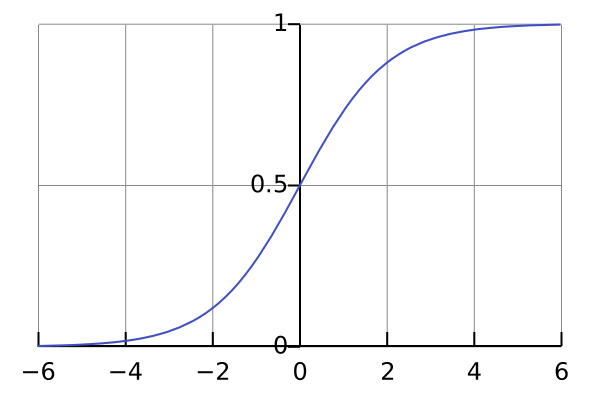
Logistic Growth Curve (courtesy of Wikipedia)
Students of economics will likely be familiar with the logistic growth curve.  The curve has been used to model population growth, in modeling of stochastic processes and adoption of new technology. The early part of the curve is nearly exponential in the early stages, then moves to linear, and finally into exponential decay.

Recently, HHS released data on Meaningful Use attestations (through November of last year) on Data.gov. Brian Ahier posted a couple of extractions from this data earlier today.  The data includes the following elements:


Variable Name Definition
Vendor Name Name of EHR vendor
EHR Product Name Name of EHR product
EHR Product Version Version of EHR product
Product Classification Whether product meets all Meaningful Use requirements (Complete) or meets only part of the Meaningful Use requirements (Modular)
Product Setting Practice setting for which product is designed for (Ambulatory or Inpatient)
Attestation month Month that the provider successfully attested to MU
Business State/Territory Business location of provider who successfully attested to MU (state/territory)
Provider Type Whether attestor was an eligible professional (EP) or eligible hospital (Hospital)
Specialty Specialty or provider type
Program Year Year of EHR Incentive Program
Payment Year Payment year of EHR Incentive Program
Program Type Whether the attestor registered under Medicare or Medicare/Medicaid
ID Unique ID for each Attestor

I put together a quick pivot chart report which showed the number of attestations by month for Meaningful Use, and looked at the growth trend.  Here is how it looked:

And here is the raw data for this chart:

Month Attestations
4 506
5 812
6 1045
7 1461
8 2268
9 3774
10 5754
11 7341


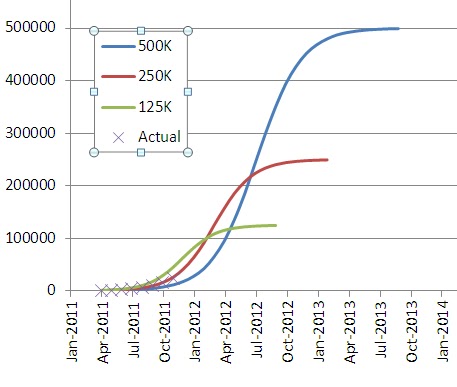
What this chart clearly shows is that we are still in the exponential growth stage for attestations.  I found some information on logistic curve fitting data.  It required an estimation of the saturation point for the population, so I looked up the number of physician practices from Wikipedia and applied it to the model.  Given the the disparity between EP attestations (21,461) and Hospital attestations (1,500), I figured that an estimate of 250,000 was sufficient.

What I wanted to find out by this was when MU would be "done" (i.e., CMS would be "saturated" with attestations), and my results were rather surprising.  So I went back and checked it again with two other estimates (125K and 500K).  Then I took the 95% confidence interval on my low and high estimates.  I plotted it out so that you could see the range of possible answers here:


What this shows me is that by mid-year of 2012, we'll be halfway to saturation, and by the end of 2013, we'll have reached saturation. And if I'm too high on my estimate of providers, it will be by October of 2012, and if I'm to low it will be by October of 2013.

Now, my 95% bands were on the transformed linear equation, so I don't know how that impacts things with respect to confidence bands (I could figure it out, but I'm not that deeply interested).  What this tells me is that Meaningful Use, rather than being "off schedule" appears to be ahead of schedule.  I still don't know if I believe that.

One thing this model doesn't account for is how many providers attesting were already EHR users, and so were ready to attest, vs. those that have yet to adopt.  I suspect that the market is just a bit more complex than a simple logistic curve can account for, but even if it is, there's still another whole year before "Meaningful Use" is over using the figures I went with.  I'd stick with the "ahead of schedule" estimate at this point.

So, 2012 should see EHR adoption rates at several multiples of the current rate.  We'll look at the numbers again when they've released new data to see how things are going.

Wednesday, November 9, 2011

Federal Turf Battles on EHR Safety? Not Really

The IOM Report commissioned by ONC came out in preprint yesterday.  I took a quick read through it last night and today, and thought I would share some of my observations.  Before I get started, just a reminder that the opinions posted here are my own, not those of my employer or any other organization that I volunteer with.

I'm not going to do a detailed review of the report.  All-in-all, I found the 197 page document pretty decently done and rather comprehensive on first read [even though I don't come to quite the same conclusions as the report authors on every detail ;-)].

I was somewhat amused by this discussion on page ix in the Preface:
 "...but came to the realization that the information needed for an objective analysis and assessment of the safety of health IT and its use was not available.  This realization was eye-opening and drove the committee to consider ways to make information about the magnitude of the harm discoverable." 
The lack of evidence wasn't a surprise to me.  After reading through the NIST report on safety, and the evidence it and other referenced papers provided, it was clear to me that specific studies on EHR safety are needed.  The IOM report cites (p. 1-5) some of that same material, which I previously reviewed here.

Later on the same page, it reports:
"Definitive evidence was not available in many areas, such as determining what the roles of specific private- and public-sector actors should be, and how regulation would impact innovation in this area."
Certainly, the FDA has quite a bit of experience on the impacts of regulation on medical devices, both in hardware and software.  As I think about departmental systems that support patient monitoring, and PACS solutions (both highly regulated).  I know that these are not "out-of-the box, turnkey devices" (p. S-10), but are rather highly configurable software products.  I also know of several software systems from multiple manufacturers that are both classified as medical devices subject to FDA regulation and which are also certified for meaningful use.  I would expect that the FDA would have some input on the impacts of its regulation on innovative solutions, and would be interested in what they have to say.

While the report itself focuses on Health IT that is "not a medical device", one type of Health IT that fits into the report, but is a medical device was recently reclassified by the FDA.  The recent Medical Device Data System rule from the FDA reclassified certain types of devices from Class III (the most restricted) to Class I (the least restricted).  The FDA provided this guidance on requirements for manufacturers and developers of these devices. I've summarized the requirements below (but read the FDA guidance for the real details):
  1. Register and list the regulated products (software versions)
  2. Implement a quality management system
  3. Report on Adverse events
Some of the recommendations in the IOM report are nearly identical:
Recommendation 5: All health IT vendors should be required to publicly register and list their products with ONC, initially beginning with EHRs certified for the meaningful use program. (p. S-7)
Recommendation 6: The Secretary of HHS should specify the quality and risk management process requirements that health IT vendors must adopt, with a particular focus on human factors, safety culture, and usability. (p. S-7)
Recommendation 7: The Secretary of HHS should establish a mechanism for both vendors and users to report health IT–related deaths, serious injuries, or unsafe conditions. (p. S-8)
Sound familiar?  I do have to laugh just a little about the comments regarding "duplication" of existing efforts (p. 6-14) since the FDA's registration process and database predates ONCs CHPL.  Coordination of these two systems would surely be valuable, as would any adverse event reporting capability, since there are products out there already that are both regulated and certified.

One recommendation 6, the report notes that FDAs process is not well suited to Health IT, and recommends something a bit different. Given that the EHR really is a platform, this idea seems like it might have some value.  Perhaps this could be an alternate classification for the FDA?

Other reports in the media seem to think that IOM doesn't think FDA is the right place to manage EHR Patient Safety.  In several places, I've seen references to "capability ... but ... lack of capacity" (e.g, p. 6-23).  And then I read this:

Recommendation 9a: The Secretary of HHS should monitor and publicly report on the progress of health IT safety annually beginning in 2012. If progress toward safety and reliability is not sufficient as determined by the Secretary, the Secretary should direct the FDA to exercise all available authority to regulate EHRs, health information exchanges, and PHRs. (p. S-10)
Recommendation 9b: The Secretary should immediately direct the FDA to begin developing the necessary framework for regulation. Such a framework should be in place if and when the Secretary decides the state of health IT safety requires FDA regulation as stipulated in Recommendation 9a above. 
(p. S-10)
It certainly sounds like the IOM thought that FDA was at least the right place to develop the regulatory framework.  I think what IOM is really getting at here is that they was a "Lean" process for dealing with Health IT and Patient Safety, so as not to be perceived as interfering as much with innovation and adoption.  Quite honestly, I think the "anti-FDA" press on this report is way over-sensationalized.

Interestingly enough, there are already voluntary reporting programs available. It would seem important that HHS coordinate with these organizations, and build from, rather than duplicate these existing efforts.  I almost missed the references to these efforts in the report in my initial read through.  They were mentioned briefly (p 6-24) with respect to the "Patient Safety Organization" (PSO) program, but only by acronym.


Thursday, October 27, 2011

Be Afraid of EHR

Be Afraid.

EHRs are going to be more widely used.  Therefore:


Never mind that:

Because, after all, change in the way medicine is practiced is always risky.  Therefore it should be avoided.


So, remember and be afraid.


Monday, October 24, 2011

Got ACO? You will still need EHR and HealthIT

OK, so I've just finished plowing through nearly 700 pages of the ACO Final Rule.  I also bookmarked the Preview copy, so you can download it from Google Docs for your own reading enjoyment ;-)

As a patient, my main focus in reviewing the rule is what it does for me.  There are few changes from my original review that really impact patients here, except in:

  1. How ACO providers are measured on quality (the final rule uses 33 measures phased in with respect to performance, whereas the proposed rule had 65),
  2. The requirement that a certain percentage of ACO providers were meaningful users of HealthIT.
  3. That Federally Qualified Health Centers and Rural Health Centers can now form (by themselves) and better participate in ACOs (which is great if you happen to live in a rural or underserved area). 
In general, the requirements for patient engagement, and patient participation in ACO governance are still present.

From the Health IT side, I was interested in how the changes impacted the Health IT industry.  They removed a specific requirement on the number of ACO Professionals who are Meaningful Users, but that doesn't really worry me.  Measure 11 has double weight, and is "% of providers who are meaningful users", so that will still have an ACO program impact.

My 140 character summary of the ACO rule from a Health IT perspective?  "Got ACO? You'll still need EHR and HealthIT, even if the regs don't require it."  

The reason for that is the amount of coordination that will be needed by members of the ACO.  The point of shared savings is that the providers actually get a benefit for not duplicating work.  So, if the lab was already done, and provider A has it, then provider B (and everyone else) can potentially benefit from the savings when Provider B uses the existing result.  Recently my wife had knee surgery.  The surgeon wanted a recent EKG.  He would have been incented (under the savings model), to reuse the one my wife already had.  Perhaps not as much as he might have earned from doing it over, but the world is not perfect.

There are a couple of places where Health IT and EHRs will really matter to ACOs:
  1. Assessing the health needs of the patient population.
  2. Identifying High-Risk Individuals and support of individualized care planning
  3. Supporting the use of evidence based medicine (e.g., through clinical decision support).
  4. Reporting on Quality Measures
  5. Managing care through an episode, including transitions between providers
  6. Dealing with monthly claims data and quarterly aggregates
Page 178 of the Final Rule points out that coordination of care between ACO participants and non-participants is one way to accomplish ACO goals.  Amusingly enough, some commenters were looking for CMS to fund some of the IT Investments needed.  CMS points these commenters to the Meaningful Use program for Health IT and EHR incentives.
  

For those of you who are interested in how ACOs will be measured, Table 1 from the final rule shows the quality measures (You can also find this on page 324 of the final rule text in the Federal Register Preview).

 
Table 1 Measures for Use in Establishing Quality Performance Standards that ACOs Must Meet for Shared Savings

#DomainMeasure TitleNQF Measure #/ Measure StewardMethod of Data SubmissionPay for performance
R = Reporting P=Performance
Year 1Year 2Year 3
AIM: Better Care for Individuals
1 Patient/Caregiver Experience CAHPS: Getting Timely Care, Appointments, and Information NQF #5, AHRQ Survey R P P
2 Patient/Caregiver Experience CAHPS: How Well Your Doctors Communicate NQF #5 AHRQ Survey R P P
3 Patient/Caregiver Experience CAHPS: Patients' Rating of Doctor NQF #5 AHRQ Survey R P P
4 Patient/Caregiver Experience CAHPS: Access to Specialists NQF #5 AHRQ Survey R P P
5 Patient/Caregiver Experience CAHPS: Health Promotion and Education NQF #5 AHRQ Survey R P P
6 Patient/Caregiver Experience CAHPS: Shared Decision Making NQF #5 AHRQ Survey R P P
7 Patient/Caregiver Experience CAHPS: Health Status/Functional Status NQF #6 AHRQ Survey R R R
8 Care Coordination/ Patient Safety Risk-Standardized, All Condition Readmission* NQF #TBD CMS Claims R R P
9 Care Coordination/ Patient Safety Ambulatory Sensitive Conditions Admissions: Chronic Obstructive Pulmonary Disease (AHRQ Prevention Quality Indicator (PQI) #5) NQF #275 AHRQ Claims R P P
10 Care Coordination/ Patient Safety Ambulatory Sensitive Conditions Admissions: Congestive Heart Failure (AHRQ Prevention Quality Indicator (PQI) #8 ) NQF #277 AHRQ Claims R P P
11 Care Coordination/ Patient Safety Percent of PCPs who Successfully Qualify for an EHR Incentive Program Payment CMS EHR Incentive Program Reporting R P P
12 Care Coordination/ Patient Safety Medication Reconciliation: Reconciliation After Discharge from an Inpatient Facility NQF #97 AMA-PCPI/NCQA GPRO Web Interface R P P
13 Care Coordination/ Patient Safety Falls: Screening for Fall Risk NQF #101 NCQA GPRO Web Interface R P P
AIM: Better Health for Populations
14 Preventive Health Influenza Immunization NQF #41 AMA-PCPI GPRO Web Interface R P P
15 Preventive Health Pneumococcal Vaccination NQF #43 NCQA GPRO Web Interface R P P
16 Preventive Health Adult Weight Screening and Follow-up NQF #421 CMS GPRO Web Interface R P P
17 Preventive Health Tobacco Use Assessment and Tobacco Cessation Intervention NQF #28 AMA-PCPI GPRO Web Interface R P P
18 Preventive Health Depression Screening NQF #418 CMS GPRO Web Interface R P P
19 Preventive Health Colorectal Cancer Screening NQF #34 NCQA GPRO Web Interface R R P
20 Preventive Health Mammography Screening NQF #31 NCQA GPRO Web Interface R R P
21 Preventive Health Proportion of Adults 18+ who had their Blood Pressure Measured within the preceding 2 years CMS GPRO Web Interface R R P
22 At Risk Population - Diabetes Diabetes Composite (All or Nothing Scoring): Hemoglobin A1c Control (<8 percent) NQF #0729 MN Community Measurement GPRO Web Interface R P P
23 At Risk Population - Diabetes Diabetes Composite (All or Nothing Scoring): Low Density Lipoprotein (<100) NQF #0729 MN Community Measurement GPRO Web Interface R P P
24 At Risk Population - Diabetes Diabetes Composite (All or Nothing Scoring): Blood Pressure <140/90 NQF #0729 MN Community Measurement GPRO Web Interface R P P
25 At Risk Population - Diabetes Diabetes Composite (All or Nothing Scoring): Tobacco Non Use NQF #0729 MN Community Measurement GPRO Web Interface R P P
26 At Risk Population - Diabetes Diabetes Composite (All or Nothing Scoring): Aspirin Use NQF #0729 MN Community Measurement GPRO Web Interface R P P
27 At Risk Population - Diabetes Diabetes Mellitus: Hemoglobin A1c Poor Control (>9 percent) NQF #59 NCQA GPRO Web Interface R P P
28 At Risk Population - Hypertension Hypertension (HTN): Blood Pressure Control NQF #18 NCQA GPRO Web Interface R P P
29 At Risk Population – Ischemic Vascular Disease Ischemic Vascular Disease (IVD): Complete Lipid Profile and LDL Control <100 mg/dl NQF #75 NCQA GPRO Web Interface R P P
30 At Risk Population – Ischemic Vascular Disease Ischemic Vascular Disease (IVD): Use of Aspirin or Another Antithrombotic NQF #68 NCQA GPRO Web Interface R P P
31 At Risk Population - Heart Failure Heart Failure: Beta-Blocker Therapy for Left Ventricular Systolic Dysfunction (LVSD) NQF #83 AMA-PCPI GPRO Web Interface R R P
32 At Risk Population – Coronary Artery Disease Coronary Artery Disease (CAD) Composite: All or Nothing Scoring: Drug Therapy for Lowering LDL-Cholesterol NQF #74 CMS (composite) / AMA-PCPI (individual component) GPRO Web Interface R R P
33 At Risk Population – Coronary Artery Disease Coronary Artery Disease (CAD) Composite: All or Nothing Scoring: Angiotensin-Converting Enzyme (ACE) Inhibitor or Angiotensin Receptor Blocker (ARB) Therapy for Patients with CAD and Diabetes and/or Left Ventricular Systolic Dysfunction (LVSD) NQF # 66 CMS (composite) / AMA-PCPI (individual component) GPRO Web Interface R R P

*We note that this measure has been under development and that finalization of this measure is contingent upon the availability of measures specifications before the establishment of the Shared Savings Program on January 1, 2012.


In case you want a quick summary of what's changed financially, Table 5 from the final rule summarizes the changes between the Proposed rule and the Final Rule.  You can also find this on page 396 of the Final Rule text  (in the Federal Register Preview).

Table 5: Share Savings Program Overview


One-Sided Model
Two-Sided Model
Issue
Proposed
Final
Proposed
Final
Transition to Two-Sided Model   
Transition in third year of first  agreement period  
First agreement period under  one-sided model. Subsequent  agreement periods under two- sided model
Not Applicable   
Not Applicable   
Benchmark 
Option 1 reset at the start of each  agreement period.
Finalizing proposal 
Option 1 reset at the start of  each agreement period.
Finalizing proposal. 
Adjustments for health status and  demographic changes                
Benchmark expenditures adjusted  based on CMS-HCC model.                
Historical benchmark  expenditures adjusted based on  CMS-HCC model.  Performance year: newly  assigned beneficiaries adjusted  using CMS-HCC model;  continuously assigned  beneficiaries (using  demographic factors alone  unless CMS-HCC risk scores  result in a lower risk score).  Updated benchmark adjusted  relative to the risk profile of the  performance year.    
Benchmark expenditures  adjusted based on CMS- HCC model.               
Historical benchmark  expenditures adjusted  based on CMS-HCC  model.  Performance year :  newly assigned  beneficiaries adjusted  using CMS-HCC  model; continuously  assigned beneficiaries  (using demographic  factors alone unless  CMS-HCC risk scores  result in a lower risk  score). Updated  benchmark adjusted  relative to the risk  profile of the performance year.
Adjustments for IME and DSH    
Include IME and DSH payments    
IME and DSH excluded from  benchmark and performance  expenditures  
Include IME and DSH  payments   
IME and DSH  excluded from  benchmark and  performance  expenditures
Payments outside Part A and B claims  excluded from benchmark and  performance year expenditures;   
Exclude GME, PQRS, eRx, and  EHR incentive payments for eligible  professionals, and EHR incentive  payments for hospitals  
Finalize proposal     
Exclude GME, PQRS, eRx,  and EHR incentive  payments for eligible  professionals, and EHR  incentive payments for  hospitals
Finalize proposal     
Other adjustments   
Include other adjustment based in  Part A and B claims such as  geographic payment adjustments  and HVBP payments
Finalize proposal   
Include other adjustment  based in Part A and B  claims such as geographic  payment adjustments and HVBP payments
Finalize proposal    
Maximum Sharing Rate   
Up to 52.5 percent based on the  maximum quality score plus  incentives for FQHC/RHC  participation
Up to 50 percent based on the  maximum quality score  
Up to 65 percent based on  the maximum quality score  plus incentives for  FQHC/RHC participation
Up to 60 percent based  on the maximum  quality score 
Quality Sharing Rate 
Up to 50 percent based on quality  performance
Finalizing proposal 
Up to 60 percent based on  quality performance
Finalizing proposal 
Participation Incentives  
Up to 2.5 percentage points for  inclusion of FQHCs and RHCs 
No additional incentives  
Up to 5 percentage points  for inclusion of FQHCs and  RHCs
No additional  incentives 
Minimum Savings Rate 
2.0 percent to 3.9 percent depending  on number of assigned beneficiaries
Finalizing proposal based on  number of assigned beneficiaries
Flat 2 percent 
Finalizing proposal:  Flat 2 percent
Minimum Loss Rate 
2.0 percent 
Shared losses removed from  Track 1
2.0 percent 
Finalizing proposal 
Performance Payment Limit
7.5 percent.
10 percent
10 percent
15 percent
Performance payment withhold
25 percent
No withhold
25 percent
No withhold
Shared Savings  
Sharing above 2 percent threshold  once MSR is exceeded 
First dollar sharing once MSR is  met or exceeded. 
First dollar sharing once  MSR is exceeded. 
First dollar sharing  once MSR is met or  exceeded.
Shared Loss Rate     
One minus final sharing rate     
Shared losses removed from  Track 1    
One minus final sharing rate     
One minus final  sharing rate applied to first dollar losses once  minimum loss rate is  met or exceeded;  shared loss rate not to  exceed 60 percent
Loss Sharing Limit 
5 percent in first risk bearing year  (year 3).
Shared losses removed from  Track 1.
Limit on the amount of  losses to be shared phased in over 3 years starting at 5 percent in year 1; 7.5 percent in year 2; and 10 percent in year 3. Losses in excess of the annual limit would not be shared.
Finalizing proposal