Showing posts with label Informatics. Show all posts

Friday, April 5, 2019

Find your Informatics mentor at IHE or HL7

I was interviewed yesterday by a college student as part of one of her student projects.  One of the questions I was asked was: What would be your one piece of advice for a graduating student entering your field?

I told her that it would depend (isn't that always the answer?), and that my answer for her would be different than my general answer (because she's already doing what I would have advised others).

My general answer is to find an group external to school or work related to her profession to volunteer in, either  a profession association or a body like IHE or HL7.  I explained that these organizations already attract the best talent from industry (because company's usually send their top tier people to these organizations).  So, by spending time with them, she'll get insight from the best people in the industry.

Organizations like this also have another characteristic, which is that they are already geared up to adopt and mentor new members.  I think this mostly might be a result of the fact that they already have more work than they can reasonably accomplish, and having a new victim member to help them is something that they are naturally supportive of, and as a result, also naturally supportive of the new member.  It's an environment that's just set up to provide mentoring.

There are days when I'm actually quite jealous of people who get to do this earlier in their career than I did.  Participating in IHE and HL7 has given me, and many others quite a boost in our careers, and the earlier that acceleration kicks in, the longer it has to effect your career velocity.  In her case, I'm especially jealous, as she's been working in this space since middle school!

In any case, if you are a "newly" minted informaticist, health IT software engineer, or just a late starter like me, and want to give your career a boost, you can't go wrong by participating in organizations like IHE, HL7, AMIA or other professional society or organization.

   Keith

connectathon

Tuesday, January 29, 2019

Relearning: One of my Favorite Things

One of my favorite things to do is go back to something I learned how to do once and relearn it.  I actually mean that.  I try to keep all of the text books from classes that taught me something that might be useful later on, because quite often, I know I might need to know it in the future, even when I don't have plans for it today.  Those books live in my office in different places, from each different era of my career (usually because I arrange by topic, and I generally float between topics over time), so long as I remember where / what I was learning, I can go back and find the book.

Earlier today, I was looking at a graph and was reminded that it clearly showed the effect of an intervention (basically hiring my employer to take something on), and I was trying to remember how to evaluate that effect.  Then later today, I was trying to identify when and why measuring days between events was a good process measure.  Both of these topics are related to control charts, a method that is used for statistical process control.  Over the last week, I was also looking for how to identify cases when a regime change was identified to trigger further activity.


So, I dug up my second edition copy of the Healthcare Quality Book (now in it's third edition), and turned to the chapter on statistical tools for quality improvement (Chapter 7 in the Second edition).  And there we find a whole chapter basically talking about the utility of control charts, and how to compute the values associated with them.

This would allow me to take a chart like the one below (a graph counting some item N over time T), and through a series of computations, compute a graph like the one on the right.

Where the rate of growth of N clearly enters a new regime, and to clearly show it. Now, for this graph, it's quite obvious, but that's because we've got a couple of years of sample data, and what I want to know is that the regime is changing sooner, rather than later.

In other words, I don't want to wait a day longer than I have to in order to see the effect.  Control charts let me do that.  Why is this important?  Often, providers want to know when something abnormal has happened.  What the control chart does is help to establish a normal range of variation, which makes it possible to detect variation due to special cause, i.e., variation that falls outside of the normal range.

In my particular case, I was looking for a way to signal that a particular event needed special attention, and through control charts, I can readily do that visually, and anything I can visualize, I can generally compute.  Unfortunately, I didn't find the chapter that talks about G/H charts yet, but that simply means I have more reading and searching to do.

I'd never be in a position to apply these charts to what we applied them to in class, because I'm not a doctor.  But I do get to develop software that doctors use, and I also happen to have my own set of "patients" that often need diagnosis and treatment (software systems).  Control charts can work for them just as well as they do for quality management in patient care.

   Keith


Friday, March 18, 2016

It's both what and who...

You've probably heard the line: It's not what you know but who you know that counts.

In standards more than anything else, that's always been true, and yet not true at the same time.  I've found that if you can figure out who to ask, and WHAT to ask, you've conquered 90% of the problem.

What you are doing here is working the problem backwards.  You have a question, and you don't know the answer.  So the next question is WHO has the answer.  But way you don't know who actually has the answer, what do you do now?  Some get stymied at this point, and thrash around until they find out who.  I've been on the end of e-mail chains six and eight long that are evidence of that sort of thrashing.

So, the next question you have to figure out is WHAT form the answer will likely take. From there, you can often figure out the WHO.  This is a fairly obvious step, but it's surprising how many never take it.  So, if it is an HL7 Vocabulary question, the place to look would be active members of the HL7 Vocabulary workgroup.  If you can narrow it down to SNOMED CT or LOINC, that cuts down the number of likely people to two or three.  And so on.

But even then, sometimes you still won't know WHO.  You might have a good starting point for a question once removed from your original question.  Try this:

Dear XXX, I am trying to figure out _____ because _____.  Is this something you can help me with? If not, can you tell me who might be able to answer my question?

Worded this way, your question will often get you at least one more lead.  When you follow up, with your new lead, acknowledge the lead giver:

Dear YYY, I understand from XXX that you are the expert in ____. I'm ...

Suck up a little.  We love it.

If your problem requires more than a one or two line answer, you may need to be prepared to pay for it, but often you will be surprised by how many two-four page answers you will get.  Some of the experts in my particular field like to show off their expertise (I don't personally know anyone like that ... #saracasm).

Be persistent, and don't be afraid to look ignorant.  We understand in this field that ignorance is a correctable problem, and are often more than happy to apply the correction.  In fact, the cure to ignorance is a healthy dose of curiosity.

Thrice today knowing the what told me the who, and knowing the who and asking the right question got me answers quickly. If you keep digging for what and who, eventually your contact list will look like mine.

You won't need to know the answers to all standards questions off the top of you head, but you will know how to get them quickly, and that is JUST as valuable.

   Keith


Tuesday, March 15, 2016

Status Update on my Pubmed for HealthIT Standards Project

So my capstone project has taken several twists and turns since I first conceived of it, but is still a going concern.  I am very nearly to the point of having many IHE profiles loaded into my index, and will very quickly thereafter have a large number of HL7 standards and implementation guides also loaded.

What have I learned thus far?

  • The lack of a standardized publication format for standards makes it challenging to build an index of them but not impossible.
  • You need deep understanding of the content to parse anything useful from it.  I'm not the only person who could do this, but you'd certainly need someone with both standards expertise, as well as a good deal of experience dealing with structured documentation.  Fortunately, I've got a good bit of that in my background before I ever got deeply involved in standards.
  • PDF is no longer the bane of standards existence, but there is still enough pain that you need to invest pretty significantly to get anything useful out.  Fortunately, I managed to find Apache's PDFbox in time to rescue me from days of copy and paste (instead I traded days of coding, but I can guarantee I won't be sorry).
Agile is clearly the way to approach this, even to the point of building out the index content.  I'm starting with the basic stuff, and will support full text searching of titles and abstracts, but will probably take a bit longer to get to some more complex coded detail (such as coding system or actor types).  For that, I'm going to see what looks to be useful as I go.

I expect in a couple of weeks to have the first build available for public testing, so that people can readily see what is available.  I had hoped to be finished with that at the end of this term (coming very soon), but automating extraction of metadata from the PDF took both longer than I though, and shorter than I thought.

In the original case, I never thought it would be possible for me to do that, but when I looked at copying/pasting data on a dozen plus profiles or more from a half dozen or more documents, I was daunted by the manual task.  Few would have the patience or experience to to do that drudgery. When I discovered PDFbox, and realized that I could automate much of it, I HAD to do it.  For one, the quality of the indexing would jump by at least an order of magnitude, and the speed by two orders (once I got everything coded up).  There's enough us of PDF in the standards world that this would be a godsend.

The ideal solution (and the one I had originally envisioned) would be to get SDOs to agree to a standard format, but that's not really something I can fit into a six month project.  I might get one to move in that direction, but four or more?  Not at the same time.  I have to give them a reason to do so, and thus, I changed my plans a bit.  Let's give people a taste of what such an index can do, and see if then they could be convinced.

So, stay tuned, I should be tossing it out there on the web real soon.

Monday, December 7, 2015

What is a Standard?

In my spare time [yes, such a thing does exist], I've been thinking about how my "PubMed for Standards" capstone project should index standards.  Which leads to the question in the title of this posting.

It's not the usual form of this question, but rather, what I'm trying to figure out is what is teh "unit of indexing" in the database.  Let's take some examples:  IHE Cross Enterprise Document Sharing (XDS), Web Access to DICOM Objects (WADO), DICOM Key Object Selection Document, HL7 Messaging Standard Version 2.3.1 (HL7 V2.3.1), HL7 V2.3.1 Patient Administration Message, HL7 Version 3, HL7 Clinical Document Architecture Release 2, HL7 Version 3 Person Registry, the IHE PCC Technical Framework, HL7 Consolidated CDA, HL7 CCD Version 1.1, and FHIR.

Now, how would you like to see these indexed in a retrieval system?  Each of these "publications" works in different ways.  XDS lives in the ITI Technical Framework, and is described in Section (Chapter) 10 of Volume 1, and several sections in Volumes 2a, 2b, and nearly all of 2x.  Web Access to DICOM Objects is the last of 18 sections in the DICOM Standard.  A Key Object Selection Document is a DICOM Information Object found in section A.35.4.1 of Part 3 of the DICOM standard.  HL7 Version 2.3.1 is 1026 page document with 12 chapters and 5 appendices, Patient Administration Messages make up one of these chapters (chapter 3). HL7 Version 3 is an aggregation of several standards published on the web by HL7 under the Version 3 title.  Clinical Document Architecture is one of those several standards published under the Universal Domains section of the previous publication, where Person Registry is a topic are under the Patient Administration domain of the Universal Domains section in the same.  The IHE PCC Technical framework is a collection of profiles developed by the Patient Care Coordination Domain.  HL7 Consolidated CDA is an implementation guide, the HL7 CCD Version 1.1 is a type of document described in the previous. FHIR is a standards framework: a collection of data types, resources, and protocols used for the development of health IT interfaces and systems.

Every single one of these may be relevant in a query for information about relevant standards.  As a system designer I may want to learn about all of FHIR, or just a single resource, all of CDA, or just a single template, all of DICOM or just a single part or part of a part, et cetera.

The challenge this creates for developing an appropriate index is trying to understand the granularity. Publication unit is just one level of granularity.  What makes the unit size is perhaps best understood as the smallest invariant unit size for provenance of the information: what is the smallest unit to which you'd provide author information about, or even better, what requires a briefer explanation of the thing being described as a whole.

What I've finally worked out is that an indexable unit is something to which I can identify some form of abstract: A subsection labeled abstract, description, introduction, purpose, scope or some similar heading is what I'm going to call a "Standard" -- for the purpose of indexing them.  Because that's the level at which they can be used or reused.

Where I won't go is in indexing templates beyond those of a document in CDA, or publication units below Implemetation Guide in FHIR, because the degree of proliferation once I break that level of granularity becomes unreasonable ... at least for the scope of my capstone project.

So, if I can reasonably find an abstract, and it isn't a fine grained data object, I would index it.  Where does that leave FHIR resources or OpenEHR templates?  Honestly, I don't know.  Both are as fine grained as CCDA or IHE PCC templates, and yet, they are also considered by some to be primary standards with some level of separately maintained provenance.  I think what I want to do is leave them out for now.

The next area for me to address is vocabularies and value sets, but the real answer for that is that it is out of scope.  I'm trying to fill a gap, and for value sets and vocabulary, UMLS, VSAC, and PHINVADS all address the location problem for these resources.  I don't need to do something to address that non-gap.

   Keith

Monday, August 3, 2015

Bucket List

I'll be checking off another first in a couple of weeks, as I co-teach the onsite portion of Standards for Interoperability in Healthcare (BMI 516/616) with my colleague Harry Solomon and Dr. Judy Logan. It won't be the first time I've spent a week teaching, or even teaching this topic, or even for university credit, but it will be the first time I've played such a significant role in such a prestigious program.

Teaching is usually part of my day job, but this time, it will instead be part of my education.

It's going to be a great class, and I'm quite looking forward to it.  The week before that, I'll be relaxing in Honolulu for a well-deserved vacation.

Friday, September 5, 2014

Is HealthIT Software Development an Informatics Job?

I'm working on a term paper for my Business of Health Informatics class.  This question cropped up while I was writing the paper.  My answer is fairly simple: it depends.  The developer writing straight forward middle-tier database access code, or implementing the service layer, or the user interface probably doesn't need (but might benefit from) informatics training,

However, the designer and architect would certainly benefit from it.

So, is it an informatics job?  No for most.  And yes for some.  In general, I would say about 2 or even 3 orders of magnitude more people writing Health IT software would answer no.

What do you think?


Monday, August 25, 2014

The Impedance Mismatch

A quiz question that tripped me up today is a perfect illustration of one of the more challenging issues in developing standards: The Impedance Mismatch.  It was a true/false question of the form:

X qualitative adverb A affects Y.

According to the text:

X qualitative adverb B affects Y.

... where the degree of qualitative adverb B is greater than the degree of A (I verified that before I submitted the quiz for grading...)

Is the statement true or false?  If false, the implication is that Y is not qualitatively affected by X at least to the degree specified in A, but that is not explicitly stated, only implied by the language of the question.  If true, it does not accurately define the degree with which X affects Y.  What is happening is that a qualitative measures of slightly, moderately or heavily is being turned into an adjective for classification which is then used in a question that then has a Boolean result.

Herein lies the rub.  We have three different ways to answer a question, qualitatively on an ordinal scale, as one item from a set of classifications, or as a Boolean value.  And we haven't even touched on the various ways in which saying "I don't know" could impact it.  When looking for information to solve a problem, the challenge is often in making sure that the question being raised is asked in the right way.  When you build your forms or your interchange standards, are you dealing with the correct representation of the variety of possible answers?  If not, you could wind up with situations that cannot be adequately represented.  On the flip side, is your representation of variety so constrained as to be widely different from the data that is captured in the system that needs to communicate to the reciever?  Is it possible to infer the answer from data that is captured, if so, you might save some effort.  Making sure that the outgoing signal from one system is aligned with the incoming requirements for the other, basically that they have matched impedance, is very important to maximize information transfer.

In this particular example, the question being asked in my case was actually "Did you understand the material on how A affects B".  The outgoing signal (from the quiz) if I truly understood it, would have focused on is the work "slightly", rather than any other word in the question.  It's subtle enough (and confusing enough) that I'd almost call this a trick question except that that only trick was that the answer was cleverly evoked to see how well I did understand it.

   Keith

P.S.  This experience has provided me with a new test tasking skill that I can share: Look for qualitative adjectives in true/false questions, and test your answer against how well those apply.

P.P.S. This ends my Root Cause Analysis for how I messed up my most recent quiz.

Thursday, August 14, 2014

An Apple for my Teacher

As promised yesterday, here is my update on HealthKit.  This was a homework assignment for my Informatics class at OHSU.

Is tracking consumer health data the next big niche for Apple?  

His iPhone alarm goes off at 7:30.  He hits his alarm, stumbles into the Kitchen to make coffee.  After downing his morning medications, he opens up an application on his iPhone and records that he remembered to take his blood pressure medication.  Slipping a blood pressure cuff over his wrist, he takes his daily reading.  He then sips his coffee, and realizes he forgot the cream.  On his way to the refrigerator to get the cream, he stops by the nearby scale and weighs himself.  Opening another app, he records that data.  Finally, he adds the cream to his coffee and begins reading his e-mails.  He wishes that he could have just one app for all these details, or that he could at least have a single app to show the impact of his weight on his blood pressure, and what happens when he forgets his medications.  

The story above is very nearly real life.  While I do not have an application to record whether or not I took my medications (I just look at my pill box), I might use one .  However, it is already too frustrating having to use two applications to track my health data.  There are presently more than 30,000 Health and Fitness Apps and 24,000 Medical Apps in the App Store(4) for Apple’s IOS based products.  Almost all of these applications do not work together in any way to share information.   However, Apple’s newest operating system feature for its iPhone devices could soon change that.

Recently Apple announced Health Kit(6), a new feature found in the IOS 8 Operating system to be released later this year, and a new Health App co-developed with Mayo Clinic.  Apple also announced a partnership with Epic, in which Health Kit may be used to share information with Epic’s MyChart portal application  for patients(7).  Other Apps by health and fitness recording device manufacturers Nike, FitBit, and iHealth were also hinted at during the Apple announcement.

From a software developer’s perspective(8), Health Kit is a framework of components that come with the IOS Developer tools used by programmers to develop applications on the IOS Platform.  These tools provide developers with basic components supporting the recording of user characteristics such as birth date and gender, and data samples, such as activity, caloric intake, weight, blood pressure, et cetera.  It also includes tools to create this information, and to access it through queries and aggregate statistic functions like sum, min, max and average.

Founded in 1976, Apple designs, builds and sells cell phones (i.e., iPhone), tablet computers (i.e., iPad and iPad Mini), personal computers (i.e., Mac), media devices (e.g., iPod and Apple TV) and software, services (e.g., iCloud and iLive) and content (e.g., iTunes and iBooks) that are supported on those devices.  Products are sold directly through retail outlets and online stores, and through third parties such as cellular network carriers (e.g., AT&T), retailers (e.g., Best Buy) and value added resellers(1).  With a market capitalization of $587B, worldwide distribution and manufacturing channels, and over $160B in cash, Apple could be a very strong competitor in any market it chose to enter.

Apple rarely competes on price, their products are typically targeted at the premium market, rather than the bottom(3).  Apple has also focused on key niche markets: The Apple II concentrated on the K-12 education market.  The MacIntosh focused on media creation; specifically graphic design, image manipulation, and music and video editing.  In the iPhone and iPad markets, Apple has again targeted the high end, prestige seeking user.  In the Healthcare sector, the iPad remains the tablet of choice according to a recent summary of two tablet market reports(5) and physicians also seem to favor the iPhone over other smart phones.
Historically, Apple has been noted for its attention to user experience with its products.  In 6 Reasons Apple Is So Successful, industry analyst Tim Barjarin enumerates why he feels Apple has succeeded(2).  The reasons include:

  1. People creating the product must want it themselves
  2. Products have to be easy to use
  3. Things should be kept simple
  4. Offer great customer service and in-store experiences
  5. Only make products if Apple can do it better
  6. Stay at least two years ahead of competitors

Every single one of these reasons speaks to various aspects of user experience.  The product needs to be desirable, easy to use, and simple to understand.  The customer should have a great experience, and the best and most technologically advanced product.  This focus on user experience may be the key to differentiating Health Kit form other offerings.

How Health Kit may be different from Other Offerings

Neither Google Health nor Microsoft HealthVault seem to have been great successes for their respective owners.  Google dropped out the personal health record market three years ago, and Sean Nolan recently left his position as General Manager of HealthVault at Microsoft.  Using the cloud for personal health data seems to be on very shaky ground.  Is the consumer market really ready for yet another big vendor’s entre into (and potential early exit) from the consumer health space?

Apple’s foray into this space is a bit different than those of Google Health or Microsoft HealthVault.  Google Health and HealthVault were principally focused on storage of Health data in the cloud for consumers, and not on development for App makers.  However, Apple appears to be more focused on the App developer channel, rather than data in the cloud as being of interest to its consumers.  While Steve Jobs hinted at the future of medical data in the cloud(10), little information has been provided by Apple about where a Health Kit based Health Store lives, or how (or even if) it is synchronized between a user’s different mobile devices, and how iCloud services come into play.  A bit of research indicates that the Health Store object where all Health Kit data lives is not presently supported on iPad devices.  If the Health Store object were simply iCloud based, it would almost have to be supported on the iPad. Further investigation shows that the Health Kit data is presently limited to local storage on iPhone devices(11).

The developer base for IOS is a captive audience for Apple, similar to the MacIntosh before it and the Apple II before that.  Because developers have a great impact on the user experience of its customers, Apple strongly controls that channel.  One must be a Registered Apple Developer just to list an application in the company’s App Store.  As Apple’s App Store is the only method supported by the manufacturer to obtain apps for IOS devices, developers rely heavily on Apple for tools, SDKs, documentation and distribution.   Developers agree to Apple’s Program License Agreement, Human Interface Guidelines, and various other restrictions(9), including subjecting their application to review by Apple before inclusion into the App Store.

Both Microsoft and Google provided APIs and SDKs to access their services in web-based applications, but neither were developing APIs for a nearly captive audience like Apple has.  While Microsoft strongly controlled the Windows APIs, they did not have a lock on the Windows application distribution channel like Apple does.  Microsoft today supports the HealthVault .Net SDK and provides Open Source libraries for about a half-dozen other development platforms to use its HealthVault API.  Google Health had provided a library delivered over Google Code (Google’s own Open Source network) to support its API, but provided little else.  Developers consuming these APIs worked on diverse platforms, and were not readily controlled by either Microsoft or Google.  There was often no direct relationship between these developers and the companies hosting the health data in the cloud.

Apple’s developer channel has fewer development platform choices.  While the rest of the industry has focused on programming languages like C, C++, C#, Java and others for development, Apple has focused on Objective C as its programming language of choice. This stems from Apple’s acquisition of NeXT and the NeXTStep operating system from Steve Jobs, from which later Apple operating systems including IOS are eventually derived. The different development platform, and focus on customer experience makes Apple developers stand apart from the rest of the computing industry. It is essential to use Apple supplied development tools, APIs and selected programming environments and languages to develop for Apple products.  The focus on a single development platform makes it easier for Apple to develop for this market.  There are a few development platforms that support other languages in the IOS space, but these are principally targeted at companies developing Apps for multiple mobile platforms (e.g., Android, Windows Mobile and IOS) at the same time.

Competing Clouds

Fitness and Health Device vendors like FitBit and iHealth presently have their own consumer facing cloud storage offerings that work with their devices.  Several devices also have the capability to share data with Microsoft HealthVault.  Apple’s initial offering in Health Kit supporting local storage of health data appears non-threatening to these vendors because it does not propose to limit their ability to drive customers to their independent cloud solutions.  However, the tempting capabilities offered by Health Kit today could be driving more of cloud business to Apple tomorrow.  The only choice for some device developers may be to partner with Apple and use iCloud as their data provider to provide the same user experience for users of some of these devices.

Some device makers, like FitBit, are not wholly bound to Apple for their user experience.  The iPhone or iPad App simply provides transportation from the Bluetooth connected health or fitness device to the Internet and enables display of recent history.  Risks for these device makers in using Health Kit seem marginal.  However, Apple’s insistence that App developers follow Apple’s rules and use Apple’s APIs to support capabilities could hinder future health data exchange outside of iCloud.  For example, Apple’s Push Notifications API is the only way that Apps can receive push notifications, even though numerous other push technologies could be implemented in software under IOS.  Apps which are found to implement these other methods are not permitted in the App Store and can be removed from it should Apple discover later that they exist.  Similar restrictions on API use in the future could prevent device makers from utilizing something other than Apple’s APIs to push health data out to the web. This seems an unlikely strategy for Apple. Clearly the partnership with Epic and its MyChart product promises that data will flow from the Apple device to the physician chart, and perhaps even back again.

Industry experts have pointed out the complexity of multiple device access and security(11). Synchronization of health data across multiple devices is also challenging.  It is not surprising that Apple chose not to support that capability in its first release.  Apple’s documentation over the Health Kit API and developer guidelines shows a strong integration of security into not just the HealthKit framework, but also the Health Kit user experience.  With all of the attention being paid to security of Health data, Apple may well be waiting until it gets the fingerprint scanner (now integrated in new iPhone models) into the new models of the iPad and iPad mini before supporting Health Kit on those products.

Conclusion

Health Kit promises to solve real problems for consumers and their healthcare providers by enabling them to selectively share health data via various Health and Fitness Apps.  By focusing on the App developer channel, Apple can approach this problem in ways that neither HealthVault nor Google Health were able.  The Health Kit API seems to have been developed to support straightforward migration for existing Apps manipulating health data.  Apples engagement with key industry leaders, such as Mayo Clinic, Nike, and Epic in the recent announcement of HealthKit should also encourage other App and Health and Fitness device vendors to line up behind it.

Avoiding complex challenges like multiple device synchronization and cloud storage also makes the capability easier to understand.  It also becomes simpler for App developers and consumers who may have some concerns about security of their data in the cloud.  There are many obvious ways that Apple could advance Health Kit in the future; however, Apple appears to be proceeding with caution to see how well Health Kit takes hold.  The company has a long history of secretive strategy development which it unfolds over time.
I look forward to using my first Health Kit enabled apps on my personal device, where presently I keep track of various health data in different apps, none of which can share data with each other today.  I also look forward to a time when I can share some of that data with my physician, a capability already promised with some EHR systems in the recent announcement.  To summarize: I want it, it looks easy, it feels better than other solutions, and appears to have a strong future.  In short, Health Kit appears like another example of Apple following a time honored recipe for success.
 
References
1. Apple Inc (AAPL.O) Company Profile: Reuters; 2014 [cited 2014 July 30. Available from: http://www.reuters.com/finance/stocks/companyProfile?rpc=66&symbol=AAPL.O.
2. Bajarin T. 6 Reasons Why Apple Is Successful: Time; 2012 [updated May 07, 2012; cited 2014 July 30]. Available from: http://techland.time.com/2012/05/07/six-reasons-why-apple-is-successful/.
3. Nair S. Apple’s premium pricing strategy and product differentiation: Yahoo! Finance; 2014 [cited 2014 July 30]. Available from: http://finance.yahoo.com/news/apple-premium-pricing-strategy-product-191247308.html.
4. App Store Metrics: Pocket Gamer.biz; 2014 [cited 2014 July 30]. Available from: http://www.pocketgamer.biz/metrics/app-store/categories/.
5. Kirk P. Physician Use of Tablet PCs for Medical Purposes and to Access Clinical Pathology Laboratory Tests Results Predicted to Include Majority of U.S Doctors by End of 2013: Dark Daily; 2013 [updated October 2, 2013; cited 2014 July 30]. Available from: http://www.darkdaily.com/physician-use-of-tablet-pcs-for-medical-purposes-and-to-access-clinical-pathology-laboratory-tests-results-predicted-to-include-75-of-u-s-doctors-by-end-of-2013#axzz38xpI1d8F.
6. Apple Inc. Apple - iOS 8 - Health: Apple; 2014 [cited 2014 July 30]. Available from: https://www.apple.com/ios/ios8/health/.
7. Moukheiber Z. Behind Epic Systems' Alliance With Apple: Forbes; 2014 [updated June 4, 2014; cited 2014 June 30]. Available from: http://www.forbes.com/sites/zinamoukheiber/2014/06/04/behind-epic-systems-alliance-with-apple/.
8. Apple Inc. Introducing HealthKit. WWDC 2014 Session Videos - Apple Developer: Apple; 2014.
9. Apple Inc. App Store Review Guidelines - App Store Resource Center: Apple; 2014 [cited 2014 July 30]. Available from: https://developer.apple.com/appstore/resources/approval/guidelines.html.
10. Isaacson W. Steve Jobs: Simon & Schuster; 2011.
11. Shaughnessy H. The Revolution Hidden In The Apple Health Kit: Forbes; 2014 [cited 2014 July 30]. Available from: http://www.forbes.com/sites/haydnshaughnessy/2014/06/17/the-revolution-hidden-in-the-apple-health-kit/.


Wednesday, August 13, 2014

Integratics

I think it was a Steve Perry book (The Man Who Never Missed) where I read about some future group develops a science called integratics. For me, it is not about predicting tornadoes from butterflies, but rather how I integrate my informatics classes into my day job, so it becomes a mashup of those two words (Portmanteau is the word for that)
Twice this term I have to write an individual paper which supports a team paper, and so I let my day job influence the topics about which I write.  Both papers will be shared outside of my classroom experience. The first paper, and accompanying presentation was to be on a Healthcare IT Vendor and Product.  I chose Apple and HealthKit for two reasons.  First, because I wanted to learn more about HealthKit than I was able to cover in my initial post.  Secondly because I could get information from Apple that I would not, due to my employment, be able to get from another vendor easily.  That was for my Business of Healthcare class, and you will see it here later this week.

The second paper is for my Organizational Behavior class, where small teams must do a case study on an organization.  I applied some of my HL7 influence last week to request board approval for our team's case study on that organization, which would get the team some inside information to make it easier to do the study.  There's plenty of information publicly available on HL7 already, so even if we were refused (I abstained from voting), we could still do it.  That one will also go to the HL7 Board when we are done with it.

Both papers will help me both in my classes, and professionally.  And by combining my day job with my night classes, I might be able to get more sleep.

   Keith


Tuesday, June 24, 2014

Another Term Ends

I just finished another term in my Clinical Informatics program at OHSU.  This term I took two classes, Consumer Health Informatics, and Clinical Quality Improvement.  I expected Clinical Quality Improvement to be harder, and in some ways it was, but when I look back on the two classes, I think that Consumer Health Informatics really is the harder discipline, at least for me.

I say that because Consumer Health Informatics is both softer, and broader than Clinical Quality Improvement.  I can do math, and often do it in my sleep, and a lot of Quality Improvement is about understanding measurement and statistics, and evaluating graphs and charts.  Other parts of it are also fairly objective, so it comes to me fairly easy.

It's the qualitative, subjective stuff where my brain sometimes goes to mush. Or perhaps not mush, so much as I feel like I'm trying to nail mush to the wall.  While I did well on my final exam, it's also the lowest exam grade I've gotten yet.  Part of it has to do with really focusing on a consumer's needs fully.  And while I certainly have a consumer perspective, I don't get to work with other consumers that often (especially those not in the e-Patient crowd), so I only have my own (and my family's) experiences to rely on.

Next term I'll be looking at a completely different side of things.  I've registered for two classes, Organizational Behavior and Management, and the Business of Healthcare Informatics.  Neither of these is something that I can claim any special expertise in, although working to change organizations is something that I have been practicing for quite some time, and understanding the other end of the business (the sales rather than purchasing side) may give me some interesting insights.

I thought about taking the summer off, but that would just push my education down the road, and I really do enjoy the classes.

   Keith

Friday, June 20, 2014

Is Your Doc IT Savvy? How an ePatient can find out.

How would you even know?  How could you find out?  This 15-minute video is my attempt to help patients answer this question.  It's designed to interrupt the Health IT Video a few seconds in...


This was one of my assignments for my Consumer Health Informatics class this term.

   Keith

Monday, June 2, 2014

How do you teach a subject that is changing rapidly?

Two of the classes that I'm taking at OHSU this term are in topic areas where the difference from year to year about what is known is advancing rapidly.  The classes are Consumer Health Informatics, and Healthcare Quality.  This is challenging, a text book that is five years old is already out of date, and numbers from even a year ago may be significantly different.

One of the applicable techniques here is "teaching a person how to fish." and gratefully, both of my instructors are doing that by pointing us where to go find stuff, and which organizations are actively working in the space.

In both places it is fun to see some of what is being taught being influenced by stuff I've been involved in, for example, Blue Button Plus in Consumer Health Informatics, and HQMF in Healthcare Quality.

My advice to students in these areas is the same advice that was given at some point by both my instructors, which is to get involved.  That's the best way to learn what is going on.

    Keith

Wednesday, April 9, 2014

Third Term

I'm starting my third term of Informatics classes at OHSU.  Last term I spend on two classes: Medical Decision Making, and Project Management.    My expectations about the classes were flip-flopped, because I though the first one would be more difficult for me than it was, and I though the second would be less difficult because I've been managing projects for 30 years.  I was wrong.

The first one was aided by the fact that I do math for fun, and logic is the mainstay of my work, so learning formulas and ways to evaluate them and assign probablistic values to them was something I do all the time, and I also have played around with Markov Chains, so none of the material was new, just the ways to apply it (which was extremely valuable).

On the Project Management side, there's a ton of stuff that I have already "made lean" in the way I manage projects, but recalling the original process that has had the extra stuff cut away was extremely useful.  I may have cut it away because I didn't need it in one environment (e.g., the org chart), but in other projects its extremely useful because the material isn't the same each time.

This term I'll be taking Quality Management and Consumer Health Informatics.  I won't make any predictions about which will be easy or hard but I suspect both will be engaging and challenging.  I hope to use some of my FHIR / HQMF work as part of my class project in Quality Management.  On the Consumer Health Informatics side, I got a bit of a jump in my first term because I did a term paper on the topic, but that doesn't mean I'm at all an expert, maybe just a bit ahead of the class on SOME of the material.

I'm hoping to avoid a repeat of last two terms where I spent final's week on the road.  I already have a good start.  Instead, I spent opening week between Bangalore, India and Riyadh, Saudi Arabia.

   Keith

Thursday, March 13, 2014

Seven Hours ahead and Way Behind ...

on Blog posts.

This has been a very busy week.  Once again I'm in Saudi Arabia, and as usual, my days are packed with day job work on developing Saudi standards, and my evenings hours reserved for conference calls with the US, and late hours are spent preparing for the next day and way to late hours for school work.

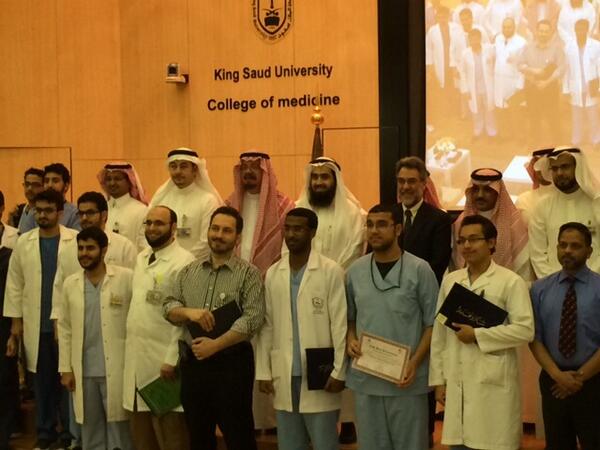
I was privileged to be a member of the Faculty presenting at King Saud University for the closure of their inaugural AMIA i10x10 program, teaching alongside my academic adviser Dr. William (Bill) Hersh. You can see a picture of the distinguished faculty and students involved in the program in the image below.

At the back row is Dr. Hersh in the blue suit and tie.  Next to him on the left is Dr. Amr Jamal, head of the program for King Saud.  And then me, again in my thobe (which was quite a hit with students and faculty both).  I think some few didn't recognize me until I put on my motorcycle vest, thinking I was a Saudi national ;-)

I attended the entire day and was quite interested to hear from other presenters about the Saudi Ministry of Health's eHealth program from several different perspectives.  Leading off the day was Russel Gann, formerly involved with CDC programs in the US, and just recently finishing a stint with the Saudi CDC.  He spoke to the students about the complexities of population health and the need for informatics understanding in the country.

I followed him, and spoke about the standard program in Saudi and their use of HL7 standards and IHE profiles.  The standards presently under development include HL7 Version 2, Version 3, and Clinical Document Architecture Release 2, and also include IHE profiles.  This I presented with my OHSU student hat on.  I figuratively switched to my HL7 Ambassador hat, presenting the CDA Ambassador presentation to the students and faculty so they would understand what CDA and CCD could do for eHealth.  Finally I put my IHE hat on to present what IHE was.  Lastly, I returned to my student hat and put it all together to explain why these standards and organizations were important to the students.  Many of the students expressed a deep interest in the formation of an HL7 Saudi Affiliate, and were also interested in participating in the work of the MoH supporting healthcare interoperability in the Kingdom.

Dr. Hersh gave the students a brief overview of the AMIA 10x10 history, talking about how the program came about and how the international edition emerged as a result.  We also heard several award winning student presentations after his talk.  Afterwards, there was a presentation of awards and certificates.

The day was completed by Dr. Ahmed Belkhair who spoke about the Saudi eHealth strategy.  He also presented on this topic at the most recent HIMSS conference in Orlando last month.  Dr. Balkhair's department is leading the standards efforts in Saudi Arabia, and he also has the honor to be the HL7 Saudi chair.

Later in the week I joined Dr. Hersh, Dr. Jamal, and several other distinguished faculty from the University for a dinner at Najdi Village Restaurant.  I felt quite privileged to attend the dinner, and hope to have a meal there again.  Dr. Jamal, our host was quite gracious with his attention.  I hope to have the opportunity to return again to King Saud to teach again in the future, Insh'allah.

Signing off from Riyadh (but still here for a few more days).  I'll be taking my OHSU finals from here again this weekend, as I did in December, so I must go study now.

   Keith

Friday, March 7, 2014

Killing a Bad Standards Project

This term I'm studying project management, and as we are finishing up the term, the current discussion is around killing projects.

I've previously noted how hard it is to kill a standards project in the past.

The easiest way to kill a bad standards project is before it starts.  But how do you know that a standards project is a bad one?  There are a few signs that you can look for that mean you need to do more investigation:

  1. Does the project leadership come from within the consensus body or share the same values as it, or does it come from outside expecting the consensus body to adopt its values?  If the latter, ensure that the values of the leadership are aligned with the values of the consensus body.  If they aren't, investigate further.  It may be that you are experiencing Not-Invented-Here syndrome, but it could also be a sign of a misfit project.
  2. Is the project one-sided or designed principally to benefit a single organization or type of organization? Do benefits of the standard accrue to only one of the consensus bodies stakeholder groups and not others?  There's almost never a complete balance, but if both parties don't get something, it needs further investigation.  I wrote about this idea briefly with regard to how HQMF can help take those costs out of the system 5 years ago.  I find it interesting that we are still expecting EHRs to do the heavy lifting with regard to computation, but I also see many organizations centralizing that capability to make life easier.
  3. Is the project within the main area of expertise of the consensus group, or is it stretching the edges and would fit better elsewhere.  This can be a sign of the proposer cherry-picking the consensus body that would approve the project.  This happens all over.  Sometimes it happens within an SDO, and other times it happens across SDOs.
One sign that I always look for is who is getting paid to do the work and by whom and how much influence they have and how well does the schedule fit with my own.  This is part and parcel of how much standards work gets done, but it can also be a significant clue.

Once a project has started, it becomes harder to kill.  Both IHE and HL7 have some processes in place to make sure that ongoing work receives necessary approvals before it continues on to the next step, and that causes projects that aren't really making progress to die.  I've seen several projects die in both organizations even though they may have started with very good reasons.  For example, the original CDA Release 3.0 project died due to lack of participation. It has now been replaced by a new project (previously named CDA Release 2.1, but changed to 3.0 because of HL7 rules about major and minor versions).

Even after they have died, dead projects still have something to contribute, if only as a teaching experience. The "CCR wars" eventually prevented the ASTM XML (defined in an adjunct) from being the dominant format, but a CCD is, by definition, still conformant to the ASTM CCR standard (which functionally described the data being exchanged), even in the 1.1 version now present in the C-CDA.

A last note about failure.  If you never have failed projects, you aren't trying hard enough!  Some projects are destined to fail, and others to succeed.  You cannot predict which ones will do which.  If we could, the world might be a better place, but it would also be more boring.

Monday, February 24, 2014

MeaningfulUse 2015 Certification Rule

A quick summary of what is new and different in the recently published Voluntary 2015 Edition Electronic Health Record Certification Criteria: Interoperability Updates and Regulatory Improvements.  You can also find the Word version here, and I recommend it to you for making comments.  Kudos to ONC for making that version available, as it helps both them and us review the material and effectively make comments.

This is but a summary of what I ready between 5:30pm Friday afternoon, and finished reviewing sometime Sunday morning.  It's amazing that I've already had three deep discussions about this content with three other people who've also read it through, and it has yet to be officially published in the Federal Register (but will be there by the time most of you are reading this post).  Note that I started reading this document in Virginia returning from "vacation", and finished my first pass Sunday morning around 9:30am before taking off for HIMSS 2015.  I spent around 90 minutes on this Friday, 15 on Saturday, and about two hours Sunday morning.  While I read, I tweeted the highlights using the hashtag #mu2015 as a way to keep notes.

Some tips when reading NPRM's.  I read them through several times.  The first time, to get the gist of it, I start after the boilerplate and history and regulatory authority, and stop as soon as it gets to the financial impact statement.  So, I don't actually read the proposed regulation, just all of the commentary around what they proposed and considered.  That's the essential stuff you need to know for commenting, while all else is useful, the meat is in that chunk.  It cuts about 25 pages from the front half, and another 75 from the back, so I only had to read 150 pages, not all 252.  Normally, I'd go through 150 pages in about 2.5 hours, but remember that I'm also taking notes while doing this, so not bad for four hours.  I know people who've already put 8 hours into this thing.  So what you are getting is just the gist from that first read through.  Note that in the following, all page numbers are in the pre-publication public inspection version of the rule (and the ONC Word Version), not the prettily formatted Federal Register version that will be published Monday.
  • Many criteria have been split to better support modular certification, which is the only form expected to be supported henceforth.  It makes sense because not everyone needs a "Complete EHR" or has one from a single source.
  • The first of these to be split out is CPOE, separately for labs, imaging and medications. (p26-29)
  • The standard to use for transmitting orders to labs will be the S&I Framework LRO Guide balloted through HL7.
  • Additional criteria has been added for labs, and the NPRM strongly hints at future ramifications regarding CLIA requirements for labs interfacing with 2015 Certified EHR technology.  This was my second predicted standard back in December.  I also made some points about possible CLIA ramifications almost a year ago that got some attention, and may be in the works if I read between the lines correctly.
  • I complained quite loudly about how ONC messed up the selection of the standard for language codes by selecting a different standard than was already in CDA.  It appears they are considering how to fix this problem now.  I'm all for using RFC 5646 which is what the Internet understands (and so does CDA).
  • P38 of the rule offers explanation of how AHA recommends BP be taken. Have you ever had you BP done this way?  Me neither.  Lets use LOINC for the vocabulary as suggested in the NPRM.
  • Note, many criteria are unchanged, for example, the need to record current problems, medication allergies and medications.  I skip a lot of this, as well as minor version updates of standards.  The point is that a summary should only address those things that are pertinent and relevant.
  • P39-44 explains rationale for use of #HL7 Health eDecisions and DSS guides.  There's a lot of explaining here, and probably for good reason.  That standard needs quite a bit of work still to harmonize with everything else already in the MeaningfulUse architecture.  Prediction #3 came mostly true.  I'll count this one in full because the key was HeD, and not VMR.  DSS implies VMR in any case.
  • P44 searching across electronic notes added.  This is a pretty significant change.  Dare I say, they want to be able to Google within a patient record?
  • P48 smoking status unchanged.  This is one of the unchanged things that really matters to people.
  • P49 access image results unchanged.  And another one.
  • P49-50 covers changes to family history, and this is going to be a whole blog post.  Family health history to be recorded using HL7 Pedigree standard, as SNOMED CT dropped.  The key challenge here is that the Pedigree standard is a model, not an XML expression.  How do you test conformance to a model?
  • From P25 to page 51 there are at least four references to FAQs which have adopted into regulation thus far.  I see a pattern developing.  Check the FAQs
  • In the HL7 InfoButton standard, there's no real way to do a patient education or CDS based information request based on a lab result value, only the lab result code.  Thus, I can request information on A1C, but not on a value of 7% in an A1C result.
  • If the patient has a device that has a GUDID, then it appears in their record.  I missed that in my predictions, and it should have been obvious in retrospect given the big splash back in the September HL7 meeting that the FDA and others were trying to make.  I don't know that missed predictions count against me though ;-)
  • P62 begins the discussion of splitting the create and transmit to be separate criteria.  I know a few interface engine vendors who cobbled together a CCDA just to get certified to support create and transmit because you couldn't separate them in order to meet their customer's needs to be able to use that engine to support transmit.  You needn't show create to certify for transmit & versa visa! +1 for @johnmoehrke
  • P65 "would no longer require testing and certification to the primary Direct Project specification" supports more flexible approach, which simply involves demonstrating that you can get your message to a Direct address.
  • In my tweet I said OMG, but I really wanted to say something much stronger when I realized they actually named CCDA Release 2.0.  As that standard presently stands during reconciliation in HL7, the template identifiers are completely different and it will be largely incompatible with MU 2014 certified systems.  So only 2015 certified systems will understand it, and that will cause a HEAP of hurt because 2015 is an optional criteria, which now means we are back to two standards, CCDA 1.1 and CCDA 2.0, and the two at present don't have a backwards compatible path for 2014 Certified EHR products.  Another prediction right (although I later withdrew it thinking, or perhaps hoping they wouldn't make that mistake.  Then again, it's still correctable because 2.0 is still in surgery right now (ballot reconciliation).
  • ONC added a performance measure that "EHR technology would need to be able to receive no less than 95% of all" valid CCDA documents.  This is pretty significant, especially since ONC never really defines what "receive" means.  To me, that means successfully import. This is where I hoped they would name the TOC Guide instead of CCDA 2.0, and they didn't.  So, I think between CCDA and TOC, I get a half a point.
  • P74-75 discusses name matching criteria that includes first, middle, last, dob, place of birth, maiden name, sex, and current & historical address.  For name matching purposes, some of these are good confirmatory elements, and others are good elements to confirm or reject a match, but the criteria doesn't say how to use which ones.
  • Note that the above criteria, and the addition of GUDID means that the Common MU Data Set will likely be changing to support those additional data elements.
  • P78 In one place, two requirements were merged: The requirements for reconciliation and incorporation requirements were combined.  I keep telling people that the IHE Reconciliation profile is a good profile to adopt for these requirements.  IHE is going to be updating it this year to simplify the requirements and make it easier for systems to declare conformance.  Maybe ONC could adopt it?  They did ask.
  • P83-86 discusses #HL7's #HQMF release 2 standard, proposed for EHRs to interpret Clinical Quality Measures.  Another prediction right.
  • P88 CEHRT must be able to filter populations by several criteria before producing measures.  This one seems kind of silly, since a measure already has a population criteria which filters the population to which the measure applies.  It may well be that some don't understand how measures or HQMF really work.
  • P90 They asked for feedback on support for two factor authentication for ePrescribing of controlled substances and remote EHR access.
  • P97 Contains a spoiler alert "given our proposal to discontiinue the Complete EHR concept ..."
  • P101 WCAG level AA proposed instead of level A for View capability
  • P103 Imaging is back into play for patients. This was proposed for 2014 but later dropped.  Shouldn't patients be able to get diagnostic quality images?
  • P109-113 Both CDA and QRDA standards were proposed for syndromic surveillance in ambulatory space.  Both might work.  The former would be used as specified and the surveillance would occur by simple inspection of that appeared without a lot of net new exchange requirements.  However, we'd be utilizing QRDA instead of using it for this purpose.
  • P129 ONC provides a 2014 to 2015 equivalency table that will save many of us a lot of work understanding the rule.  Thanks!
  • P149 Finally Meaningful Use gets meaningful brand identification with introduction of a certification mark 
  • Questions about 2017 criteria start at p154, and so I stopped reading there, since my review was strictly to address 2015 criteria.
Of significant note, BlueButtonPlus didn't make it into the proposed criteria, and was barely discussed in such as way as it could be included.  However, there's a way forward.  But first some discussion about regulations.

There's rules about regulations, not surprising.  One of those rules is that if it wasn't discussed or asked in the proposed regulation, it cannot be done in the final rule.  So if there is no discussion about Blue Button + in the regulation, it couldn't be in the final rule, right?  Except there is a big hole in the second paragraph of Page 100 which says: "We seek comment on whether we should require another transmission method as part of this certification criterion in addition to the one just discussed."

There's the opening for Blue Button +, which is after all, a transmission protocol.  So, if you want Blue Button + to be part of the 2015 criteria, that appears to be your opening.  It is such a close thing to what is already required in VDT, couldn't we just go there?

As a summary, this is pretty long.  Let me make a long story short.  My grade on predicting appears to be 3.5 right out of 5, with one major missed prediction (GUDID).  I can live with that score, especially since I don't know many others who were willing to go out on such a limb.

     Keith

P.S.  I proposed in my Project Management class to take on planning a project to do an assessment of the 2015 criteria.  Now that we have half a clue what it is, my team can proceed to the next step.

Tuesday, February 4, 2014

Medical Decision Making intersects with Data Mining

One of the classes I'm taking this term is call Medical Decision Making.  We'll spend quite a bit of time on Decision Trees, Simple Markov Models, and Monte Carlo Simulations to develop our skills with a set of tools useful for decision making.

Some of these tools I've used before for classifying information.  I used data from simple Markov models to build a predictive part of speech recognizer, and decision trees were something I built to make hyphenation rules, back in the days when I used to care about spelling correction.  These are also tools found in the tool-box of anyone familiar with a variety of data mining techniques.

And those same techniques are being applied to micro-signals in analytics applied to big data generated by organizations to help detect and improve some other measure (be it quality, profitability or something else).

In fact, there is so much similarity that I'm beginning to wonder about the application of other data mining techniques to medical decision making.  Do I hear a thesis topic coming together in my back brain?  If I focus it on patient-centric medical decision making, there might just be something worth looking into that also fits into my personal and career goals.

Funny how all that early work in linguistics keeps coming back to haunt me (as he hunts for red squiggles in his blog post [note to self: add squiggles to my custom dictionary]).


Putting what you know together with what you do

One of the luxuries of taking a class that covers material that I've been doing is NOT that I've been doing it, but rather, that is reminds me of the steps I've been skipping.

For example, I've been managing projects for the past thirty years.  I've got (somewhere around here), a print copy of the PMBOK guide, as well as a shelf full of books on software engineering, process, project mangement, et cetera.  I'm used to applying project management to software development projects.

What I'm NOT used to, is applying that knowledge to other kinds of projects, since I've neither been the PM, nor part of a project large enough (until last year), to require some serious PM skills from me.  So, the reminders I've been getting in class are good, timely, and helping me to recognize where to apply those skills to my more recent work.  And it's of course, just in time education, which means I'm getting it when (or just slightly after), I need to be using it, which means I am using it, which means I'm learning it (and teaching it to others, which is an even more effective way to learn it).

So, to cap it all off: This weekend I applied it to my personal life.  We are planning a move to happen some time in the next year, allowing me to move my mother in with the rest of my family.  But I need a bigger house, and for several other reasons, moving is more attractive than building.  So we kicked off that project this weekend, and I have a charter, list of stakeholders, WBS, task effort estimates, and a few other things already from that first meeting.

Project meetings are weekly on Saturday morning [after coffee/breakfast, before cartoons].  So now I get to try this three ways.  What fun.  And now my kids get to see what I do for my day job applied to their lives.

We've got a set of items to do for the next two weeks, and if we hit everything (or nearly everything), everyone gets to go out do dinner (on the project sponsors [my wife and I]).

    Keith

Sunday, January 5, 2014

The Next Term

Next week starts the new quarter in my MS in Clinical Informatics program.  Again I'll be taking two classes.  This time I'm going to be taking:

  • Project Management
  • Medical Decision Making
I've been doing project management for years.  I cannot find my copy of the PMBOK Guide, so now I have the Kindle edition, which will be more useful.  Some of my texts will be paper though, but hopefully not so much that it makes travel difficult.  I'm looking forward to that class, because while I'm not wholly self-taught, there's still plenty to learn and be refreshed on about managing projects.  I'll also be interested in seeing what is new in the field.

Medical Decision Making promises to be interesting because there's at least some degree of math involved. This class should also be a good lead into Evidence Based Medicine which I don't get to take for a while because of the course scheduling (I missed the chance last term, but was glad to just do two classes).

I did get my grades from the last term, and as Bill alluded to in this post, I did just fine.  Two A's.  One of the challenges I had with the last term was keeping up with this blog, since I was writing a 500 words or more a day for class.  I'll have to figure that piece out.

One of the things I remember from my last degree (an AA) was the challenge in scheduling everything so as to finish within a set period of time.  So I've got the next two years already planned out.  And of course, as soon as I do that, Bill writes this post discussing how he's working on curriculum changes.  So, I'll probably have to change my plans, which doesn't disappoint me at all.  After all, a plan is simply a framework that rarely survives the first engagement with reality (as I'm sure I'll be hearing about in my Project Management class).  The idea behind the plan is to know where you are headed so that when you come to an unexpected fork in the road, you know which direction is likely to lead you where you want to go.

Where am I going?  I'm not really sure, but my plan is to take an interesting journey, where ever it is.  So, my choices get to be a little bit different when I see a fork in the road.  Because I get to pick the path that looks the most interesting.  Oh, and just so you don't get confused, I expect it all to lead me right back to where I started, but with new tools and skills to apply to what I'm doing.